“Of course, you’ll get smashed sometimes but you’re not going to die from it,” says Keryn Seal, sounding exasperated at being asked if his regular games of five-a-side football are not completely terrifying.
An England captain with 95 international appearances, Seal and his team-mates are preparing for the IBSA Blind Football European Championships, which begin this weekend at the Royal National College for the Blind in Hereford. You are encouraged to go along and support them but short of celebrating goals, quietness is required so those playing can hear the ball.
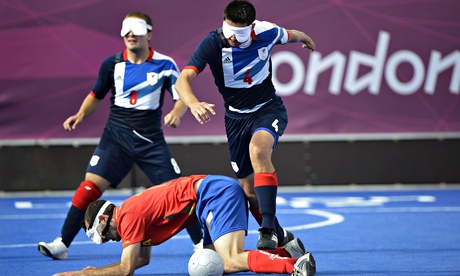
Notwithstanding the shouting of players and coaching staff, blind football is played in eerie silence; a bit like Arsenal home games, but with different rules and smaller crowds. Smaller, heavier and noisier, the ball contains bearings that help players locate it by sound, while they establish their own positions on the pitch by listening to assorted people who are watching the action unfold.
Confined to a tiny penalty area, the goalkeepers are sighted athletes. The managers can also see and offer guidance from the halfway line. Rival coaches do the same from behind each goal, enabling players to triangulate their own position on the field from these fixed points. Beyond this aural assistance, the eight outfield players go about their football business as they do every other aspect of their daily life: in complete darkness. For good measure, they wear blindfolds to ensure uniformity of blindness all round.
“It is very mentally draining,” says Seal, a Welshman based in Exeter, who grew up with impaired vision and lost his sight in early adulthood. “If you’re running around as a sighted footballer, you’re processing information with your eyes without thinking about it. We generally get decent reference points off those people in fixed positions and as far as knowing where your team-mates are, that comes down to a shape thing, which is something you have to work on in training.
“If you know where you are, you’ve got a good idea where you’re team-mates are going to be. It’s also very physically draining, because you’ve got guys covering five or six kilometres in a 50-minute match, as well as having to do all that thinking and processing.”
Seal and his team-mates are professional footballers, funded by the Football Association which pledged £1m after UK Sport withdrew its patronage following a disastrous showing at the 2013 Euros. From finishing eighth out of eight teams in Italy, the team reached the final of this year’s World Games in South Korea. Not for the first time in football history, it was a match against Argentina that ended with England’s players feeling aggrieved by a dubious decision made by a referee Seal deemed “too inexperienced”. It is heartwarming to learn it is not just in sighted football that match officials are forced to bear the brunt of the players’ ire.
“From eighth in the Euros to second in the World Games is a big swing and the first part of that is that we got a new head coach,” Seal says. “Jon Pugh came in as somebody who’s been involved with the game for 17 years as a goalkeeper and a coach, so he’s somebody that knows it inside out. Tactically we were already on to a winner there and the FA funding has enabled players to go full-time, which means we can dedicate our lives to this. We trust in Jon and we trust in each other. That World Games final aside, which is just one of those things that happens in football, we’ve been on a hell of a run.”
In such good form and with the home advantage of their bespoke facilities in Hereford (they also have their own pitch at the National Football Centre at St George’s Park), England have every reason to feel confident going into a European Championships from which the top two teams will automatically qualify for next year’s Paralympics in Rio.
“We’ve been preparing for this now pretty much non-stop since November 2013 and without doubt this is the best prepared the team has ever been,” Seal says. “In the last month, we’ve had four or five pretty extensive camps and we’ve got all our players back from injury and the team’s in a pretty good place at the moment.”
As brave, inspirational and skilful – their dribbling and close control is little short of incredible – as these footballers are, they have struggled to convince the public that theirs is a genuinely entertaining sport worth going to watch. The lack of any sort of public profile has not helped their cause.
“Apart from the Paralympic Games, our sport doesn’t really receive any media coverage and that’s a great source of sadness for me and for the players,” Seal says. “Not for ourselves, but for getting the next generation of players into the game and letting people know it exists.”