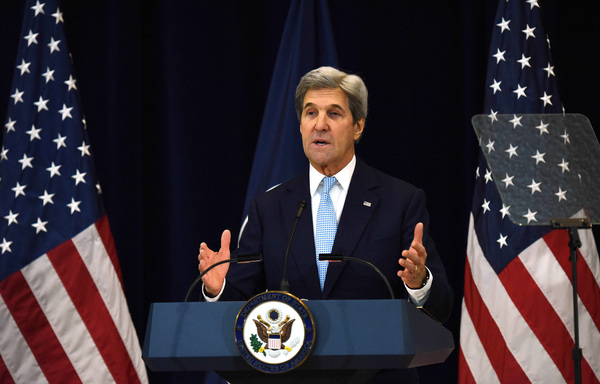
WASHINGTON _ With President-elect Donald Trump tweeting from the sidelines, Secretary of State John F. Kerry on Wednesday outlined broad principles for reviving the moribund Israel-Palestinian peace process _ a call that quickly ignited a new burst of Israeli anger against the Obama administration.
Kerry's lengthy and impassioned address, delivered at the State Department, marked the latest chapter in an unusually bitter public clash between the United States and Israel � and the even more extraordinary spectacle of a president-elect again inserting himself into a sensitive diplomatic matter before taking office.
In a speech lasting more than an hour, Kerry appealed for a hiatus in Jewish settlement activity in the West Bank and East Jerusalem, called on Palestinian leaders to explicitly denounce terrorist attacks against Israelis, and warned repeatedly that the prospects for a "two-state solution," with Israel and a Palestinian state existing side-by-side, were in jeopardy.
"We cannot in good conscience do nothing, and say nothing, when we see the hope of peace slipping away," he said.
With less than a month until he leaves office, Kerry's speech was a mainly symbolic gesture, an emblem of last-ditch hopes to restart a U.S.-brokered peace process that collapsed in 2014. During his four years at State, Kerry tried again and again to revive the talks, but failed.
Kerry offered up a full-throated defense of President Barack Obama's Mideast policies, saying the administration had been "Israel's greatest friend and supporter." And he was sharply critical of the government of Prime Minister Benjamin Netanyahu, saying it was creating a "dangerous dynamic" with continued settlement expansion.
"Time and again we have demonstrated that we have Israel's back," said Kerry. But, he added, "friends need to tell each other the hard truths, and friendships require mutual respect."
Less than two hours before the secretary was to speak, Trump used Twitter, his preferred medium, to denounce what he called "disdain and disrespect" shown toward Israel _ a reference to the Obama administration's failure last Friday to veto a United Nations Security Council resolution calling Israeli settlement activity a flagrant violation of international law.
"Stay strong Israel," Trump tweeted. "January 20 is fast approaching!" _ the date when he will take office.
The president-elect has already indicated he intends to upend long-standing U.S. policy on the Israeli-Palestinian conflict, picking a financial patron of the settlement movement as U.S. ambassador to Israel and pledging to move the U.S. Embassy to Jerusalem from Tel Aviv, a move the Palestinians believe would undermine their statehood hopes.
Obama and Kerry have been the target of intensifying Israeli broadsides since Friday's vote at the U.N., and even before Kerry spoke, a member of Netanyahu's Cabinet denounced the U.S. administration's efforts to influence events in Obama's last weeks in office.
Speaking to army radio in Israel, Public Security Minister Gilad Erdan called the Obama administration "pro-Palestinian" and Kerry's planned speech a "pathetic" move. Another Cabinet minister, Naftali Bennet, told the BBC immediately after Kerry's speech that the secretary's remarks were "profoundly disconnected from reality."
Netanyahu's office has said it would bypass the White House and deal directly with Trump, providing the incoming president with what it said was proof that the Obama administration colluded with the Palestinians to bring forth the U.N. resolution.
In his speech, Kerry vehemently denied that and said Israel had been warned repeatedly that the U.S. would not use its Security Council veto to block the resolution if it were fair and balanced.
Obama's relations with Netanyahu have long been rocky, but the past few days of exchanges marked some of the harshest public rhetoric in years between the two nations.
The White House decision to abstain on the U.N. resolution, and thus let it pass, has been awkward for Democrats in Congress and other allies of Obama, who fear it will be read as a betrayal of Israel.
Successive U.S. administrations have tried to coax Israel and the Palestinians toward common ground over disputes, including the status of Jerusalem, which both sides want as their capital, and a drawing of borders between Israel and a Palestinian state.
Palestinians say stepped-up Israeli settlement activity has prejudiced the outcome of negotiations, depriving them of contiguous territory needed for a viable state. Israel in turn has accused the Palestinians of negotiating in bad faith and inciting violence against Israeli civilians.
Although most of his speech took aim at Israeli policies, Kerry was also critical of Palestinian leaders, saying they needed to do more to condemn specific attacks against Israelis. As an example, he cited the naming of streets and squares for Palestinians who carried out such strikes.
"Murderers of innocents are still glorified," he said.