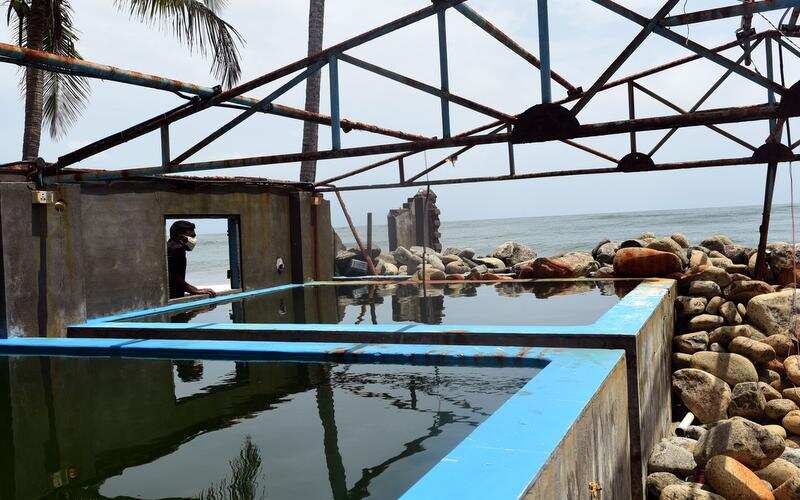
KOCHI: With the state government conducting a detailed study to find a permanent solution to the sea erosion in Chellanam, a team of researchers, naval architects, shipbuilders and people working in the field of sustainable development came up with a new idea. They propose to build T-shaped groynes using a floating structure which can prevent seashore erosion and wave-related destruction of the coastal area and at the same time harness energy using waves.
The Kerala University of Fisheries and Ocean Studies (Kufos) has been inviting opinions and suggestions for the Model Fishing Project to be implemented at Chellanam. The objective is to create a hybrid technological solution for the protection of seashore and generate energy in the selected sites. Kufos will be adding the proposal in its fishing village interim report to be submitted before the state government.
Santhosh Thannikat, a responsible-tourism consultant and the coordinator of the team, said that seawalls, groynes using stones / concrete tetrapods, offshore breakwater barrier, geotubes and other solutions have failed and drained a lot of public money from the treasury. “Most of those man-made solutions are environmentally hazardous and not sustainable,” he said.
The team proposes to make a T-shaped groyne using stainless steel and it will be jetting out from the coastline into the sea up to 200m. It is fixed on the seashore and also anchored in the sea. The T end, which has a width of 50 to 100m, will have a power generator that can harness power from any of the sources or combined sources — wave, tide, current, air / buoyancy, ballast water pressure or wind. “Our objective is to make a steel T-shaped groyne at a cost similar to that of a stone / concrete based T-Shaped groyne, serving the same purpose,” Thannikat said.
Other team members include Anantha Subramanian, retired faculty of IIT Madras, naval architect Sandith Thandashery, Hatch Marine Consultants founder Ruchi Kalra, geo-data collection specialist Jagadish Vallarampara, etc.


.png?w=600)