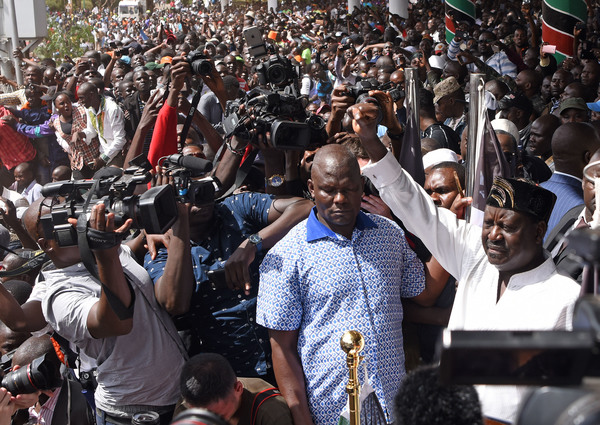
NAIROBI, Kenya _ Kenyan authorities shut down independent television and radio stations Tuesday as opposition leader Raila Odinga was "sworn in" as rival president in a mock inauguration that came following disputed elections last year.
Shortly before 3 p.m., Odinga, clad in white, raised a green Bible in his right hand and swore an oath to assume the office of "People's President," promising to defend the constitution and to protect the sovereignty and dignity of the people of Kenya.
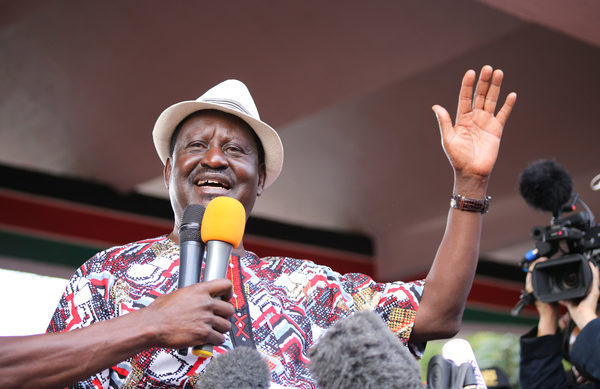
"Today is a historic day in the history of Kenya. For the first time in our history people have gathered here in their hundreds of thousands to say enough is enough on election-rigging," Odinga said. "This step is one step away from doing away with electoral autocracy and establishing proper democracy in our country."
The swearing-in took place at a mass rally of supporters at Nairobi's Uhuru Park. It carried no legal weight but was part of his effort to reject the presidency of Uhuru Kenyatta and set up a parallel government called the "People's Assembly." Odinga defied a government ban on the event and government warnings that the move would be treasonous.
Within hours of the mock inauguration, Interior Minister Fred Matiang'i declared Odinga's National Super Alliance a criminal political group, raising the prospect that its leaders could be charged in coming days.
Odinga's running mate, Kalonzo Musyoka, was to have been similarly "sworn in" as deputy president, but was not present. The opposition claims Kenyatta, who officially took office as president in November, is illegitimate.
Amid fears of violence, security was tight in much of the capital as police prevented some buses crammed with opposition supporters from entering the city. But a government threat to block access to the ceremony did not materialize.
Since the election, Kenyatta's government has been accused by human rights groups and news media organizations of intimidation.
Kenyatta called news editors to his office Friday and threatened to shut down media organizations that covered Odinga's declaration, according to the Kenya Editors' Guild. In an ominous setback to freedom of speech, the government shut down broadcasts on independent television and radio stations.
The political showdown is retarding Kenya's efforts to move on after one of the most contentious and divisive votes in its history, and calls into question the nation's position as a stable economic powerhouse in East Africa.
Although the opposition ceremony was just symbolic, the strong turnout sent a message that the veteran opposition leader commands significant support. The Kenyatta government now faces the dilemma of whether to carry out its threat to treat the ceremony as treason and arrest Odinga _ at the risk of turning him into a populist martyr _ or to downplay the event.
Kenya, a key U.S. ally fighting Islamist extremism in the region, is struggling with deep fractures along political and ethnic lines after a disputed presidential election last August and a repeat election in October. A previous disputed election in 2007, also contested by Odinga, triggered ethnic violence for weeks across much of the country, killing up to 1,500 people.
Odinga and his political alliance took court action to contest the results of the August election. After the Supreme Court overturned the election results because of irregularities and called for a rerun, Odinga boycotted the repeat election, accusing authorities of failing to ensure a fair vote. He has rejected Kenyatta's presidency as illegitimate.
The election had been controversial from the outset. A key electoral official, Chris Msando, was killed a week before the August vote. Days before the poll, security agents arrested and deported a group of election experts from the U.S., Ghana and Canada who had been hired by Odinga's team to check the integrity of the vote.
A week before the October rerun election, a member of the electoral commission, Roselyn Akombe, fled to the United States, saying the commission was partisan and would not deliver a credible election. She warned that electoral commissioners and staff faced political intimidation and lived in fear they would be killed.
Dozens of people have been killed during protests and violence in the wake of the disputed elections, the majority shot by police.
When protests erupted after the repeat election, security forces fired live ammunition on demonstrators and bystanders, according to the Kenya National Commission for Human Rights, killing at least 30 people. That came after at least 67 people were killed during protests after the first vote, according to Amnesty International and Human Rights Watch.
Since the August election, Kenyatta has taken a combative approach toward the news media, human rights groups and the judiciary, raising fears that he may usher in a more repressive era.
After the Supreme Court decision to annul the August election, Kenyatta called the judges "crooks," accused them of stealing the election and vowed to "fix" them.
Thousands of opposition supporters, many of them from the impoverished Kibera district, carrying twigs, whistling and blowing horns, surged toward the city early Tuesday. They faced a long wait. The ceremony took place seven hours after its scheduled time, for reasons that were not explained. Odinga took his oath to the deafening cheers of supporters before speaking briefly and swiftly departing.
"This is a beautiful day. Freedom has come to our people. You can feel it in the air," opposition lawmaker Gladys Wanga told the crowd at Uhuru Park earlier in the day.
Another supporter, Samuel Ochieng, 38, a day laborer, traveled from Migori, one of Odinga's strongholds in western Kenya, to see him sworn in. "We have come with Bibles ready to swear in our president, Raila Odinga, today," he said.
Anther opposition supporter, vegetable seller Lilian Ondiek, 27, said she woke up at 4 a.m. to attend the event. "We are suffering as Kenyans. We need change and that change must come today," she said.
But Naftali Muigai, a Kenyatta supporter, said the opposition move was illegal and divisive.
"It's an illegal exercise that will not change anything, except to polarize the country further. The opposition should use legal means in their quest for electoral justice," he said. "Swearing themselves in is just drama since we already have a legitimate government in place."
Since independence in 1963, Kenya has been ruled only by leaders from the Kikuyu and Kalenjin groups. (Kenyatta is from the Kikuyu group; Odinga is a Luo.) The "winner-takes-all" mentality, in which the governing party looks after members of its own ethnic group when distributing jobs and contracts, has deepened the sense of injury among other groups.