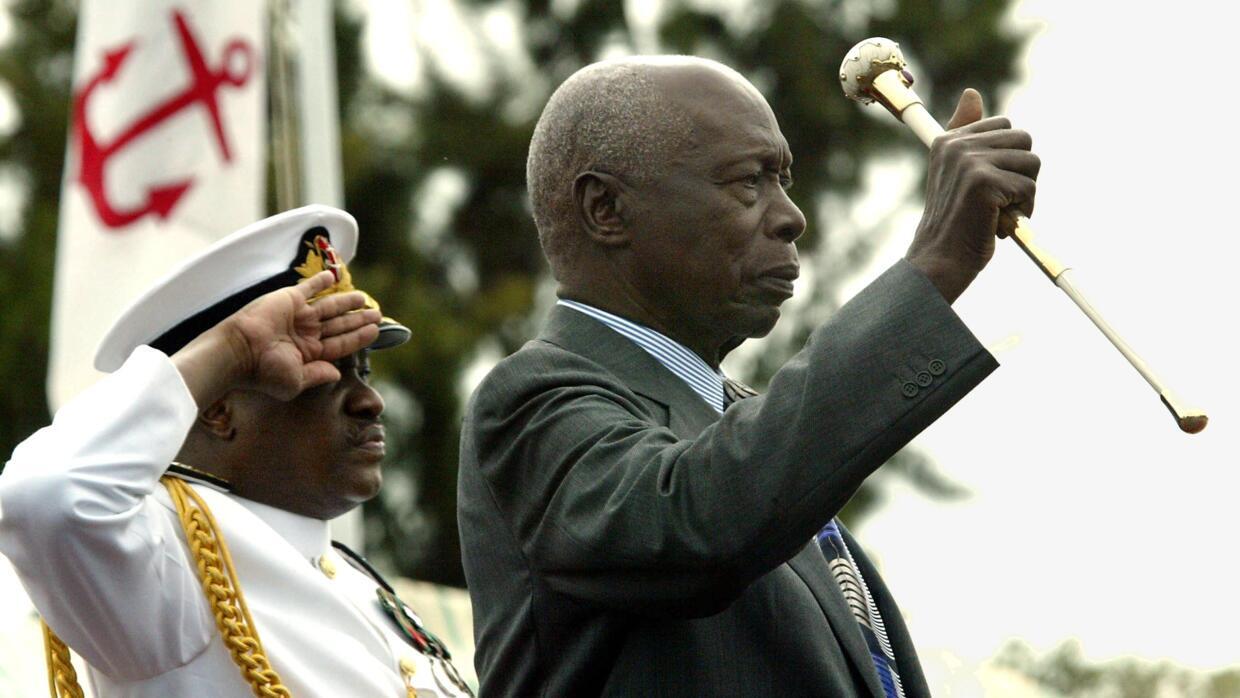
Moi, whose 24-year rule saw Kenya become a one-party state where critical voices were ruthlessly crushed, died on 4 February, aged 95.
Mourners began gathering at a national athletics stadium before dawn to pay their respects.
Moi, who towered over Kenya between 1978 and 2002, lay in state for three days in parliament, with tens of thousands of people filing past.
On Tuesday morning, he was taken on a gun carriage draped in Kenya's flag through the streets of Nairobi to the crowded Nyayo national stadium.
A leader of continental stature
President Uhuru Kenyatta, who opened the memorial with the national anthem, called Moi "a champion of Pan-Africanism".
Former opponent Raila Odinga, who was jailed for several years under Moi, called the late leader a "greater fighter" but who had eventually accepted multiparty politics.
"I was one of the victims... but he was forgiving, like I am also forgiving, and we made our peace, and we shook hands, and then worked together," Odinga said.
"We remember the good things that he did," he added.
Those targeted by his regime included human rights and environmental activists, including the writer Ngugi wa Thiong'o and the Nobel Peace Prize winner Wangari Maathai.
Moi was however praised for keeping Kenya a relative haven of peace during a chaotic period in East Africa which saw the genocide in Rwanda and civil wars in both Burundi and Somalia.
Regional leaders remember a gallant president
Several foreign leaders attended the ceremony, including Djibouti's Ismail Omar Guelleh, South Sudan's Salva Kiir and Uganda's Yoweri Museveni.
Ethiopian President Sahle-Work Zewde and former Tanzanian presidents, Jakaya Kikwete and Benjamin Mkapa, spoke at the ceremony.
"One of the gallant leaders of this great country," Rwandan President Paul Kagame said.
The body of the late president will be buried on Wednesday in his home area of Kabarak, 220 kilometres northwest of Nairobi.
Daily news briefReceive essential international news every morning
Subscribe