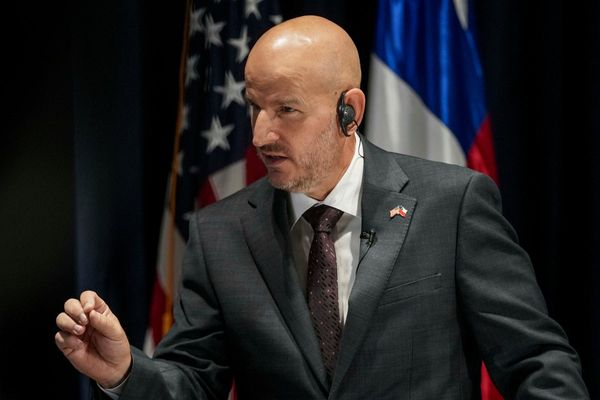
FANCY FARM, Ky. _ Jim Gray walked to the lectern on stage, leaned in to the microphone, and began to speak. Kentucky's openly gay Senate candidate was making history.
He would say later the boos were so loud he could barely hear his own voice.
No more than 10 yards in front of the Democrat, a teeming mass of yelling, chanting Republicans were trying to intimidate him. A few hundred of them had crammed underneath this pavilion, no bigger than half a football field, to stay dry from the storm soaking the surrounding fairgrounds in this tiny western Kentucky town.
Gray, of course, welcomed this.
The St. Jerome Fancy Farm Picnic is an annual showcase for Kentucky's top politicians to give (they hope) a funny, sharp-elbowed speech at the other party's expense. While they speak, hundreds of loud-mouthed partisans are encouraged to yell and scream as loudly as they can _ as if the American political id was caged in a small pavilion two hours from a major airport.
"I want to introduce myself to Senator McConnell," he said, looking over to the Senate majority leader seated a few feet away, who minutes earlier had given his own speech. The Republicans, whose voices drowned out the sound of nearby thunder, chanted "Go away Gray!"
The candidate continued: "He earlier called me a 'nobody.' Well, let me introduce myself, senator. I am Jim Gray, and I am the guy who is going to beat Rand Paul."
What went unnoticed this recent Saturday afternoon was that Gray was probably the first openly gay person to speak at Fancy Farm. Records aren't easy to come by for something that began in 1880, but veterans of the event say they can't recall an openly gay speaker.
This is how Gray's campaign has gone: He's making history, and nobody seems to notice. Or, for that matter, care.
Gray would be the first openly gay man to serve in the U.S. Senate, and the possibility that Kentucky would be the state to elect him should be remarkable. This is a Southern state that sits on the buckle of the Bible Belt, where even the Democratic Party is culturally conservative.
It's a state where, only a year ago, Kim Davis made international news when she refused to issue marriage licenses to same-sex couples in the small county where she served as a clerk.
And yet, Gray's sexual orientation has drawn little interest, from voters, his opponents, or the even the media.
"I'm constantly surprised by what a non-issue this has become," said Geoff Reed, a longtime adviser to Gray.
Gray's campaign is undoubtedly a sign of how far gay and lesbian candidates have come. It even suggests that in the year 2016, they may not have all that much further to go.
Voters have certainly moved past their bias and prejudice before. Catholics, for instance, once faced imposing barriers to office that, about the time John F. Kennedy won election in 1960, simply ceased to exist.
The LGBT community isn't there yet. Even among Gray's allies, beliefs that have been pushed to the boundaries of mainstream society _ like whether being gay is a choice _ persist.
But his candidacy suggests that only a year after the Supreme Court legalized gay marriage, this country might be closer to a kind of post-gay politics than many realize.
"You always hear that politics is a function of timing and pacing," Gray said the day before attending Fancy Farm, seated not far from the stage where he had just delivered a speech in Paducah, Kentucky. "My being here, at this time, gives me the opportunity."
Gray publicly announced he was gay 11 years ago, in a 2005 front-page story of the Lexington Herald-Leader. He was contemplating a run for office and didn't want whispers about his personal life to slow him down.
"We live in a small community," he told the newspaper. "I'm active in it. I want to stay active in it. So if folks deserve to know more about me, I'm OK with that."
Gray had run for mayor three years earlier, in 2002, and lost. In part, according to some, because of rumors about his sexual orientation.
Some of his friends aren't sure that's true, but they're crystal clear about the personal cost of keeping his sexual orientation hidden from public view.
"I can tell you it affected him personally," said Ben Chandler, the former congressman and longtime Gray ally. "I can tell you it was unfortunate for him to be a candidate and feel like there was something that people didn't know.
"He didn't feel like he was presenting his entire self and it made him uncomfortable," the congressman added.
So when it came time for a new campaign in 2006, Gray knew he wanted to try to put questions behind him.
That didn't make the decision easy: George W. Bush had just won re-election after pushing a series of state-based amendments banning gay marriage. In Kentucky, such a measure passed with 75 percent of the vote.
That same year, in the state's highly competitive Senate race, the former president of the Kentucky state Senate said the Democratic nominee Daniel Mongiardo had a "limp wrist" _ part of an orchestrated effort to insinuate he was gay.
Coming out "was probably the most single important thing I've done in my life," said Gray, who won a race in 2006 for an at-large city council seat and then was elected mayor in 2010.
He added: "It was also the single most difficult thing."
Gray is of slight build and looks younger than his 63 years, with only flecks of gray hair near his temples. He's seemingly one of the few politicians left who prefers thin-wired glasses to the thick, hipper type worn by politicians like former Texas Gov. Rick Perry.
Befitting a Democratic candidate in red Kentucky, his stump speech sounds like a Republican's. He talks a lot about budget and pension reforms he undertook as mayor. He mentions good-paying jobs, working families, and cracks jokes about Paul spending more time in New Hampshire coffee shops than Kentucky's towns and cities. When he can, he notes the successful and well-known family business, Gray Construction, he once helped run.
He's also thoughtful in interviews. Asked during one sit-down if he considered himself a role model for the gay and lesbian community, he requested time to think about an answer.
Four days later, he called to offer one.
"I still have kids come up to me and tell me how meaningful it is to them that I am doing this," he said. "That I have taken an out, public role."
Gray, notably, mostly declines to talk on the record when asked about how being gay shaped his life before entering public service. But the native of Glasgow, a small town in southern Kentucky, offered one telling anecdote about how much society has changed: At about age 15, in the mid-1960s, he visited his local library to read the Kinsey Reports, a landmark study about human sexuality. It was then that he learned what the word "homosexual" meant.
In 2005, Gray says reaction to his decision to come out publicly was universally positive.
But he knew that, even after more than a decade of social change, running statewide in Kentucky would be different.
Gray and his advisers, a team that included Chandler and Reed, debated the issue, before eventually deciding a campaign was worth it. The candidate's sexuality couldn't be written off entirely, but the team concluded it would have a minimal impact on the bottom line.
"There is always going to be bias and prejudice out there," Chandler said. "But in this case, he wasn't going to benefit from the votes of those people anyway."
Gray explains it in a different way. To him, the decision to come out was also part of a political calculation to be totally honest with voters at a time when they were distrustful of their elected leaders.
In his thinking, being forthright with his personal life would yield more votes than being gay would cost.
"If I can convey an authentic character in that way, then that's a very big deal politically," Gray said. "Public trust in congress is at a low point. So in a sense, as a candidate I'm putting myself on the line for trust."
In interviews, about a half-dozen other Democrats expressed a deep conviction that a gay candidate could not have run statewide a decade earlier. The state, they said, had come a long way since that Herald-Leader story.
"Ten years ago? No way," said Sam Gaskins, the Democratic Party's nominee for Congress in Kentucky's 1st Congressional District. "You have to think, you're in the buckle of the Bible Belt here."
The evidence that America is marching toward a state of post-gay politics is mounting, and not just in Kentucky.
Public opinion about same-sex marriage moved comprehensively in the last decade, precipitating the Supreme Court's landmark decision last year. Already, the culture war appears to have moved on to a new flash point: transgender rights in bathrooms.
Voters, meanwhile, already have elected one gay senator, Wisconsin Sen. Tammy Baldwin, way back in 2012. Another gay candidate, Democrat Angie Craig in Minnesota's 2nd Congressional District, is running this year with even less fanfare than Gray.
Even on the GOP side, attitudes are changing. When Sen. Rob Portman announced that he would support same-sex marriage, social conservatives vowed the incumbent Republican from Ohio would pay the price.
Portman was effectively unchallenged in his primary this year, easily defeating a little-known opponent.
Donald Trump, the Republican presidential nominee who has insulted everyone from Muslims, Latinos, to women, conspicuously has avoided singling out gay men and women.
During his acceptance speech at the Republican National Convention, Trump vowed to protect gay men and women _ and then complimented the gathering of Republicans when they applauded.
Republicans still don't have an openly gay elected official serving in federal office, and until they do, it's a stark signal that being gay remains a real barrier for some politicians.
But the GOP has come close: Dan Innis nearly won a Republican primary in New Hampshire's first congressional district in 2014, losing by fewer than 10 points.
"It's within reach," said Tyler Deaton, senior adviser to American Unity PAC, a well-funded group that promotes gay rights within the GOP. "I think the benchmark will be when LGBT Republicans are able to win Republican primaries."
Two other gay House GOP candidates, Carl DeMaio and Richard Tisei, also nearly won during the 2014 election.
When it comes to gay candidates, the media appear to have moved on as well. Gray's candidacy has hardly attracted attention from major national outlets.
In one of the few national stories written about Gray, The Huffington Post suggested Gray needed to be more gay. (The mayor bristles at the implication that he's trying to cover up his sexual orientation.)
On the campaign trail, Gray's aides and friends say, his sexual orientation is almost never discussed.
"I haven't had one person ask me about it," said David Ramey, who is the chairman of a county Democratic Party in the western part of the state.