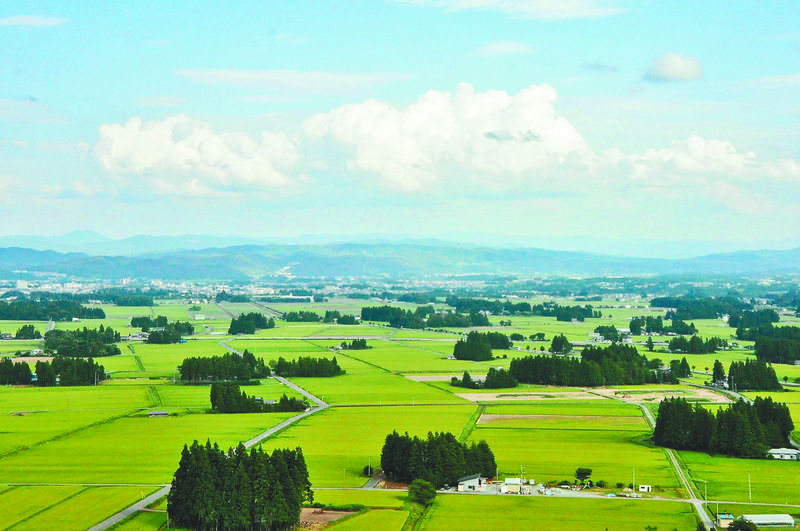
HANAMAKI, Iwate -- Green paddy fields are seen on the outskirts, while colorful flowerbeds are planted everywhere in the urban districts. Hanamaki, Iwate Prefecture, is the hometown of the famous author Kenji Miyazawa (1896-1933). I visited there in the middle of August, when the wind was blowing calmly.
'Kenji-san is ...'
Local people affectionately call him Kenji-san when they talk about him. "He ate simple dishes, the same as local farmers," explained Koko Takahashi, 70, a member of the Hanamaki omotenashi tour guides.
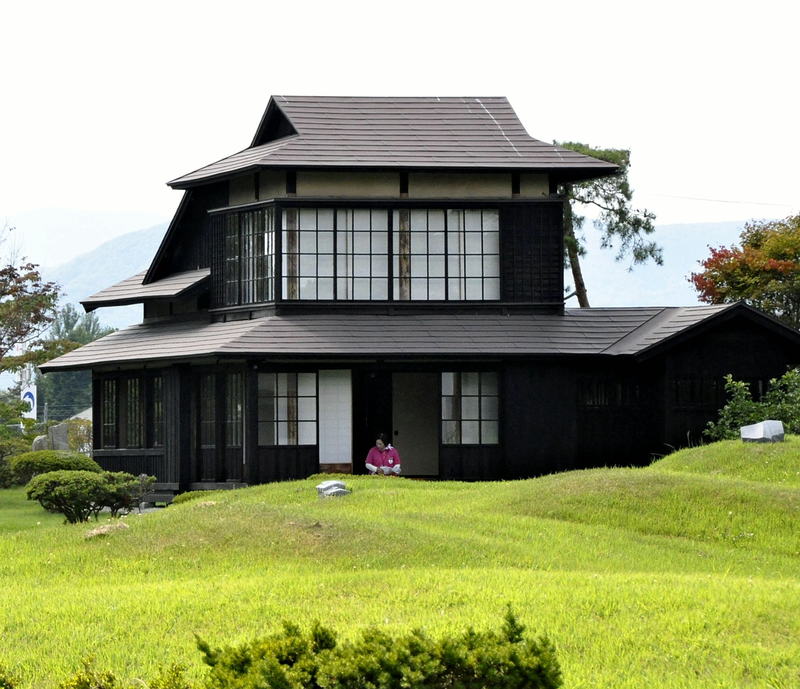
When Miyazawa was 30 years old, he opened a private school called Rasuchijin Association at a secondary residence of the Miyazawa family to teach agronomy and various technology to local farmers. The house was later relocated to Hanamaki Agricultural High School's precincts. Around there, the lawn glowed vividly under the summer sunshine.
At the time, Miyazawa every day bought the exact amount of rice he would eat that day. He sometimes ate only a tomato picked from his field. "Though his family was rich, he stood by poor farmers," said Takahashi.
The main purpose of this trip was to think about the relationship between "Kenji and food." In his work "Yodaka no Hoshi" (The nighthawk star), he wrote: "Oh, beetles, many winged insects are killed by me every evening. And now, I, unique in this world, will be killed by a hawk."
In many of his works, he repeatedly expresses dislike for the concept of the food chain.
One of his famous works "Amenimo Makezu" (Strong in the rain) gives us a strong image of coarse dining habits.
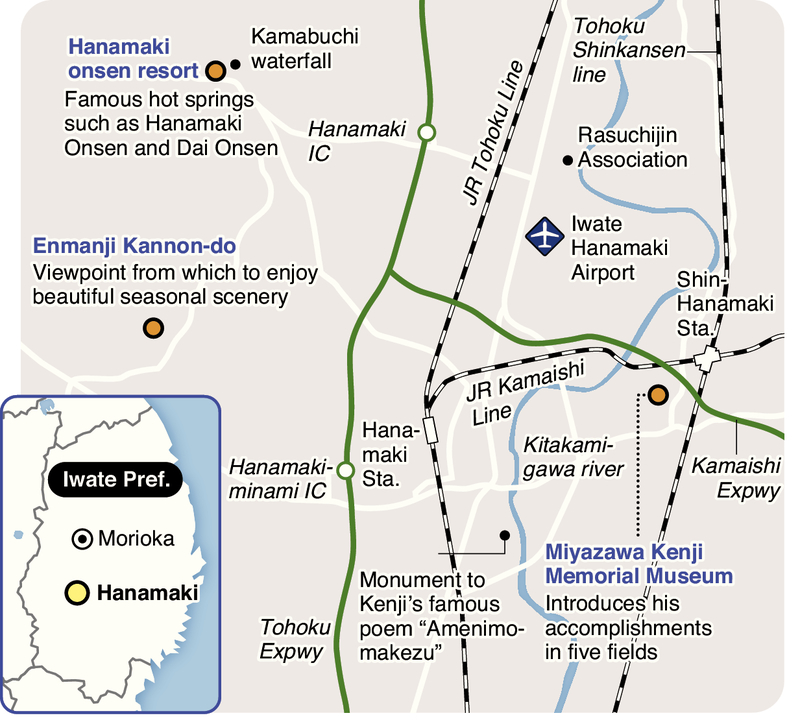
I visited the Miyazawa Kenji Memorial Museum built on Mt. Koshiozan in the city. Toshiya Ushizaki, 63, a curator at the museum, explained: "We have many perspectives to find out who Kenji is, such as religion, agriculture and science. Food is one of the most interesting themes. It is multifaceted, though."
Miyazawa lived on vegetables for five years from when he was about 22, influenced by Buddhism. However, after that, he often went to Western restaurants and soba restaurants, showing his enthusiasm for food.
Nevertheless, he wrote about the tragedy of pork in "Furandon Nogakko no Buta" (The Frandon agricultural school pig.) At the Rasuchijin Association he ate plain foods while he grew vegetables new to Japan at the time such as asparagus and Chinese cabbage. He is quite intriguing.
"It's like he's a different person depending on the time and perspectives," said Ushizaki. "Still, what I think he really wanted to denounce is to kill without eating. The food chain is an undeniable and uncontrollable structure. He might have sensed life glowing even in the structure."
I had lunch at a restaurant named Yamanekoken nearby the museum. It was named after his famous story "Chumon no Oi Ryoriten" (The restaurant of many orders). There is a notice, saying, "Plump and young parties especially welcome." Children and their parents saw the notice and asked each other, "What do you think of the meaning?" The common sense that humans always eat something, and not the other way round, was challenged.
During my stay, I made the long trip to Kamabuchi waterfall, which Miyazawa also visited. There were signboards that called attention to bears along a promenade. I just recalled "Nametokoyama no kuma" (The bears of Mt. Nametoko). It's the story of a hunter who loses his life while he and a bear understand each other. Suddenly, I was startled by the sound of something moving roughly. I looked back and saw a squirrel in a bush. Amid rich greenery, the white cascade of the waterfall cooled me down with its spray.
This trip made his works more familiar to me. "The world of Kenji is bottomless. If I were him, I would think another way. These ideas come out successively," Ushizaki said with a laugh. I might have stepped into Miyazawa's world.
Home to baseball stars
Hanamaki is also a town of baseball. Hanamakihigashi High School took part in the National High School Baseball Championships at Koshien Stadium in Nishinomiya, Hyogo Prefecture, this summer. The high school has produced many professional baseball players such as Yusei Kikuchi of the Saitama Seibu Lions and Shohei Ohtani of the Los Angeles Angels in the major leagues. Fuji University in the city also produced Hotaka Yamakawa of the Lions. Uniforms and balls with autographs of these players related to Hanamaki have been displayed at JR Shin-Hanamaki Station since August.
--Access
It takes about three hours and 10 minutes from Tokyo Station to Shin-Hanamaki Station by Shinkansen bullet train. It is about six hours from the Kawaguchi JCT of Tohoku Expressway to Hanamaki-minami IC.
For inquiries, call the Hanamaki Tourism Association at (0198) 29-4522.
To find out more about Japan's attractions, visit http://the-japan-news.com/news/d&d
Read more from The Japan News at https://japannews.yomiuri.co.jp/