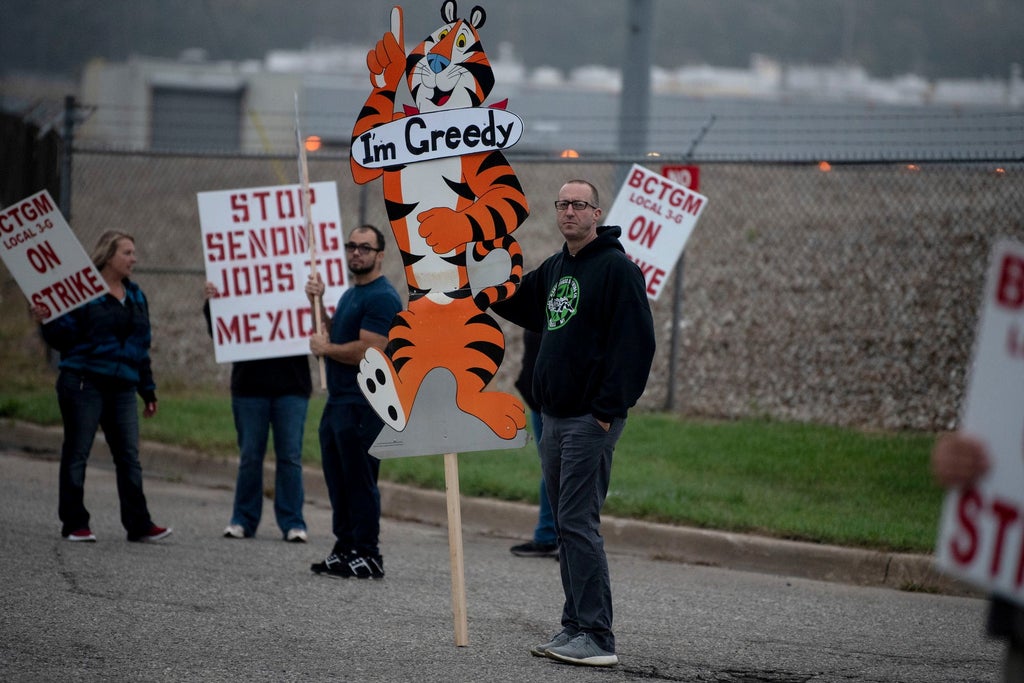
Workers at breakfast cereal maker Kellogg Company have gone on strike after a year-long negotiation between union and management broke down.
Around 1,400 cereal plant employees in its hometown of Battle Creek, Michigan, Lancaster, Pennsylvania, Omaha and Memphis are on the picket lines.
The Bakery, Confectionery, Tobacco Workers and Grain Millers International Union says that workers in the cities produce Rice Krispies, Rasin Bran, Froot Loops, Corn Flakes and Frosted Flakes.
Kellogg’s has demanded that workers give up quality health care, retirement benefits, and holiday and vacation pay, according to union boss Anthony Shelton.
And he claimed that the company had treated to send jobs to Mexico if workers did not accept their proposals.
“For more than a year throughout the Covid-19 pandemic, Kellogg workers around the country have been working long, hard hours, day in and day out, to produce Kellogg.
“Kellogg’s response to these loyal, hardworking employees has been to demand these workers give up quality health care, retirement benefits, and holiday and vacation pay. The company continues to threaten to send additional jobs to Mexico if workers do not accept outrageous proposals that take away protections that workers have had for decades.”
Kellogg’s said that its US cereal plant employees received some of the best pay and benefits in the industry.
“We are disappointed by the union’s decision to strike ... our offer includes increases to pay and benefits for our employees,” said Kellogg spokesperson Kris Bahner.
A company filing stated that Kellogg had a total of 31,000 employees as of the start of this year, meaning that less than 5 per cent of its workers worldwide are on the picket line.
The Covid-19 pandemic saw a huge jump in the sale of breakfast cereals as people stocked their homes with the product.
In 2019 cereal sales dropped 0.6 per cent following a 1.4 per cent fall in 2018, according to Nielsen data.
But in 2020, sales increased by nearly 9 per cent.