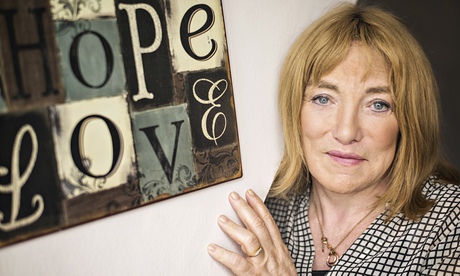
Sunshine streams into Kellie Maloney’s flat on the top floor of a house tucked away in suburban Kent. Six weeks have passed since the final operation completed her transformation from a man into a woman and the mood is as light and airy as the boxing manager’s home in Bromley.
The last time I interviewed Maloney her first name was Frank and, as a diminutive and wise-cracking south Londoner, he was on his way to managing Lennox Lewis to the world heavyweight title while battling Don King. “I framed that interview,” Maloney says, her voice sounding exactly like it did all those years ago. “I had it hanging up because it was one of the first big interviews I ever did.”
Maloney smiles wryly, and then looks down shyly. “This might sound silly but as Frank Maloney I used to look at all the girls at ringside and feel envious. They looked great enjoying a night out at the boxing. That’s why I loved going to boxing for the first time again in Germany [last year]. The reception I got was great and sitting at ringside as a woman was so different. It was better. I’m not jumping up and down, I’m not banging on the ropes, my blood pressure is not soaring. I hope I keep that same calm and enjoyment now I’m back in the business.”
She has been enticed back into boxing by Tony Jones, a light-welterweight from Telford. The 23-year-old fighter pursued Maloney for months in the hope of persuading the retired 61-year-old manager and promoter to take charge of his career. Maloney finally agreed and Jones makes his professional debut in Glasgow later this month on a bill including the unbeaten Scottish heavyweight Gary Cornish – who has appointed Maloney as his “consultant”.
Maloney’s return has been received in a mostly generous way. “People have been kind,” she says. “I felt anxious, and emotional, as I was going back into something I love passionately. You can see in people’s eyes it’s difficult. They’re nervous and don’t know how to react but after a while they settle down. But there are some who I worked with before in boxing and I’ve called them and they’ve said: ‘We can’t get our fucking heads around it.’
“I’ve just gone: ‘Please, there’s nothing to get your heads around. I’m still the same person.’ One of them said: ‘Look, I never even want to imagine you in a dress … ’ and I’m like: ‘Okayyyy … ’ I’m not forcing myself on anyone but a couple who were very close to me haven’t spoken to me since. I’m a little upset. But this time I am on a very personal mission. I have to prove myself. I’m going into a very tough world where anything ‘different’ is alien. I know some people are freaked out.”
Did she hint at her true self to anyone in boxing years ago – or dress secretly as Kellie while maintaining the façade of Frank? “I never could go out as Kellie. There were some private places in America when you could dress up [as a woman] and chat for an hour. I’d come back and make out I’d been to a hostess club – to keep my playboy image. I also threw in the odd reference to transvestites and lady-boys but it never went down well.”
Maloney insists that, during the two years she prepared for her gender reassignment, she had no intention of rejoining the battered old fight business. “The most successful transsexuals slip back into society and no one knows. That was the original plan. But I was being followed by paparazzi, wasn’t I? I think someone in the transgender social group, rather than the support group, told them. So we needed to find a paper where I’d have editorial, headline and picture rights and the Mirror did a great job when I came out as transsexual [last August].
“I regard myself as a human being – but society needs these labels so I call myself a transsexual. I’m hoping with boxing it will make people realise we’re the same as any human being. We have feelings. We suffer with depression. We have children. We have hopes and ambitions and are entitled to go out and earn a living. Above all we’re entitled to be respected. We’re accepted in society but we’re not always respected.
“Many transgender people end up killing themselves and it’s an indictment of society. I have a friend who had her op a week after me and she was a director of a transport company. She was drummed out of her own company by the other two directors who said: ‘What the fuck do you think you’re doing – wanting to come back here in a dress? If you do we’ll cut your pay by half because women don’t get paid as much as men.’” Maloney shakes her head. “She ended up trying to commit suicide. That’s the one thing most transsexuals have in common.”
In her past life, in a disastrous liaison with Ukip, Maloney made disparaging comments against gay people. She looks mortified. “I was still Frank and very defensive. I’ve apologised. I hurt people – but that came out of my confusion.”
Maloney’s front room features some happy family photographs – from his wedding day with his second wife, Tracey, with whom he was together for almost 20 years, to his three daughters, son-in-law and grandson. “I have three wonderful daughters. They’ve all been very supportive but they had to come to terms with it. Emma’s 37. Sophie’s 20, Libby’s 14. It was very hard for Libby. At first she thought it was a joke and wouldn’t talk about it. Eventually she came around and Libby has actually spoken at Diversity meetings which is amazing. I’m much closer to them than in my previous life where I was always lying and hiding.
“My biggest fear was losing them and I had to accept it could happen. I couldn’t stop my journey, so I tried to commit suicide a couple of times. Once, I was saved by these dogs.”
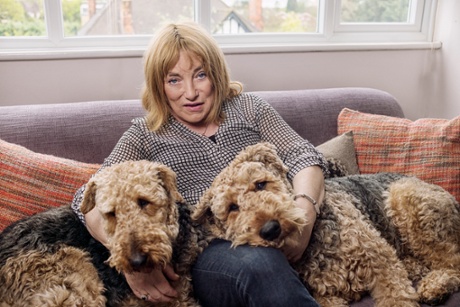
Maloney points to two airedale terriers stretched out at her feet, asleep in the afternoon sun. “It was Christmas 2012. I went back to the family because Tracey invited me for dinner. I thought it was to sort things out so I decided to lock out Kellie. But once you open that Pandora’s box you can’t lock it away. I misread the signals and we had a terrible row. I started swallowing my heart tablets, tablets for depression and tablets from Tracey’s medical cupboard with alcohol. I walked out of the house because I didn’t want to do it there. I had nothing against Tracey.
“I took the dogs for a walk. They saw a cat and I had a bottle in one hand and they pulled me over. I passed out. Next thing I heard voices and the dogs were licking me. Someone said: ‘I’ve called an ambulance.’ I said: ‘No, I’m all right.’ I thought if I went to hospital it would be all over the newspapers. So I got up and walked for three hours. It was the worst Christmas.”
Did the girls know then about his transgender trauma? “No, but Tracey did. I told her in 2009 but she would have taken that secret to her grave.”
The house is quiet when Maloney starts to cry. Her tears fall and, despite a cracked voice, she keeps talking. “Outside counsellors, she was the first I told. That’s my biggest regret … Tracey.”
Maloney regains her composure. “It’s one of the few subjects that still really upsets me – but now it’s very smooth and level-headed. We’re very close. When I decided to come back to boxing, Tracey said: ‘I’m really pleased because that’s what you love and you’re no longer at war with yourself. You’re at peace.’”
Boxing has given Maloney the most thrilling nights of her life – and she steered Lewis, Paul Ingle and Scott Harrison to world titles. “I’m really proud they were with me from the day they signed pro to becoming world champion. The best night of my career was when all three won on the same night at Madison Square Garden [in April 2000].”
Eight months later Ingle was close to death when, after his fight against Mbulelo Botile, he was rushed into emergency surgery to remove a blood clot from his brain. Ingle’s life was blighted for years – and Maloney fell out of love with boxing. She reached her lowest ebb when, in September 2009, she discovered the body of her fighter Darren Sutherland. The unbeaten Irish middleweight hanged himself in a flat in Bromley – not far from where Maloney lives now.
“I freaked out. I didn’t know it but I’d had a heart attack three days before. Watching my fighter John McDermott against Tyson Fury I had pain in my chest and went down on one knee. I asked for a bottle of water. The pain subsided as I sipped the water. I got up and was convinced John won. I said, ‘At least when Dick Turpin robbed you he had a mask …’
“The next night, Saturday, we went for a meal with my family and Darren. We asked if he wanted to stay over with us. But he went back to his flat. On Sunday and Monday no one could contact him. When I found Darren I keeled over. Next thing I know I was in an ambulance and they’re saying: ‘Have you had any chest pains?’ I said: ‘On Friday.’ They said, ‘You’re very lucky to be alive. You had a heart attack.’”
Maloney’s latest hospital visit, for the surgical procedure that completed her sex change, was in March. “I’m fully functional now,” she says dryly. “I had been living as a woman for two years but the surgery makes me complete. I have never felt more contented.”
Does she wish she had made the transition years ago? “I wish I’d done it 20 years ago – but then I would never have had a family. I would be very lonely without my family. I’m not lonely now. I live on my own and I have no intention of starting a relationship. Everyone confuses gender change with sexual orientation – but there’s a big difference. At this moment I don’t have a sexual orientation.”
I start to ask Maloney if life is easier if you’re a man or a woman before, realising the banality of the question, I suggest it might just be the same – being human. “You’re the first person to say that,” Maloney exclaims. “I am just a human being. Nothing’s really changed … except [Maloney laughs] I spend more money on clothes.
“I don’t need boxing. I’m going back because I regained my love for it. If I can deliver Scotland its first British heavyweight champion in Gary Cornish I’ll be really proud. I’ve been thinking of calling Don King because no one knows more about heavyweights than Don. If Tony Jones gets to the same level we’ll look at the European title. Then if we hit the jackpot …”
Maloney smiles, curbing the old hustler’s instinct. Yet her pride is obvious. “I still have dreams,” she says. “If I take one of these two fighters to a British title it’ll be a bigger achievement than anything Frank Maloney ever did.”