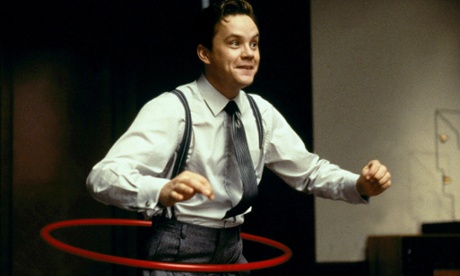
When I heard that a stage version of the Coen brothers’ breakneck comedy The Hudsucker Proxy was being produced, my first thought was: O Brother, why wouldst thou? The range of Joel and Ethan Coens’ work has been vast. From gangster movie (Miller’s Crossing) and western (True Grit) to screwball (Raising Arizona) and psychological horror (Barton Fink), there are few genres they haven’t mastered, or at least dabbled in. They have best picture and best director Oscars to their name (for No Country for Old Men) and are presiding during the next fortnight over the competition jury at the Cannes film festival.
But their talents feel specific to their chosen art form. The layered in-jokes and allusions are cinematic, the camerawork highly expressive, the editing eloquent in its precision. Ethan Coen may have branched out into theatre – his play Almost An Evening made its off-Broadway premiere in 2008, while his one-act comedy Talking Cure was produced on Broadway in 2011 – but the idea of transferring a Coen brothers film to the stage in all its meticulous detail sounds foolhardy.
The Hudsucker Proxy seems an especially perverse choice. This 1950s-set comedy concerns a mailroom sap, Norville Barnes (played in the film by Tim Robbins), who is elevated to the boardroom by a cigar-chomping executive (Paul Newman) with his own designs on the company. Jennifer Jason Leigh, as a fast-talking hack who gets wind of the scheme, gives a clench-jawed performance with a Stars in their Eyes quality: Tonight, Matthew, she’s going to be Rosalind Russell.
This is a movie steeped in cinematic effects – from the whimsical (a piece of paper following Norville along the street on a gust of wind) to the extravagant (a suicidal CEO plummeting 40 floors toward the camera before being suspended in a close-up freeze-frame). Its reference points are all drawn from film (It’s a Wonderful Life, His Girl Friday, Trading Places, The Apartment, Brazil). It was also a resounding flop; the picture’s commercial failure only looks heightened now by its position on the Coens’ CV just after their Cannes triumph Barton Fink and just before their mainstream breakthrough Fargo.
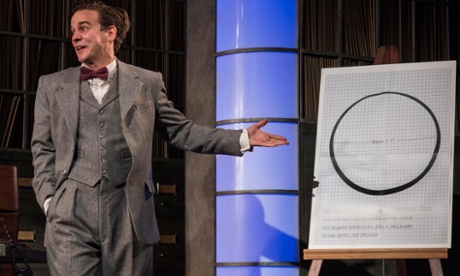
But it is this that Simon Dormandy and Toby Sedgwick are now co-directing at the Nuffield theatre in Southampton in a co-production with the Liverpool Everyman & Playhouse and Complicite. (The show begins previews this week after its opening was delayed by an incident during the final dress rehearsal.) When I meet the pair over lunch during a break from rehearsals, Dormandy shares with me his theory about why the film was largely unloved. “It was too sunny for the cult audience the Coens had built up but a bit dark and clever-clever for a larger one,” he says, getting to grips with a chicken fajita. “It fell between two stools.”
He first saw it a few years ago. “I felt right away that it was worth doing as a play because it’s organised very visually – ideas and images keep returning, especially the motif of circles. And the story of this sweet, innocent man who creates something that represents liberation, well, that resonates for me with the whole act of theatre. This is a medium which prioritises the audience’s imagination, so a story that celebrates creativity seems doubly exciting and theatrical.” The Coens were immediately enthusiastic. “They’ve been wonderful all along. Perhaps because the film was not a financial success, they’ve got a bit of a soft spot for it and they feel it deserves more life.”
Having been a key element in the theatrical success of War Horse and The 39 Steps, Sedgwick was well-placed to take on the challenge of finding a stage equivalent for the movie’s outlandish spectacle. “What we had to do was essentialise,” he says as he picks over a salad. “You take the key elements from a scene and use the audience’s imagination to enhance it. In film, very little visual imagination is necessary because you’re given everything.” In practice this means, say, converting the CEO’s suicide at the start of the story into a handful of evocative details – a window frame, some video projection of light whooshing past at high speed, an actor lying on a stool and flailing. In the case of the newspaper following Norville down the street, a puppeteer manipulates the prop. “A small leap of imagination is all it takes for the audience. Their attention is focused on the newspaper, not the person moving it.”
There have been other, more cosmetic changes. There’s now a framing device in which the entire story is recounted against the backdrop of the mailroom to a young worker just like Norville (“So the audience knows from the outset that they’re watching a fable that has a point,” says Dormandy). And there is a new emphasis on the movie’s faint anti-capitalist subtext. “The only thing we feel was lacking in the film was that maybe it didn’t go far enough in turning Norville into this money-making entrepreneur who loses touch with who he is,” says Sedgwick. “That dynamic has become very pertinent in recent years so we’ve strengthened it in the show.”
Sitting in on rehearsals, I get a flavour of this sophisticated production. The glowing set is comprised of tall mailroom walls (cubbyholes, filing cabinets) that glide back and forth with ease. The space is augmented by video projection – images of revolving cogs are cast on to the set once the action moves behind the giant Hudsucker clock, where time itself is controlled with levers and gears.
As Sedgwick delivers his directions (“When the secret door goes ‘clump!’, that’s your cue …”), it dawns on me that this change of medium could well oxygenate the world of the Coens, where the intensity of pedantic detail can sometimes be suffocating. Dormandy says he has no plans to adapt any other movies by the the Coen brothers. Someone else, though, could take up the challenge. Perhaps Blood Simple wouldn’t be complicated; there might not be far to go for Fargo to reach the stage.
The Hudsucker Proxy is at Nuffield theatre, Southampton, 19–30 May 2015. Box office: 023-8067 1771. Then at Liverpool Playhouse, 5–27 June. Box office: 0151 709 4776.