The Tokyo Olympics opening ceremony will be held Friday, but at the beginning of this week, Japan reported over 2,300 new cases of novel coronavirus infection nationwide.
The organizers and related staff have been busy taking care of myriad issues in order to hold the Games safely amid the unprecedented circumstances of the global COVID-19 pandemic.
One of the latest issues involved the South African men's soccer team.
"There are 21 people who had close contact with infected people, and most of them are players," an official of the Tokyo Organizing Committee of the Olympic and Paralympic Games said Monday.
Two players and an official of the team tested positive for the virus while staying in the athletes village in Chuo Ward, Tokyo.
The 21 close contacts are in isolation in their rooms. Meals are delivered to their rooms so that they do not have to have contact with other people.
Hidemasa Nakamura, chief of the organizing committee's Main Operation Center, said Sunday, "We should accept what had happened and look into the cause."
--Triple test system
They had of course expected there would be infection cases in the athletes village.
According to the organizing committee's Playbook on measures to prevent the spread of the coronavirus, athletes are required to take virus tests twice within 96 hours before entering Japan and provide proof of negative results of a test taken within 72 hours of their departure for Japan. They are also tested at the airport. Even so, given the virus's incubation period of up to about 14 days, some people might have negative test results even though they are actually infected.
For that reason, athletes are supposed to take saliva antigen tests every day after entering the athletes village. If they test positive, they are required to take both the more accurate PCR test using the saliva they provided for the antigen test and a nasal-throat swab PCR test. The triple test system can help closely determine whether they are positive for the virus.
Then, infected people are supposed to stay in accommodation facilities for infected people or be hospitalized in medical facilities treating COVID-19 patients.
One key is to conduct virus tests carefully and discover infected people as soon as possible to prevent the occurrence of clusters. Another is to restrict the movement of athletes and others in bubbles to stop infections from spreading among the public.
--15-member tracing team
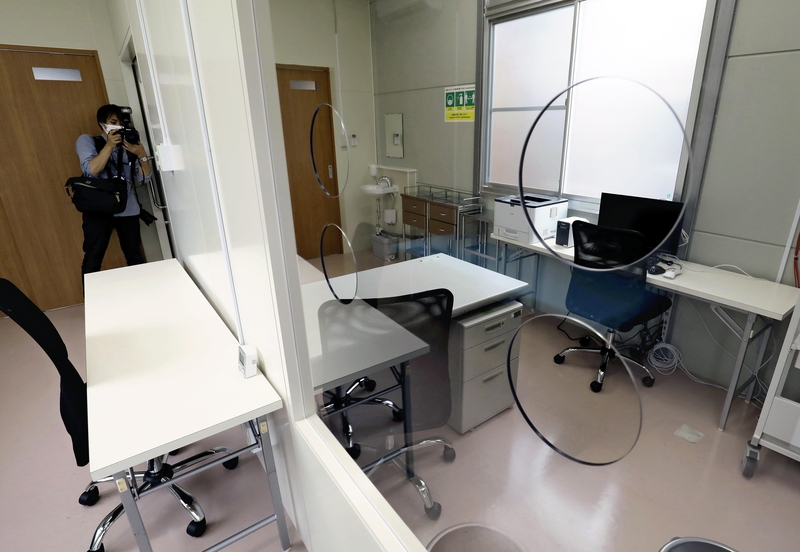
To implement these measures, the athletes village has a fever outpatient clinic to handle COVID-19 patients. Furthermore, a health center near the village was opened mainly under the auspices of the Tokyo metropolitan government.
The health center serves as a sort of second public health center for Chuo Ward and is staffed by 26 personnel: 11 doctors and nurses who are Tokyo metropolitan government officials and a 15-member tracing team consisting of experts tasked with tracing close contacts and other operations.
Officials from private testing institutions are on duty full-time and a system has been developed to quickly conduct virus tests. Infections of the South African soccer team members were identified through these measures.
In the latest case, the South African side announced their infections. The organizing committee does not announce the nationalities and other information of infected people in principle, citing privacy among other reasons.
Unless sufficient information is provided, however, daily testing and designation of close contacts will be delayed, resulting in the virus spreading.
"The organizing committee should offer as much information as possible," Chief Cabinet Secretary Katsunobu Kato said at a press conference Monday.
--Outside the village
Officials involved with the athletes village are not the only ones nervous about infections. Municipalities hosting pre-Games camps and home to official Olympic venues are also required to take measures.
Among the South African delegation, a member of the men's rugby sevens squad tested positive when the team arrived in Japan. Kagoshima, which hosts the team's pre-Games camp, dispatched two public health center officials to a facility in the Tokyo metropolitan area to hear from the players and others and was busy identifying close contacts with the infected person.
The Minato Public Health Center in Minato Ward, Tokyo, covers an area that is home to venues for events such as the triathlon as well as facilities that accommodate Olympic officials.
"Since the country decided to hold the event, we would like to take appropriate measures so that Olympic athletes and officials feel well treated in Japan," said Kayo Matsumoto, director of the public health center.
Read more from The Japan News at https://japannews.yomiuri.co.jp/