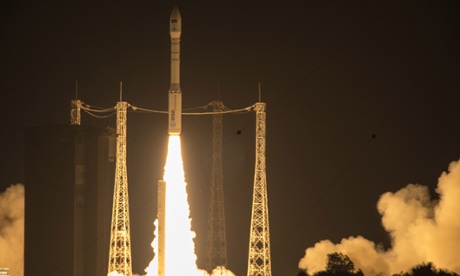
The second satellite in the world’s most ambitious Earth observation programme entered orbit this week. The European Space Agency’s Sentinel-2 blasted off from French Guiana on 23 June.
The 1.1 tonne spacecraft will be lifted into orbit by Europe’s 10-story Vega rocket. The satellite’s optical camera will provide high-resolution images of the Earth as part of the Copernicus environmental monitoring programme.
This initiative is a partnership between the European commission and the space agency. It is designed to provide accurate, timely and easily accessible information about the environment.
It is envisaged that this data will improve day-to-day management of the environment, including the management of relief efforts following natural disasters. It will help us monitor the effects of climate change, and our attempts to mitigate it.
It is also designed to provide data to the European Border Surveillance System (Eurosur). This initiative is designed to support EU member states in their efforts to reduce illegal immigration.
Images from Sentinel-2 will form an essential component in providing information on what is happening at Europe’s borders. They will be augmented by data from drones and reconnaissance aircraft, and offshore sensors.
The first satellite of the Copernicus programme, Sentinel-1A, was launched on 3 April 2014. It carries a radar system capable of providing images day and night, cloudy and clear. Sentinels 3, 4, 5P, 5 and 6 are currently in various stages of production.
.jpg?w=600)