
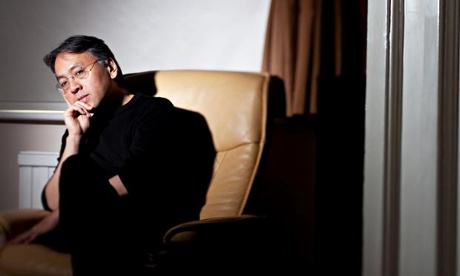
That’s it! Thank you everyone for your questions
'I tend to write the same book over and over'
poppypoppy asks:
Hi Kazuo. I’m always impressed by how varied the subject matter of your writing is from novel to novel. What is it that inspires enough passion for you to fixate on characters and emphatically weave an entire story around them? Do you have to kind of become the characters or are they more shaped by your research?
 Guardian contributor
 To answer last part first: certainly for the first person narrators, I adopt a kind of method acting technique. Well, I don't go to extremes, becoming butlers or whatever. But I do feel I have to get to the point where I could, say, hold a fairly long conversation with my wife in the kitchen in the voice of the character. That way, I don't have to think line by line, 'how would s/he say this?'. Until I get to that point, I'm not comfortable starting the narration.
As for subject matter: well, let me tell you a dirty secret. My subject matter doesn't vary so much from book to book. Just the surface does. The settings, etc. I tend to write the same book over and over, or at least, I take the same subject I took last time out and refine it, or do a slightly different take on it. Example: Remains was essentially a repeat of the territory covered in Artist of the FW. But that latter book, when I came to the end of it, struck me as dealing with the theme of the wasted life only from the career perspective. It occurred to me there were other very good ways to waste your life - especially in the personal arena. So Remains was Artist Plus. Stevens wastes both his vocational life and his love life. I set it in England, not Japan, and everyone talked about a huge leap. But it was a re-make, or at least, a refinement of the earlier book.
Updated
'A lot of fine writers hit their peak aged 60'
Eglantine asks:
Is it ever too late in one’s life to begin seriously writing fiction? And how do you personally push past the self-doubt and silence the critical voices in your head so that you can get on with writing – if this is indeed a problem for you?
Guardian contributor I don't think it's ever too late. In fact, a lot of fine writers hit their peak after 60 or so. Penelope Fitzgerald, maybe Cormac McCarthy, Philip Roth, etc. It doesn't even matter really if one doesn't produce world-shattering works. I think writing fiction is a good thing for almost anyone, at any point in one's life. I have been quoted saying that I believed novelists (not other kinds of writers) peaked somewhere between 35 and 45 - a little after footballers. Taken as a generalisation, that's probably true: just empirical observation suggests this, unfortunately. Most 'great' novels are written by people under 45, sometimes much younger. If you look through any literary encyclopaedia this tends to be borne out. However, that doesn't mean very good novels can't be written by people at any point in life. Countless examples for that.
As for self-doubt, etc. Well, I think we just have to have a sense of arrogance. Or maybe, we have to develop a very lonely sense of success and failure for each of us. Sometimes, I get praised for something, and I go away and think, well, I'm not convinced. And anyway, they're not praising me for what I wished to be praised for.
Updated
'My English vernacular can be pretty rocky'
Terry Smith asks:
Your first language must have been Japanese. Do you think the fact that your learnt English as a second language, though obviously when you were very young, has had an effect on your relationship with it? I am asking this question because, like many, I admire your prose style enormously.
Guardian contributor I grew up in a house where English wasn't spoken. Even now, when I speak to my mother, we speak in Japanese. So although I grew up in Britain since the age of 5, I don't have the same firm foundation, linguistically, as many of you out there. In fact, I'm pretty rocky, especially around vernacular and such. So I think this has led to a natural carefulness when writing prose. But I think that may be a good thing for me. I think in general, when people write fiction, they should be very very careful. In a way, my sense of wariness was a help to me in my early days as a fiction writer.
Also: in my early books, I was obliged to create the impression that the characters (even the narrator, in my second book) was speaking not in English, but in Japanese. But the book was somehow reaching the reader in English. So I had to create a kind of subtitles effect. I couldn't let loose with Japanese people going 'cor blimey' or 'what ho'. So I had to invent a kind of careful, 'foreign' language. I think that's stayed with me to some extent. I've never been a particularly fluent kind of prose writer.
Updated
Deshni Naidoo asks:
Never Let Me Go has been one of the most deeply affecting novels I have ever read. The questions it raised about love, sex and what makes us human; whether that in fact is a soul and where that comes from, have always stayed with me and made me question just what “human” means. What led you to phrase those questions in the novel around art, or creativity? That this was perhaps where our souls reside, in our ability to create.
Guardian contributor So pleased NLMG touched you so deeply. It's not really me believing that our souls may reside in our ability to create. That's more what certain characters in the novel believe - at least, they think for the purposes of campaigning on behalf of the clone kids, the general public would be more persuaded of them having souls if their creative work can be shown to bear witness to such a notion. The novel doesn't necessarily support that idea: My own feeling is that it's in the way these characters love and care for each other; the fact that when they realise their time's limited, they desperately want to reach out for each other, set right things they might have done to hurt one another - it's that kind of stuff that testifies to them having 'souls', if there was any doubt about it in the first place.
'There was a time when I'd have loved to take up film-making'
bobonline1981 asks:
Alex Garland wrote the screen play for Never Let Me Go after slowly shifting from novels (The Beach) to directing (Ex Machina). With some of your books being turned into films - do you harbour any desires to take a similar path and if not, why not?
Guardian contributor There was a time when I'd have loved to take up film-making. But hanging around film sets, and getting to know film directors, has made me appreciate how enormously difficult it is to direct a film. In effect, you have to be a kind of CEO of a sprawling company under extreme stress and shifting conditions. I don't think I'm able to do that kind of stuff. Alex G is an enormously gifted guy. It's very rare that someone has the ability to write novels, and screenplays, and direct. The latter requires so many practical skills, and it requires getting up very early in the morning, and shouting at people.
As for my books being turned into films - in a way, that's the ideal for me. I can leave all the heavy-lifting of the film-making to someone else, and take credit for a good film, or disown a bad one angrily.
Updated
valleyman asks:
If you have ever lived with someone with poor health and had to watch the universe pull their body parts from them over a long sustained period of time, Never Let Me Go really resonates. Was this an intention when you wrote it? or did it just grow as a side shoot in the natural birth of you story?
Guardian contributor Sorry to hear you've had to go through such a difficult experience. While I wasn't trying necessarily to recreate such an experience in the novel as such, I did certainly have in mind a kind of metaphor for the general human condition - that we would, even if we were lucky, at some point have to lose control of various parts of our bodies and leave this life. It's a cruel kind of metaphor, I suppose - the idea of drawing a parallel between the natural ageing process and a savage regime that harvests young people's organs systematically. But in some ways, our experience of facing death is very cruel.
'I wrote my narrators up in the way I felt was authentic – human nature is unreliable'
BabyH asks:
Many of your books depend on a self-deluding or otherwise unreliable narrator. What is it particularly that interests you in this device?
Guardian contributor There are a few questions in this chat about unreliable narrators, and so this is in answer to some of the others as well. When I started out, I never really thought specifically about 'the unreliable narrator'. In fact, that term wasn't thrown around back then nearly as much as it is now. I just wrote my narrators up in the way I felt was authentic - the way I felt most people would go about telling a story about themselves. That's to say, any of us, when asked to give an account of ourselves over any important period of our lives, would tend to be 'unreliable'. That's just human nature. We tend to be 'unreliable' even to ourselves - maybe especially to ourselves. I didn't think of it as a literary technique. That's kind of how I think of my narrative voices now, today. I wouldn't want my narrators to be any more unreliable than the average person would be in a similar context.
Updated
ElectricSheep60 asks:
I’m really excited and looking forward to reading The Buried Giant when my copy arrives. You’ve said once that one of your future challenges would be to write about how a whole society or nation remembers or forgets. Is this something that you’ve tried to do in The Buried Giant?
Guardian contributor Yes, definitely. I spent many years thinking about things like France's way of facing up to (or not facing up to) the occupation years; the disintegration of the old Yugoslavia; Japan's memory of its role in WWII, etc. When is it better for a country to remember accurately? When does a nation need to forget just in order to hold together and stop itself descending into violence and civil war? But in The BG I'm also interested in how this question applies to a marriage - or any long-term relationship. Shared memories are crucial to a relationship. But the same questions apply here. When is it better for a couple to forget and move on? When should they explore the dark corners of their past together and face these things? Anyway, you can see what you make of the new book when you read it.
Brooke Sherbrooke asks:
I’ve seen readers suggest that the best place to begin reading your work is with Remains of the Day. For those who do want to read/enjoy/ponder your beautiful writing, with which book do you suggest they begin?
Guardian contributor Who knows? Every reader's so different, coming from so many different directions, wanting so many different things. Remains of the Day and Never Let Me Go are certainly reckoned to be two of my most accessible books. But I think it's best to go to a bookshop, look at the covers, read the stuff on the back, and decide what takes your fancy on that day, at that time.
judgeDAmNation asks:
The Unconsoled is also my first experience of your writing, and at just over 200 pages in I’m wondering why I ever left it so long to investigate your books. Needless to say, the book has prompted much debate in our Reading Group, but a common theme seems to be that the book is a meditation on stress and memory.
Personally I see the book more about guilt and artistic success, and particularly the guilt that the artist feels towards neglecting his family in the name of his craft (hence Boris being forgotten in the cafe for hours on end and so on) - is there an element of this in the book, or am I reading too much of myself into it? (Having two young children of my own, the predominant theme in my life seems to be guilt at either not spending time with them due to work, or not being a good enough role model when I am with them). I read an old interview of yours the other day where you mentioned how having children changed you, and so I was just wondering how much of this feeling impacted on the book - there are certainly moments like this that strike me as incredibly poignant...
Guardian contributor I think it's fair to say the book is fuelled by stress and by guilt - the both of them. Not just parents' sense of guilt towards their children, but the child's sense of guilt and responsibility for things going wrong in the parents' world. I think there's quite a lot there too about people trying their utmost to fulfil other people's ideas of what they should be - other people they love - and the tragic strain that puts on them.
Updated
'Electricians are usually good guys in my books'
There appears to be several different ways of interpreting the ending of The Unconsoled, probably deliberately so. So I’d like to ask Kazuo Ishiguro not who the electrician on the tram is, but who he would like him to be.
Guardian contributor Look, I have to be honest. It's over twenty years since I wrote this book, and I haven't quite finished re-reading it. I can't quite remember about this electrician. I'll have to look at it. Electricians are usually good guys in my work. That much I do know. It's typical of Guardian readers to ask so many questions about the ending, even though I've managed to re-read 95% of it!!
Updated
nightjar12 asks:
I enjoyed The Unconsoled so much that I didn’t want to reach the end but, when I got there, the final scene turned out to be one of my my favourites. It made me want to laugh, smile affectionately and cry all at the same time. Readers seem to interpret it in many different ways though. Did you mean it to be ambiguous or was there a particular message you wanted to convey?
Guardian contributor The endings to my novels often go for a kind of sad courage. (I think my new one - The Buried Giant - ends on a note like this too. I must try and break this pattern at some point.) The situation may well be pretty hopeless, but the protagonist makes a huge desperate effort to be optimistic, against all the odds. I admire that in people. Their ability to find a bit of courage, a bit of optimism, a bit of humour and spirit in the face of overwhelming knowledge that it's all hopeless, everything one cared for is lost...
By the way, that ending on the tram turns up in musical form as the title track of Stacey Kent's 2007 Blue Note album 'Breakfast On The Morning Tram'. I co-wrote the song with Jim Tomlinson, and it's consciously a recreation of the ending to The Unconsoled. You could call it 'The Consolations of Breakfast' or something like that. I liked the idea of it happening on a tram going round and round the city on a circular track. I liked the kindness of strangers, and the overwhelming comfort of breakfast food and coffee.
theorbys asks:
1) Is Unconsoled a novel about doubles, like Dr Jekyll and Mr Hyde, The Double, William Wilson, are? If so what were you thinking of this inner double as? e.g. Hyde was the Id, William Wilson a moral consciousness. It seemed to me you did something astonishing with Ryder. His second temporary personality which sprang into being when he got to the Town seemed like a fictional correlate of the second ‘personality’ any reader develops on opening a book and starting to read, a reading self so to speak. Ryder, the Town, and the Ryder’s inner double seemed to be all three fictional correlates of the Reader, the Book, and OUR double, (a temporary task specific double), that is our reading self: an inner self that willingly suspends disbelief, identifies itself with the novel’s characters, and which disappears when we close the book (but ready for a new experience the next time we open one). Did you intend to create a double who was the fictional correlate of the reading self?
2) Are you a Philip K Dick fan? I think if Unconsoled has a clear message it is about the unhappiness and destructive power of love without empathy. Brodsky’s desire for an animal, reminded me of Philip K Dick’s story Do Android’s Dream of Electric Sheep, which is also about empathy, and in its own way (as are other Dick stories) about dissociated personalities like the one Ryder seems to develop when he gets to the Town.
3) Did you think of the story of Ryder, Sophie, and Boris as a novel within the novel? Both ‘novels’, like Ryder’s two personae, intercommunicating, which in turn requires the oniric background of the novel.
Guardian contributor I don't think doubles. It's more like the way, once again in a dream, people who are of relative unimportance to you can inhabit your vision, looking like the shopkeeper you saw earlier in the day, the person you struck up a conversation with on the train, etc, but actually, they're standing in for much more significant people - an ex-spouse, your father, etc. Many of the characters in the book 'double' in that sense, rather than in the Dostoyevskian sense. And yes, many of these characters are aspects of Ryder himself: versions - sometimes loose versions - of himself as a child, himself projected forward in his fears; others are versions or variants of his mother, father, wife, son, etc. It's another way of telling a story about a particular character. A variation on the David Copperfield 'biography' way, or the looking back with flashbacks to key moments way often used in many novels (including many of my other novels eg Remains of the Day, NLMG and others).
Incidentally, if you're interested in doubles, you might have a look at a Patrice Leconte movie called L'Homme du Train, which is a good example of the anti-double in a story. I find anti-doubles more interesting than doubles at the moment. In the movie two strangers become friends because each represents to the other the life they didn't have, the life they missed out on, and now they sense is too late to have. (Both men - one played rather well by Johnny Hallyday the singer - know they're likely to meet their deaths in the coming few days, and can only wistfully flirt with the identity represented by the other - Johnny is a bank robber and womanizer, Jean Rochefort is a provincial retired schoolteacher. Anti-doubles are fascinating and make for poignant relationships.
I've never read a Philip K Dick book, though I know that the movie Blade Runner is based on this one you mention. But I think your comment about 'unhappiness and destructive power of love without empathy' is rather good. It's very interesting and rather well put.
Updated
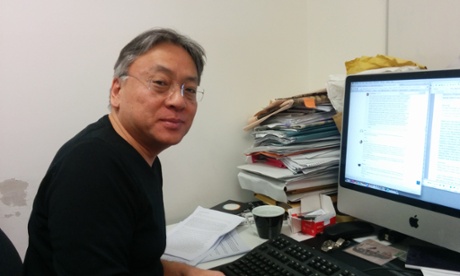
Kazuo Ishiguro is in the building!
Updated
'I used a guide of World Cup football teams to pick character names for The Unconsoled'
River12 asks:
A reader inevitably creates pictures in his or her mind based upon the descriptions and atmosphere within the novel. When I read ‘The Unconsoled’, I mainly pictured Prague. Did you have any one particular city in mind when you created your city, or were you inspired by elements of several different ones, and if so which?
Guardian contributor Didn't have any city in mind. I would have been afraid of Prague, if only because I was always nervous about the Kafka comparison. It was a kind of generic European city, and it was quite a late decision to give the characters, streets, etc, German names. I had to come down somewhere, location-wise. But it wasn't a starting point. I had my city and community in my head, then I gave them German-sounding names. In the earlier drafts, they were often just dashes - no names at all, because I couldn't think of authentic German-sounding names off the cuff, whether for people or districts or whatever. I later went back and filled them in. Actually, I used extensively a guide to the World Cup (soccer) I had nearby. I looked up the line-ups for the West Germany teams and used those names. If I had to mention in passing a chemist or the name of a museum, I'd look up a West Germany team line-up and choose a name. I avoided Beckenbauer, but I think I got through just about everyone else. When I ran out, I opened a film encyclopaedia and starting looking at the cast and crew of German films. So a lot of people, particularly towards the back half of the book, have names from the cast and crew of The Blue Angel. The city grew up in my head. I wouldn't want to go there for my weekend break.
Updated
Baby H asks:
I loved The Unconsoled, and when reading it I assumed it was an account of a dream. I have however read a comment from the author denying this was his intention. Really? It still reads to me like a dream, so if it isn’t, just what is it?
Guardian contributor Glad you loved it. Not everyone does. I've just been reading it over the weekend in preparation for this webchat - and I'm not sure I always loved it all of the time! But about this dream business. I don't think I ever thought of it literally as a dream. It was more that I was telling a story, set in a particular kind of world a little removed from the one you and I normally live in, and I decided to borrow from the world of the dreaming mind. It was more like thinking, well, if the Dreaming Mind was a famous author, and I was allowed to plagiarize many of his/her signature stylistic quirks, what would they be? Which ones would I most want to nick? So yes, a lot of what happens is dream-like, and I did refer to my own dreams in working out how to do things. Not the content of the dreams, just the method by which my dreams went about unfolding a narrative, etc. The Unconsoled isn't about dreams. It just borrows a lot of the techniques and stylistic traits from the average dreaming mind. Far too many to list here, but you know what I mean. Old schoolfriends turning up out of context, with little sense of surprise. Being able to 'remember' or 'realize' a huge hunk of someone's backstory when you've run into them for the first time. The backward projection of intentions. Odd ability to witness things happening outside of one's normal field of vision, etc, etc.
theorbys asks:
Why is there so much relentless cruelty and humiliation in The Unconsoled, and such hilarity aimed at its victims? For example the utter humiliation of the town poet was bad enough but was only a warm up for Brodsky’s. But there are lots of other examples.
Guardian contributor Not sure I agree there's relentless cruelty, etc. The conceit in the book is that a community's musical values are crucial to its well-being. If they get their musical priorities wrong, it will lead to inevitable decline and misery; conversely, getting them right will lead to regeneration and happiness. e.g. the guy called Christoff - he's the cellist who came to the town some years before, and became their 'guru': now that decline has set in, the community is turning on him in much the way people might, in our world, turn on a political/religious leader they once believed in, who they now blame for all their woes. The bitterness shown to Christoff is of the same ilk - and proportion - as we show to such figures who we feel have misled/betrayed our trust. The town poet you mention, I think, is the guy who does a turn at the concert at the end of the book. He's a minor figure, but I guess he just gets caught up in the high stakes emotion of the town, as does poor Brodsky.
Updated
Post your questions for Kazuo Ishiguro
I hardly need tell you that this is exciting news: Kazuo Ishiguro is joining us to answer your questions. He will be able to tell us about his new book The Buried Giant, his first in 10 years, and about the rest of his distinguished career.
In case you need a quick reminder, Kazuo Ishiguro is the author of A Pale View of Hills (first published in 1982), An Artist of the Floating World (1986), The Remains of the Day (1989), The Unconsoled (1995), When We Were Orphans (2000) and Never Let Me Go (2005). There’s also a collection of short stories, Nocturnes, from 2009.
Those who are reading The Unconsoled along with this month’s Reading group will know just how many questions even one of these books can provoke – and just how much there is to discuss. You might also be interested to know that as well as novels and stories Ishiguro co-wrote four songs on Stacey Kent’s 2007 jazz album, Breakfast on the Morning Tram and three more on her 2013 album The Changing Lights. He won The Booker prize for the Remains Of The Day in 1989, and also picked up another four nominations, as well as a Whitbread Prize, an OBE and numerous other awards and honours.
He is, in short, a very distinguished guest and we are lucky to have him with us. He will be here from 1pm GMT on Tuesday 20th January, but please feel free to get your question in early in the comments below.
Updated













Going off to lunch now. Thank you everyone for your interest today, and especially for reading my books over the years. Yes, do drop in for The Buried Giant, which comes out start of March. If you think it's a disaster, let me know.