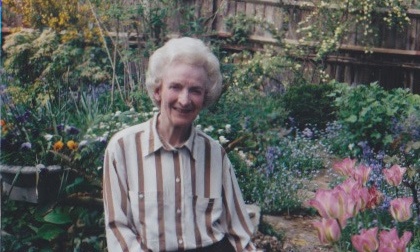
Katharine Worth, who has died aged 92, was emeritus professor and founder of the department of drama and theatre at Royal Holloway, University of London. It was typical of her indomitable vision and drive that in 1978 she achieved the creation of a new department at a time when many university arts departments were facing closure.
Katharine argued passionately, and demonstrated persuasively, how the proper study of drama should embrace theatre history, theatregoing, reviewing, theory, criticism and practice in a synthesis of approaches. This became the motivating philosophy for the new department and the hallmark of her own lecturing and writing styles.
Born in Newcastle upon Tyne, daughter of George and Elizabeth Lorimer, Katharine grew up in Newbiggin-by-the-Sea and Whitley Bay, Northumberland; she won a scholarship to Bedlington secondary school but left at 16, subsequently getting a clerical post with the civil service in 1940. While working, she studied at her mother’s instigation for a BA degree through the University of London’s correspondence course.
After the second world war she completed an MA and a PhD at Bedford College, London, under the supervision of Una Ellis-Fermor. This was followed by part-time teaching for the Central School of Speech and Drama and London University’s extramural department, before she was appointed lecturer in English at Royal Holloway College, near Egham, Surrey, in 1964, becoming reader in drama there in 1974 (it later merged with Bedford College and is now Royal Holloway, University of London).
Katharine’s first major publication, Revolutions in Modern English Drama (1973), explored the recurrences and transformations, and the cycles of evolution and change, that she detected in 20th-century British theatre. Many of the chapters (on Harold Pinter directing James Joyce’s Exiles, for example, or the RSC’s revival of Murder in the Cathedral) were stimulated by her reactions to recent stagings.
Though her range covered American theatre, popular dramatic forms such as melodrama (for many years she organised staged critical readings of the plays behind grand opera for Covent Garden) and contemporary English practice (she fiercely championed Edward Bond), her abiding research interest was Irish theatre, and she published on Richard Brinsley Sheridan, Oliver Goldsmith, George Bernard Shaw, Oscar Wilde, JM Synge, WB Yeats, Sean O’Casey, Samuel Beckett and Brian Friel. The Irish Drama of Europe (1978) was influential for its defence of Irish dramaturgy as not inhabiting a parochial backwater; Katharine chose to situate it in the context of European innovation, alongside Henrik Ibsen, August Strindberg, Luigi Pirandello, German Expressionism and Maurice Maeterlinck (about whose plays in performance she wrote in 1985). She explored the Japanese influences on Yeats’s dance plays through a number of productions that she directed.
Beckett steadily became an abiding, indeed consuming, interest that dated from the time Katharine joined the panel creating and editing the Beckett sections of the Cambridge Bibliography of English Literature. From that experience, she devised a lecture series that culminated in the publication of Beckett the Shape-Changer (1975), which she edited.
She gained Beckett’s permission to recreate several of his plays for television and radio (Eh Joe, Words and Music, Embers and Cascando, between 1972 and 1984) and followed his recommendation that she work with the actor Patrick Magee and composer Humphrey Searle. Later, Beckett allowed Katharine the rare privileges of both dramatising his novella, Company, in 1987 (Tim Pigott-Smith’s production of this won a Fringe First at Edinburgh and subsequently toured to London, Dublin and America) and attending some of his rehearsals for London productions of his plays, chiefly those involving Billie Whitelaw.
Beckett remained an enduring source of Katharine’s own creativity throughout her retirement after 1987. She wrote on Waiting for Godot and Happy Days for Macmillan’s Text and Performance series (1990); the highly personal monograph Samuel Beckett’s Theatre: Life Journeys (1999), which explores her longstanding engagement with his work as reader, spectator and critic, incorporating much of their correspondence together (now housed in the Beckett archive at Reading University); and a series of essays that culminated in the remarkable and deeply moving Beckett’s Divine Comedy, published in A Companion to Modern British and Irish Drama: 1880-2005 (2006).
Experiencing through the Beckett productions the relation of drama to film, television and radio led Katharine to found the Consortium for Drama and Media in Higher Education in 1975 with the Universities’ Film and Video Council, where the focus of its endeavours under her guidance was on using the media to enhance students’ appreciation of performance.
Her retirement was endlessly productive: she was co-editor of Theatre Notebook from 1987-97 for the Society for Theatre Research; held a Leverhulme Professorial Fellowship, 1987-89; was a visiting professor at King’s College London, 1987-96; and served on numerous advisory boards for journals, notably Yeats Annual and Modern Drama. Her advice and judgments were scrupulous and exact.
Katharine cultivated the art of friendship and her circle of friends was internationally wide-ranging. As a conversationalist she shifted brilliantly between high seriousness, flights of hilarious fancy, wit, jokes, memories (personal and theatrical), effortless exuberance and immediacy: she was always mistress of being in the moment.
Her beloved and highly supportive husband, George Worth, whom she married in 1947, predeceased her. Katharine is survived by their children, Libby, Christopher and Charles; and five grandchildren.
• Katharine Joyce Worth, drama scholar, born 4 August 1922; died 28 January 2015