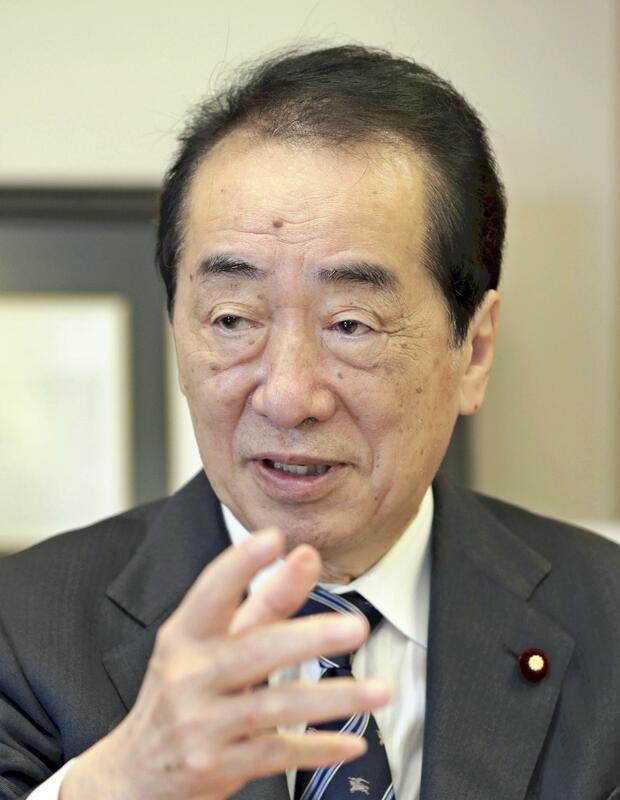
March 11 will mark 10 years since the Great East Japan Earthquake in 2011. The Yomiuri Shimbun spoke with Naoto Kan, who served as prime minister when the unprecedented disaster occurred, and asked him to review the situation at the time to pass on lessons for the future. The following are excerpts from his remarks.
In the middle of the night on Feb. 13 this year, a large earthquake occurred with a seismic intensity of upper 6 on the Japanese scale of seven, with its epicenter off the coast of Fukushima Prefecture. As my house in Tokyo shook strongly, the events of the Great East Japan Earthquake instantly arose in my mind. Aftershocks continue there even today, making me feel that even though a decade has passed, we are not out of woods yet.
The Great East Japan Earthquake was a major disaster that also triggered the accident at Tokyo Electric Power Company Holdings, Inc.'s Fukushima No. 1 nuclear power plant. As we faced one of the world's worst nuclear accidents, triggered by Japan, I was always concerned about the fear that Japan would not function as a state if it failed to deal with the aftermath of the accident on its own, relying on other countries' help instead.
-- Responsibility as prime minister
I was truly grateful for the cooperation extended by other countries, including the United States, but I thought that it was my responsibility as prime minister to tackle the accident with the resolution that we should deal with it on our own as much as possible.
This belief prompted me to rush to TEPCO headquarters, asking it not to pull out of the accident-hit plant. I likewise went to the Fukushima nuclear power plant on the day following the nuclear accident. As I met for the first time with Masao Yoshida, who was in command as the chief of the Fukushima plant, I was able to confirm his strong sense of responsibility. Although I was criticized for visiting, Even now, I believe it was the right thing to do.
However, when I decided to expand the zone ordered to evacuate within Fukushima Prefecture as the head of the government's headquarters to cope with the nuclear power disaster, some elderly people who were in the hospital or at nursing-care facilities died during their evacuation. This still pains me deeply even today. As local governments were plunged into confusion at that time, these elderly people were forced to endure a transfer for many hours in search of alternative facilities to accept them.
As a consequence, those who were in the weakest condition lost their lives. I truly feel sorry for them.
-- Position completely changed
Due to this major accident, my view on nuclear power generation has changed completely. Until then, I thought Japanese technical experts was so skilled that they would not cause any accidents triggered by human error, such as the 1979 accident at the Three Mile Island nuclear power plant in the United States or the one at the Chernobyl nuclear power plant in the now-defunct Soviet Union in 1986. That's why I promoted the export of Japanese nuclear power plants to Vietnam and other countries as the government's leader, saying, "Japan's nuclear power plants are safe."
But a nuclear power plant accident of that magnitude occurred. It was nothing but a man-made accident, as the plant was designed in a way that did not take into account the geographic conditions of Japan, an earthquake- and tsunami-prone country. This led to the cores' meltdown.
My position has been completely turned around, and I have aimed to realize the concept of "nuclear zero," allocating about 90% of my political activities to nuclear power issues over the past decade.
As a result of this major disaster, I feel strongly that the key point in risk management is anticipating the worst-case scenario and implementing measures to avoid it.
-- Something in common
Though they differ in kind, I think that a nuclear accident and the spread of the novel coronavirus have something common when looked at from the viewpoint of risk management. I have a feeling that the administration led by Prime Minister Yoshihide Suga has yet to clarify to what extent the infections could spread in Japan, by envisioning the worst-case scenario that could evolve during the coronavirus crisis, or what sort of measures need to be taken to avoid such a possibility.
The other day I questioned Suga directly at a House of Representatives Budget Committee meeting, but I could not get a concrete answer.
Ten years have passed since the major disaster, but the post-quake reconstruction of the affected areas is still ongoing. There has been a certain amount of progress in reconstruction when it comes to physical elements, such as building towns that can better deal with a tsunami. But the livelihoods of disaster-affected people have yet to be rebuilt, with the population in the stricken areas declining.
As a countermeasure, I want to work on the promotion of "solar power generating-agriculture," installing photovoltaic power generation equipment in farmland. I am thinking of creating this kind of economic base to bring back the population, through the revival of agriculture and revenue from selling electricity.
-- Naoto Kan: Former Prime Minister
Kan served as prime minister from June 2010 to September 2011, under the administration led by the Democratic Party of Japan. He is currently the chief executive advisor of the Constitutional Democratic Party of Japan. He was elected 13 times to the House of Representatives. He is 74.
Read more from The Japan News at https://japannews.yomiuri.co.jp/