
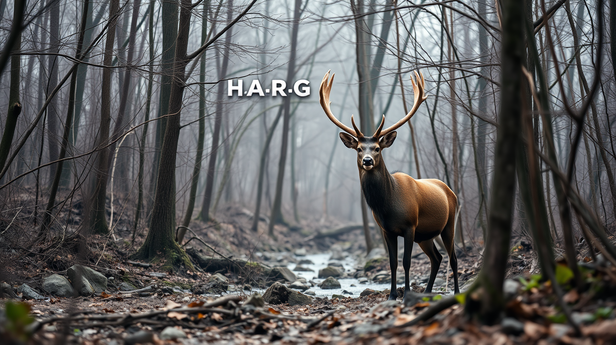
A Species Reduced to a Single Valley
The Hangul (Cervus hanglu hanglu) is the only surviving subspecies of the Kashmir stag, a large deer whose antlers can carry up to sixteen tines, more than almost any cervid on the subcontinent. It once ranged across the forests of Himachal Pradesh, parts of Afghanistan, and the Kashmir Valley. Today, its entire wild population is concentrated inside and around the Dachigam National Park, a 141-square-kilometre protected area on the outskirts of Srinagar. That is not a recovery story. That is a species backed into a corner.
The most recent government census figures place the population at somewhere between 260 and 310 individuals. The Wildlife Institute of India, which has conducted multiple surveys of the Dachigam population, has flagged that the effective breeding population, the animals actually contributing to the next generation, is far smaller than the headline count suggests. A population of this size is dangerously close to what conservation geneticists call a minimum viable population threshold, below which inbreeding and random demographic events can trigger a collapse that no amount of protection can reverse.
What Makes the Hangul Biologically Vulnerable
The Hangul's biology works against it in a shrinking habitat. Females give birth to a single calf after a gestation of about 240 days, which means the species cannot compensate for losses the way smaller, faster-reproducing animals can. Calves are born in late May and June, timed to coincide with the flush of alpine vegetation in Dachigam's upper reaches. When that seasonal movement is disrupted, by human presence, by livestock grazing in buffer zones, or by an unusually cold spring, calf survival rates fall sharply.
The Hangul is also a habitat specialist. It depends on dense riverine forest at lower elevations during winter and moves to high-altitude meadows in summer. This vertical migration, called altitudinal transhumance, requires unobstructed corridors between the lower and upper zones of Dachigam. Those corridors are now cut through by roads, army installations, and the expanding edge of Srinagar's urban sprawl. A deer that cannot complete its seasonal circuit is a deer under chronic physiological stress, and chronic stress in ungulates suppresses both reproduction and immune function.
The Threats That Don't Make Headlines
Poaching is real but secondary. The larger threat to the Hangul is something quieter: the destruction of its winter range. Dachigam's lower zone, where the deer shelter from snow between November and March, borders agricultural land and is used by Gujjar and Bakarwal herders who graze livestock in the buffer areas. The competition for forage between domestic animals and Hangul during the critical winter months is well-documented in surveys by the Wildlife Institute of India, though it rarely appears in mainstream conservation coverage.
Predation by free-ranging dogs is an underreported pressure. Feral and semi-feral dogs from the Srinagar periphery enter the lower reaches of Dachigam, particularly at night. A 2019 study published in the journal Oryx identified dog predation as a significant and growing cause of Hangul calf mortality, one that the protected area's management infrastructure is not equipped to address systematically.
Disease transmission from domestic livestock is a third risk. Foot-and-mouth disease and other infections carried by cattle grazing near the park boundary can enter the Hangul population, which has no acquired immunity. With a total population under 310 animals, a single disease event could remove a meaningful fraction of the breeding stock in one season.
Why Conservation Efforts Have Stalled
The Hangul has been listed as Critically Endangered on the IUCN Red List since 2012. India's Project Hangul, launched in 1970 under the same political momentum that produced Project Tiger, was among the country's earliest species-specific conservation programmes. It produced results: the population, which had fallen to fewer than 150 animals by the late 1960s, climbed back toward 300 through the 1980s. Then the insurgency in Kashmir through the 1990s made sustained wildlife monitoring almost impossible, and the recovery stalled.
The structural problem is that the Hangul's survival depends on decisions made outside the wildlife department's jurisdiction. Urban expansion around Srinagar is governed by town planning authorities. Livestock grazing rights in buffer zones involve revenue and forest departments. Road construction through the Dachigam periphery falls under the public works department. No single agency has the authority to coordinate all of these pressures, and the Hangul does not have the national visibility that compels political will to override departmental silos. The tiger has a prime ministerial project. The snow leopard has international NGO attention. The Hangul has a small team at Dachigam and a government programme that has not received a significant funding revision in years.
What a Real Recovery Would Require
Conservation geneticists have proposed establishing a second wild population of Hangul outside Dachigam, in suitable habitat in Himachal Pradesh's Chamba district, where the species historically occurred. This would require a formal reintroduction programme, inter-state coordination between Jammu and Kashmir and Himachal Pradesh, and a captive breeding facility capable of producing genetically diverse founder animals. None of these exist at the scale required.
At minimum, the existing population needs three things the current management framework does not reliably provide: strict exclusion of livestock from Dachigam's lower zone during winter, a systematic feral dog control programme along the park's urban boundary, and a legally enforced corridor connecting the lower and upper reaches of the park that cannot be fragmented by new infrastructure. The Wildlife Institute of India has recommended versions of all three in published reports. The gap between recommendation and implementation is where species go extinct.
The Hangul's story is a precise illustration of what happens when a wildlife crisis is geographically inconvenient, politically complicated, and not charismatic enough to command sustained national attention. The deer is not gone. But the distance between 300 animals and zero is shorter than it looks, and it is closing.