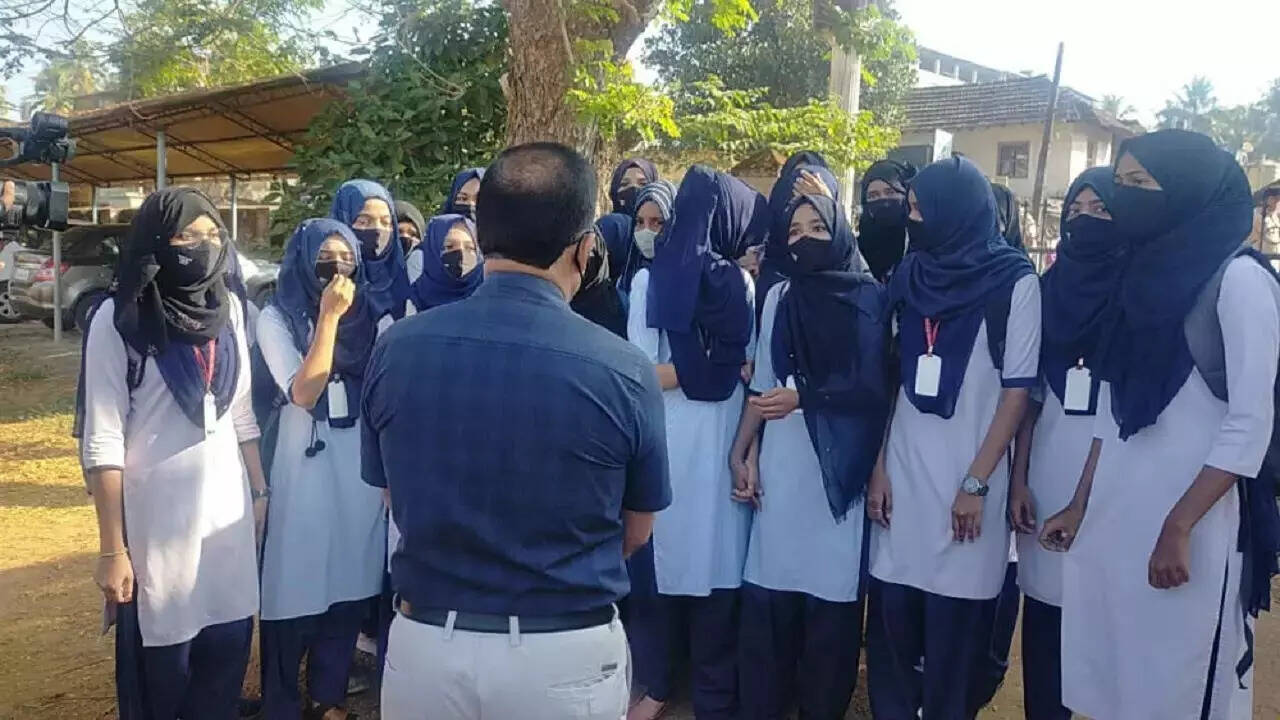
BENGALURU: Legal experts appear to be divided on the raging controversy over colleges not allowing Muslim students to attend classes wearing the hijab (headscarf) along with the uniform in Udupi district.
While a section is backing the decision of the colleges, others are supporting the students. The matter is now before the high court, which will take up the case on February 8.
BV Acharya, senior advocate and former advocate general of Karnataka, said the government is well within its right to impose uniform code in its colleges and students need to abide by it. He cited the Allahabad high court verdict delivered in August last year, refusing to allow a suspended Muslim policeman to keep a beard while in service, saying it violates official orders and he can’t seek protection under Article 25 of the Constitution.
Senior advocate Uday Holla said dress code in classrooms should not indicate faith or religion as it creates barriers between students as well as teachers. “Imagine if all students of different religions start attending classes wearing their respective religious costumes. The main concept of school uniforms is to maintain uniformity. Uniforms also help instil a sense of camaraderie among students from different castes, religions and cultures,” Holla opined.
Ashok Harnahalli, senior advocate and former advocate general of Karnataka, said students have to come with a feeling of unity and that’s the reason the government has introduced the uniform code. “Anything which affects unity and gives scope to groupism should not be encouraged. There shouldn’t be saffron shawls either on campus,” he said.
Senior advocate K Diwakar, who was adviser to CM in 2008, said all Muslims in India are governed by the Muslim Personal Law (Shariat) Application Act, 1937. This law deals with marriage, succession, inheritance and charities and dress code. “This law clearly protects the right of Muslim women to wear hijab or burqa,” he added.
BT Venkatesh, senior advocate and former state public prosecutor of Karnataka high court, said people from other religions such as Hinduism are allowed to wear bindis and bangles. So, not allowing hijab selectively targets Muslims. “Hijab should be seen just as a headgear. Even some Christians wear it in a few countries. There shouldn’t be a problem wearing hijab as long as students are wearing uniform along with it,” he said.
He said wearing of hijab by Muslim students is protected by the fundamental right to practise one’s religion under Articles 19 and 25. “Thus, any uniform code issued by the state government would not stand if students claim their constitutional right,” he added.
Another advocate, N Venkatesh, said several courts have held the right to wear hijab. In 2016, when AIIMS prohibited hijab-wearing aspirants from appearing for the entrance exam, Kerala high court ruled that students might take the exam while wearing hijab as it was an essential practice of the aspirants’ religious faith.
But most of the advocates insisted the Centre bring in a legislation in Parliament for clarity on the uniform code.