BENGALURU: The rain deficit of Karnataka, as a whole, has shrunk to 8 per cent from a peak of 47 per cent noted at the end of August. In the four months of the southwest monsoon, which officially concluded on Thursday, the state received 787mm of rainfall as against the normal figure of 852mm.
According to the Karnataka State Disaster Management Authority (KSDMA), after excess rainfall in June and July, there was a prolonged dry spell in August and the resulting deficit was the highest in four years. “But these figures are regarded as normal because plus or minus 19 is considered normal. These are national standards,” said Manoj Rajan, commissioner, KSDMA.
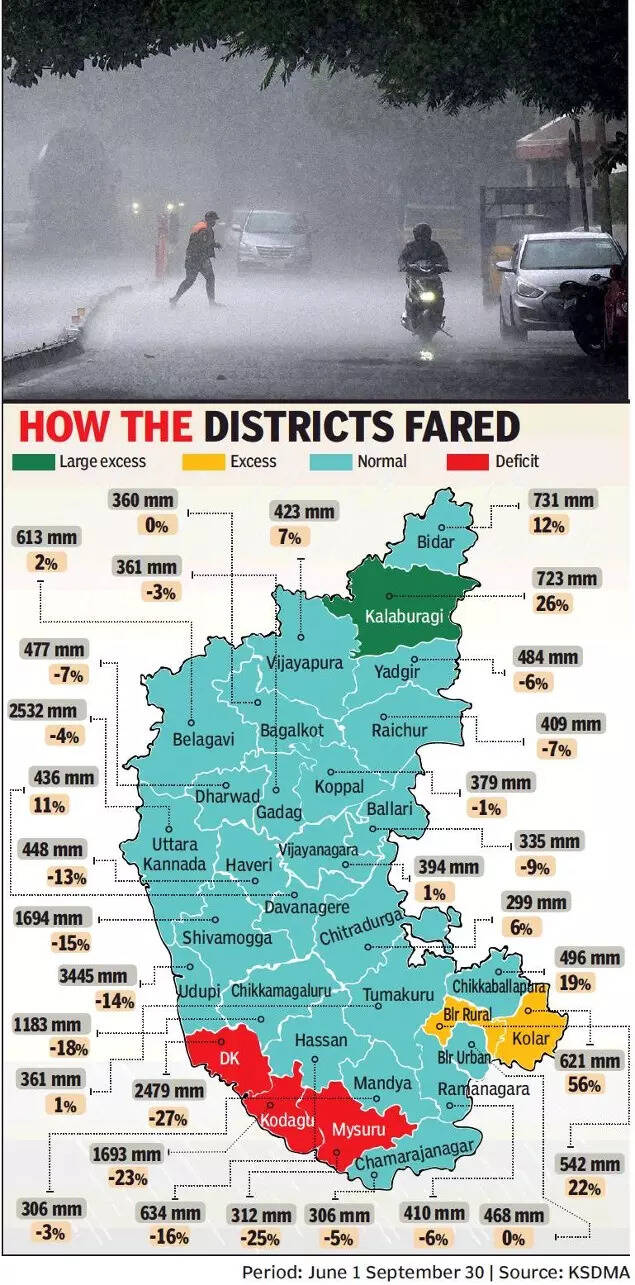
The highest rainfall deficiency was seen in the Malnad (Western Ghats) and coastal regions, which generally receive strong showers during the season. The Malnad region got 1,284mm of rainfall as against the normal level of 1,556mm. This is an 18 per cent departure from normal. The coastal region recorded 2,692mm compared to the normal figure of 3,101mm, a 13 per cent departure.
Both south and north interior Karnataka recorded a 4 per cent departure from normal, as per the KSDMA data.
Surprisingly, the arid district of Kolar received its highest rainfall in 61 years: 621mm as against the normal level of 398mm. In terms of percentage, it’s 56 per cent higher. Dakshina Kannada received the lowest rainfall of 2,479mm, a 27 per cent deficit.
“In June and July, the state received regular rainfall, which led to good sowing of crops in the state. The monsoon was weak in August because of lack of development of weather systems like depressions and circulations. As a result, there was a rain deficit. Things returned to normal in September, mainly from the second week, because of Cyclone Gulab,” Rajan said.
The sowing of kharif crops progressed at a steady pace despite rain deficiency in several parts of the state. Rajan said that it went up to 59 lakh hectares, better than the five-year average of 48 lakh hectares, because of good rains in June and July, and it reached the set target of 77 lakh hectares by September. “We expect the agriculture output to be good this year too,” he added.
In 2020-21, the state’s food production was 154 lakh tonnes, an all-time record. It was 141 lakh tonnes in 2019-20. The average output is 115 lakh tonnes.