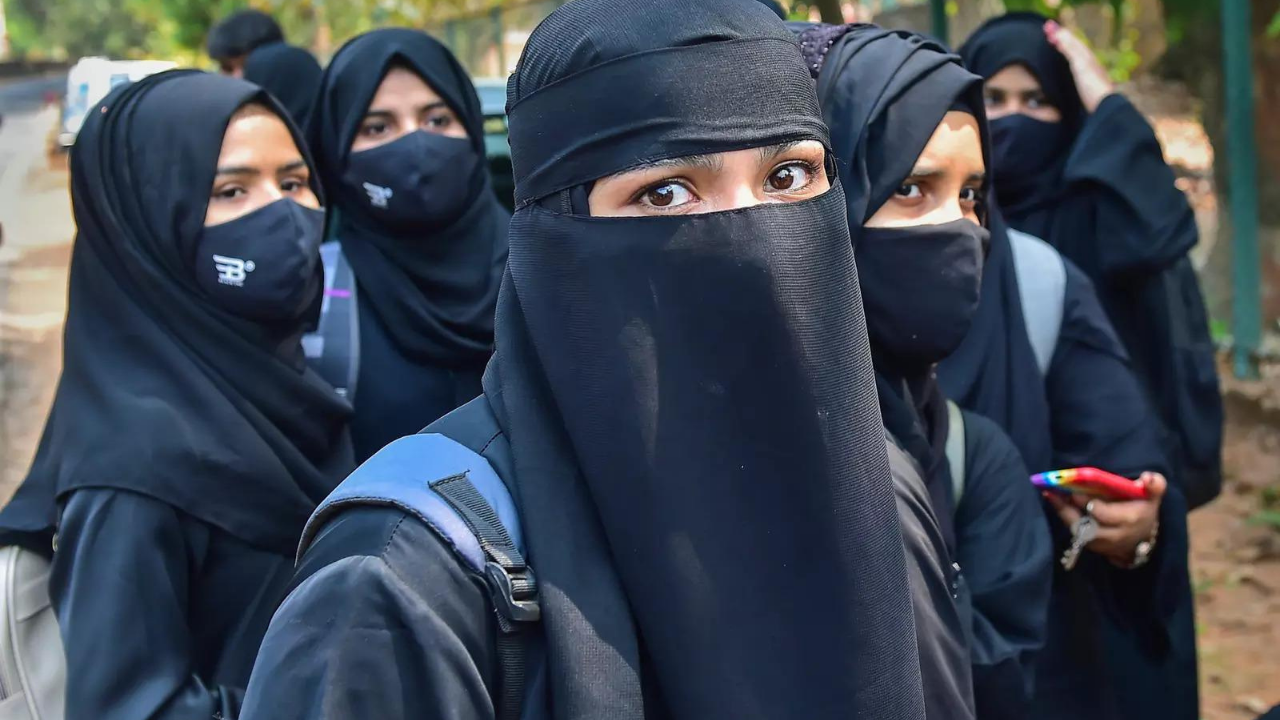
The Karnataka high court ruled on Tuesday that wearing the hijab is not an essential religious practice of Islam and upheld a state government order on adhering to uniform in educational institutions. The court dismissed a batch of petitions saying not being allowed to wear the headscarves in class violates fundamental rights.
On demand to remove the dress code
It is too far-fetched to argue that the school dress code militates against the fundamental freedoms guaranteed under Articles 14, 15, 19, 21 & 25 of the Constitution and therefore, the same should be outlawed by the stroke of a pen.
On school uniform
School uniforms promote harmony and spirit of common brotherhood transcending religious or sectional diversities. This apart, it is impossible to instil scientific temperament which our Constitution prescribes as a fundamental duty vide Article 51A(h) into the young minds so long as any propositions such as wearing of hijab or bhagwa are regarded as religiously sacrosanct and therefore, not open to question.
On hijab being essential religious practice
There is absolutely no material placed on record to prima facie show that wearing of hijab is a part of essential religious practice in Islam and that the petitioners have been wearing hijab from the beginning. This apart, it can hardly be argued that hijab being a matter of attire, can be justifiably treated as fundamental to Islamic faith. It is not that if the alleged practice of wearing hijab is not adhered to, those not wearing hijab become the sinners, Islam loses its glory and it ceases to be a religion.
Equal opportunity & positive secularism
There is a lot of scope for the argument that insistence on wearing of purdah, veil, or headgear in any community may hinder the process of emancipation of woman in general and Muslim women in particular. That militates against our constitutional spirit of ‘equal opportunity’ of ‘public participation’ and ‘positive secularism’. Prescription of school dress code to the exclusion of hijab, bhagwa, or any other apparel symbolic of religion can be a step forward in the direction of emancipation and more particularly, to access to education. This does not rob women of their autonomy or right to education inasmuch as they can wear any apparel of their choice outside the classroom.
On need to contextualise ‘rights’
All rights have to be viewed in the contextual conditions which were framed under the Constitution and the way in which they have evolved in due course. As already mentioned above, the Fundamental Rights have relative content and their efficacy levels depend upon the circumstances in which they are sought to be exercised. To evaluate the content and effect of restrictions and to adjudge their reasonableness, the aforesaid tests become handy.
On petitions not involving Right to freedom or privacy
The petitions we are treating do not involve the right to freedom of speech and expression or right to privacy, to such an extent as to warrant the employment of these tests for evaluation of argued restrictions, in the form of school dress code.
Object of prescribing uniform
The statutory scheme militates against sectarianism of every kind. Therefore, the accommodation which the petitioners seek cannot be said to be reasonable. The object of prescribing uniforms will be defeated if there is non-uniformity in the matter of uniforms.
On seeking reasonable accommodation
Counsel for the petitioners passionately submitted that the students should be permitted to wear hijab of structure and colour that suit the prescribed dress code. In support of this, they bank upon the ‘principle of reasonable accommodation’. They drew our attention to the prevalent practice of dress codes/uniforms in Kendriya Vidyalayas. We are not impressed by this argument. If such a proposal is accepted, the school uniform ceases to be uniform. There shall be two categories of girl students viz., those who wear the uniform with hijab and those who do it without. That would establish a sense of ‘socialseparateness’, which is not desirable.
Freedom of conscience and constituent assembly debates
Freedom of conscience as already mentioned above, is in distinction to right to religion as was clarified by Dr BR Ambedkar in the Constituent Assembly Debates. There is scope for the argument that the freedom of conscience and the right to religion are mutually exclusive. Even by overt act, in furtherance of conscience, the matter does not fall into the domain of right to religion and thus, the distinction is maintained.
No evidence for argument
No material has been placed before us for evaluation and determination of pleaded conscience of the petitioners. They have not averred anything as to how they associate wearing hijab with their conscience, as an overt act. There is no evidence that the petitioners chose to wear their headscarf as a means of conveying any thought or belief on their part or as a means of symbolic expression.
On petitioners’ allegation of haste in issuing go
That the contents of the government order give this impression, is true. However, that is too feeble a ground for faltering a policy decision like this. At times, regard being had to special conditions like social unrest and public agitations, governments do take certain urgent decisions which may appear to be knee-jerk reactions. However, these are matters of perceptions.
On argument of freedom of conscience
Some of the petitioners vehemently argued that, regardless of right to religion, the girl students have the freedom of conscience guaranteed under Article 25 itself and that they have been wearing hijab as a matter of conscience and therefore, interdicting this overt act is offensive to their conscience and thus, is violative of their fundamental right. . . Merely stating that wearing hijab is an overt act of conscience and therefore, asking them to remove hijab would offend conscience, would not be sufficient for treating it as a ground for granting relief.