
BENGALURU: When the prosecution’s theory in totality gives scope for genuine doubts, the benefit should be extended only to the accused, the Kalaburagi bench of the high court observed while coming to the rescue of a man convicted of killing his wife.
“This court thinks that even though the prosecution examined several witnesses and marked several documents, there is no positive, corroborative and cogent evidence to probabalise beyond reasonable doubt that the accused has eliminated his wife Sridevi,” a division bench headed by justice K Somashekar observed while acquitting Gangappa, a resident of Neermanvi village in Manvi taluk of Raichur district. Gangappa had spent over eight years in jail.
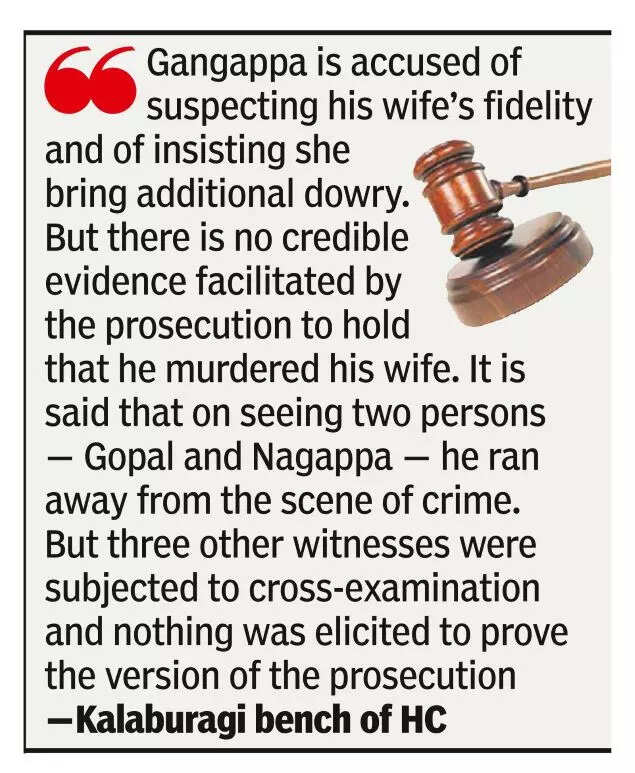
The case of the prosecution is that around 7.15pm on April 24, 2014, Gangappa picked a quarrel with his wife, suspecting her fidelity, and assaulted her with the wooden leg of a cot before fleeing. With serious injuries on her right ear, head, forehead and face, Sridevi died at a hospital. Gangappa was arrested for murder while his parents and brother were charged with harassing Sridevi.
On December 27, 2017, the principal district and sessions judge in Raichur convicted Gangappa and sentenced him to undergo rigorous imprisonment for life and pay a fine of Rs 50,000 for murder. In addition, he was sentenced to three years imprisonment and fined Rs 25,000 for offence punishable under IPC section 498a. The other accused were acquitted.
In his appeal, Gangappa contended that there are no material witnesses relating to the direct, overt acts attributed to him and there are no eyewitnesses to say he assaulted Sridevi. It was further contended that there is no proof that Gangappa showed cruelty towards his wife or demanded dowry and that the charges made against the other accused were also not proved.
After perusing the evidence, the bench noted that the benefit of the doubt had been extended only to the other co-accused.