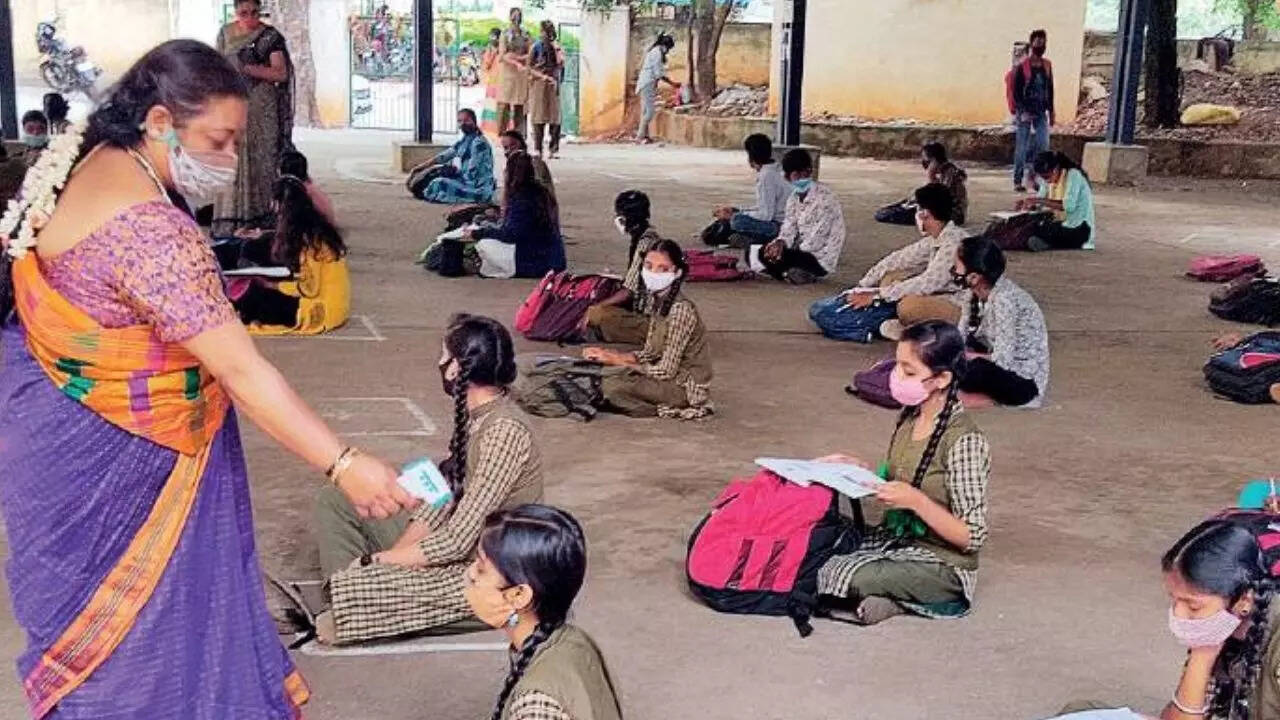
BENGALURU: The government is likely to take a decision on reopening schools for classes 1 to 5 only after Dasara and after reviewing Covid-19 situation prevailing then. Currently, schools are open for students of classes 6 to 12 and 100% attendance is allowed.
The topic of reopening schools was discussed at a meeting between Technical Advisory Committee members and senior health department officials on Sunday. Incidentally, the primary and secondary education department had sought directions from the TAC on the issue.
“There is no surge in Covid cases among children, but other viral and parainfluenza diseases, which are normal in August and September, are being reported from various districts,” sources said. “The issue will be discussed post Dasara.”
TAC’s report on Sunday also referred to the increase in outpatient screening and inpatient admission of children in hospitals. However, it said that of the 34,656 children whose swab samples were tested for Covid, only 27 (less than 1%) tested positive. Eighteen of them were from rural areas.
Deaths due to Covid in children too are rare. The TAC emphasised increasing surveillance, particularly among schoolgoing children from classes 6 to second PUC (class 12). Experts say whenever a decision is made to reopen schools for lower classes, standard operating procedure (SOP) will be issued. However, parental consent letters and attendance will be voluntary.
“Initially, 50% of class strength will be allowed for half a day and on alternate days. Strict enforcement of Covid-19 protocol in school premises and transportation shall be followed,” the report said.
The committee which also reviewed genomic sequencing reports said sublineges of Delta variant have not had serious public health consequences and Delta was infectious, but not virulent.
Resume schooling
Meanwhile on Monday, members of National Coalition on Education Emergency (NCEE) submitted a memorandum to the state primary and secondary education department, urging it to reopen schools for lower classes too.
It said while lockdowns and livelihood emergencies are visible, a “silent and invisible emergency is threatening to wipe out livelihoods of the poor and access to a life of dignity and equality”.
Niranjan Aradhya and Gurumurthy Kasinathan, both members of NCEE, in their letter to the education department, said thousands of children who have lost one or both parents and millions affected by job and income losses, will need to make a painful choice between working to support their families and returning to school.
“School closures have aggravated malnutrition, child abuse, dropout rates among students, early marriages and child labour. This is what we refer to as an education emergency,” Aradhya said, adding the need of the hour is to reopen schools for all.