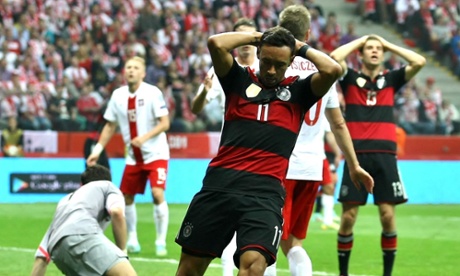
When Karim Bellarabi trudged off the pitch in the National Stadium in Warsaw and had the microphone shoved up his nose for the post-match interview, his eyes glazed over and he looked into the distance. He muttered his way through the questions, his disappointment as obvious as the joy of the booming Polish fans around him.
There was, of course, good reason for Bellarabi’s disappointment. Germany had just lost 2-0 to Poland, their first defeat to their eastern neighbours in 19 games. Besides that, the reverse meant the loss of a proud away record that had seen die Nationalmannschaft go undefeated away from home in European Championship qualifiers since October 1998 and as well as all that, it meant a losing debut for the Bayer Leverkusen player. Yet of all the German players, Bellarabi was one of the few who could leave with a sense of pride in his performance.
The starting XI was shorn of Bastian Schweinsteiger, Sami Khedira, Benedikt Höwedes and Mesut Özil but it still contained nine players who were part of the summer’s World Cup squad. Unfortunately for Germany, far too many underperformed. Toni Kroos passed and passed but too often failed to impose himself on the game. Mario Götze flickered but only in spells and André Schürrle worked hard but was wasteful. Thomas Müller, meanwhile, passed up two excellent opportunities to score in the first half and was almost a bystander for the second.
In contrast, Bellarabi’s runs, intelligent sense of positioning and speed meant that he was a consistent threat down the right wing where he started and down the left flank when he occasionally switched with Schürrle. He also came within inches of giving Germany the lead in the 37th minute. Kroos spread the ball wide on the right to find Götze. He floated a pass into the space at the back post. Bellarabi met the cross at the corner of the six-yard box with an arrowed drive that Wojciech Szczesny could only watch as it went wide. He later came close to dragging his side back into the game. With Joachim Löw’s side trailing to Arkadiusz Milik’s goal, Germany passed and Bellarabi moved. With the trigger pulled, only a last-ditch tackle from Kamil Glik saved the day for Poland.
But it was not just Bellarabi’s array of attacking talents that impressed. The midfielder consistently worked hard, helping out his fellow competitive debutant and right-back, Antonio Rüdiger. He tackled, tracked back and helped to ensure Poland had little luck down the right. So impressed was his manager that Bellarabi played the entire 90 minutes, the only player to ever do so in his first game under Löw. Bellarabi said afterwards that he “quite pleased” with his debut and Löw has since confirmed him as a certain starter for the game against Ireland. That news should provide a certain headache for Martin O’Neill.
The Republic of Ireland manager has suggested that his side, buoyed by their six points from two games, will not park the bus but instead go on the attack against Germany. “If we go down but have given it a proper go, I can live with that,” he said. “If we are sitting in all evening and get done because we’ve not made a go of it, I wouldn’t see the point in that.” Fine words for the fans but the danger with such an approach is that it could lead to plenty of space being left between the midfield and defence for Bellarabi and co to exploit. Germany missed an astonishing 22 attempts on goal on Saturday evening. Give them any space and they are unlikely to be as generous in Gelsenkirchen.
Instead of a boisterous attacking plan, O’Neill should instead look to how Adam Nawalka’s side played. They left Robert Lewandowski up front, sat deep and used their speed on either side of the pitch to hit Germany where it hurts the most, on the counter. This is especially true of the left hand-side where Erik Durm had a poor game and where both of Poland’s goals came from. With this in mind, O’Neill should consider opting for James McClean and Aiden McGeady, two players who have the necessaries to get in behind the opposition (but who can also be instructed to stay deep when Germany have the ball), as well as Wes Hoolahan.
O’Neill was cautious when quizzed about the latter’s chances of starting – “we might have to go in with a bit of strength” – but as he showed against (an albeit second-rate) Gibraltar, he is one of the few players at O’Neill’s disposal that has the passing range to find the runs of the wingers and forwards and to potentially exploit the German defence’s high line. With two sitting-minded midfielders behind him to help close the space and deal with counterattacks, Hoolahan could be the man around which Ireland’s ability to take something from the game rotates.
The defeat to Poland led some to joke that Germany’s time is already over. That is utter nonsense, of course, but as the Polish showed, there are chinks in their armour that can be exploited. Add Germany’s swelling injury list to those problems and there is a sliver of hope for Ireland that this will not be the walkover that many have predicted.