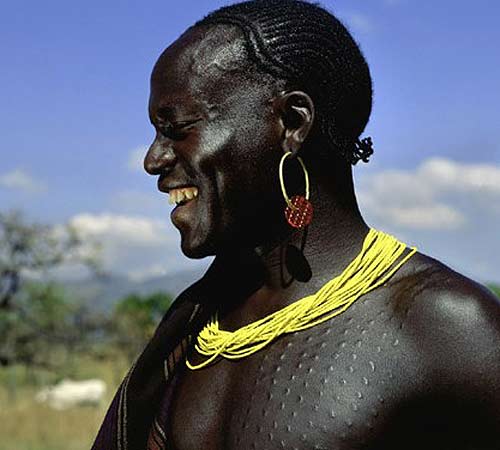
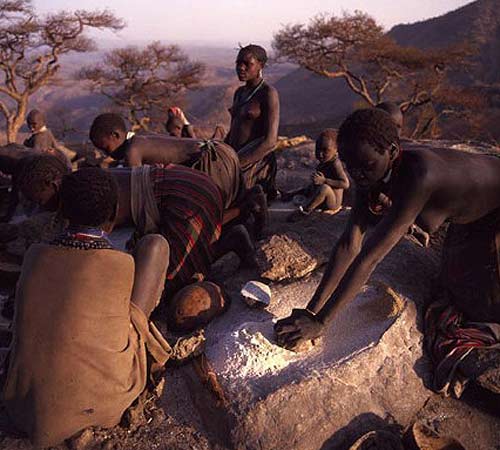
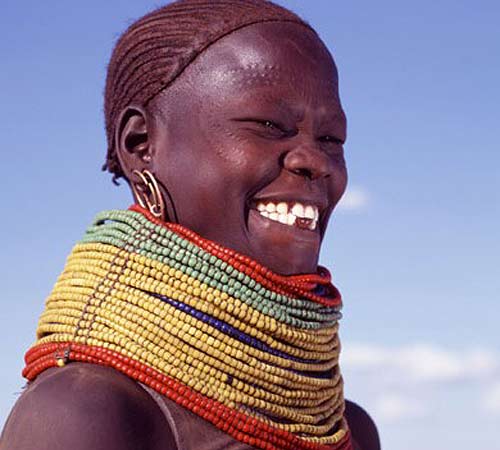
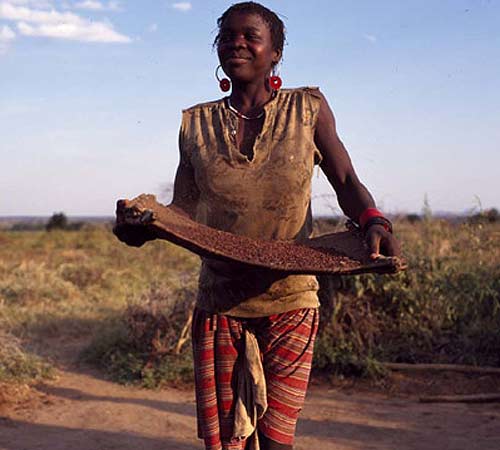
The Karamojong are warriors. To call them governable is not really the phrase I would use. They are proud and fierce and always have been. They were grossly abused by the Amin government and they had actually been ignored up until recently by the Museveni government. The citizens who live in the city tend to think of them as ungovernable savages, which is a really unfortunate characterisation. When you have an army machine-gunning them, you can understand why they don’t really have a lot of warmth for the governmentPhotograph: David Pluth/David PluthThe Smiling Killer. Some people suspend their concept of death when they kill something; they don’t think that death applies to them. So you’ll see someone kill a dog and just as easily kill a person. The Karamojong have, I would say, a certain reverence for life, but they will kill you easily if they need to. These are people who wince if they kill a fly, but if they have to shoot you they willPhotograph: David Pluth/David PluthWomen grinding. Natural death is a different thing. Part of it has been obscured and affected by the fact that particularly in the major cities, there has been a conversion to Christianity so you don’t really see a tribal concept of death. In Karamoja, there’s a sense of respect for the elderly and a sense of remorse at the death of a great personPhotograph: David Pluth/David Pluth
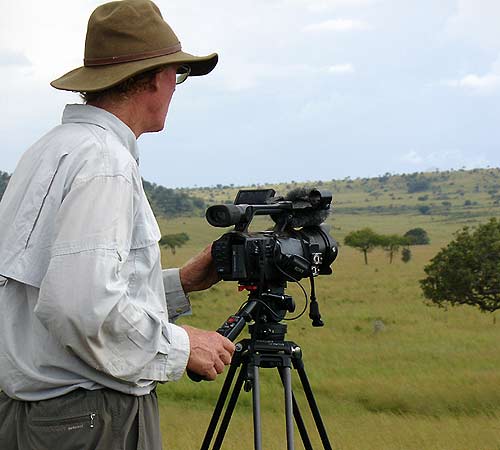
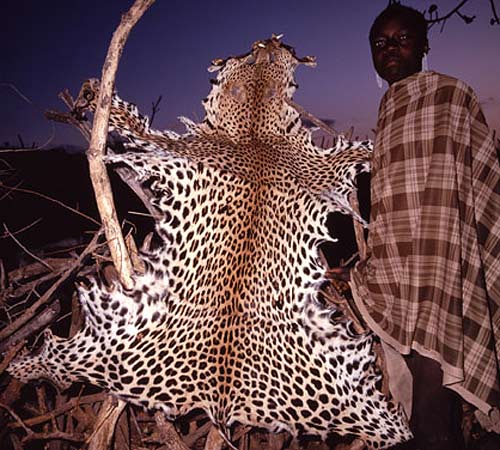
What approach do I take when photographing subjects? There is no substitute for time. You can’t walk into a village, accost some poor woman or child or man in front of their home and come away in an hour with some answers. It doesn’t work that way. You just have to drop all your preconceptions about right and wrong, sit down and watch, until the people are bored with your presencePhotograph: David Pluth/David PluthThe leopard poacher. I saw a warrior, a guy with scars on his body who has killed people, carrying a sick lamb, carrying it for miles to go seek out a veterinarian in some obscure little outpost. He has an economic interest, but he could just as easily eat the lamb and not have to carry it. There is a certain sense of companionship and unity with these animals; they become a part of your family, part of your lifePhotograph: David Pluth/David PluthThe quintessential Karamojong woman. A man and a woman had been living together for a number of years and I was at the negotiation ceremony for the bride’s price. The women are valued in financial terms and this woman went for the price of about 130 cows plus a lot of sheep and goats. She was settled, she had children, so they were of value, the fact that she was healthy and strong and could manage the household, all these were important things. Also, the fact that she genuinely had a deep affection for her husband and he had a deep affection for her was another part of the value system. The husband was willing to pay a lot of wealth to be able to keep the wife and children because if he didn’t, the wife’s family would be allowed to claim themPhotograph: David Pluth/David PluthThat woman was very strong and outspoken. She watched the negotiation, in which you have two adversarial sides: the husband’s supporters and the wife’s supporters - her family. The husband and the father of the bride were great friends except, during this ritual they had to shout insults at each other and shake their fists and they would then walk back to their supporters laughing. The woman finally stood up and ran across to her husband, turned to her family and said: “That’s enough, that’s enough.” It was like the final, unifying incident of the marriagePhotograph: David Pluth/David Pluth
Sign up to read this article
Read news from 100’s of titles, curated specifically for you.