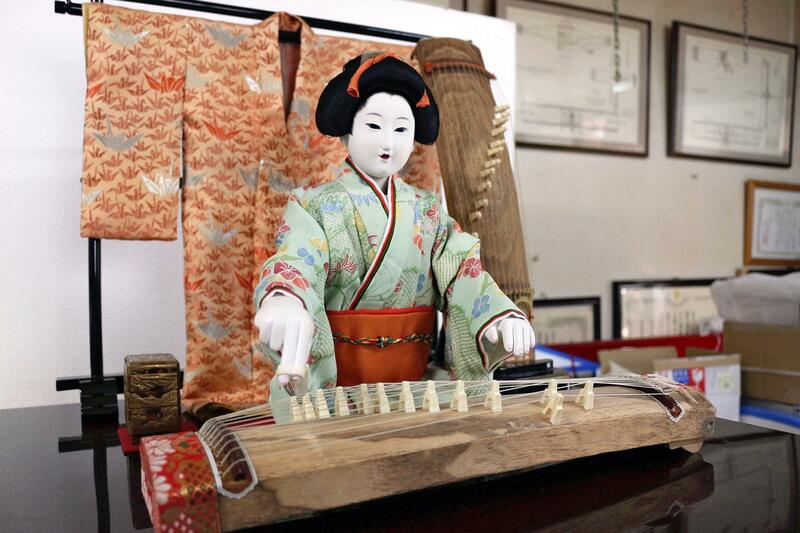
OSAKA -- It took eight years of painstaking work, but Susumu Higashino, 71, of Neyagawa, Osaka Prefecture, has completed a first karakuri ningyo mechanical doll that can play songs on a koto traditional Japanese harp. There is no example of such doll in the world.
Higashino is renowned as a creator of mechanical dolls with complicated movements, including one that shoots a bow and writes letters. He has been honored as a Contemporary Master Craftsman by the Health, Labor and Welfare Ministry.
The koto-playing doll is regarded as the culmination of his outstanding skills. Making the doll with subtle movements similar to that of humans was a large challenge for Higashino.
"I hope various music-playing karakuri ningyo will be created based on this very first one," Higashino said, expressing hope for more of these to be built in the future.
The creation of the doll was not an easy task for Higashino, who is unable to freely move the right half of his body due to aftereffects of a stroke he suffered in 2011. But with the help of his son and successor, Hideki, 35, in making minor adjustments, the doll-making master completed the doll in late December.
The karakuri ningyo plays the traditional Japanese songs "Sakura Sakura" and "Kojo no Tsuki" (The Moon over the Ruined Castle). Powered by a wind-up spring, the kimono-clad doll moves its right arm and plucks the koto strings accurately with a pick attached to its thumb. It plays the songs for about a minute each.
The doll operates based on a disk-shaped component called a cam, which sits inside the base. The cam is engraved with small bumps and dips. Interlocking components read the bumps and dips on the rotating cam to control the doll's movements. By changing the shape of the cam, the doll can be made to play different songs.
One of the main features of the doll is that its upper body moves back and forth. Higashino made it possible for the doll to pluck each of nearly 10 strings by adjusting the angle of its bent-forward posture.
The doll will be on display at the Edo-Tokyo Museum in Sumida Ward, Tokyo, in late July. "We are going to make the doll as one of the highlights of our shows next fiscal year," said Kaoru Matsui, a curator at the museum.
Higashino said: "The word 'hard' is not enough to describe the efforts involved in the creation of this unprecedented karakuri ningyo. I can hardly wait until many people enjoy the performance."
--Popular during Edo period
The origin of karakuri ningyo goes back to ancient times.
"Konjaku Monogatarishu," a collection of anecdotes compiled in the Heian period (794-late 12th century), describes a doll that sprinkled water on rice fields to prevent drought. The mechanisms of karakuri ningyo developed with the introduction of clock technology from the West during the Edo period (1603-1867),
Osaka has a deep connection to karakuri ningyo. Takeda Omi, who is said to have been a clockmaker, started a karakuri ningyo show in the Dotombori district of Osaka in 1662. The show, in which puppets wrote letters and performed acrobatics, was tremendously successful. It was so popular that people said if you don't see the show, you can never say you have been to Osaka.
The doll performances toured throughout the nation and spread as popular entertainment.
Hisashige Tanaka, the founder of Toshiba Corp., also developed karakuri ningyo and organized a mechanical doll show in Dotombori in 1824. Tanaka left behind many outstanding dolls, including a childlike doll that shoots a bow.
The influence of karakuri ningyo endures to this day in ningyo joruri traditional puppet theater.
Takemoto Gidayu, who laid the foundations of ningyo joruri, founded the puppet troupe Takemoto-za in Dotonbori about 20 years after Takeda's first performance.
It is said that Takeda Izumo, a member of the Takeda family, took charge of the management of Takemoto-za and introduced karakuri ningyo techniques to the puppet movements and stage direction of ninyo joruri.
Read more from The Japan News at https://japannews.yomiuri.co.jp/