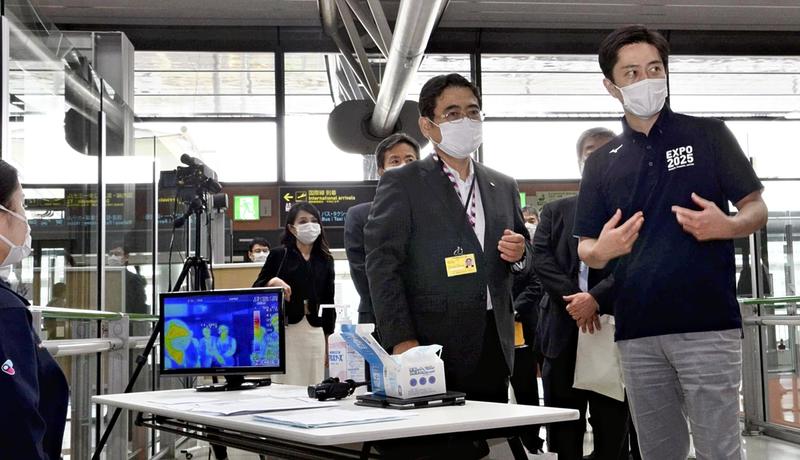
Amid growing concerns over a second wave of novel coronavirus infections, a number of people arriving at Kansai International Airport from overseas recently have tested positive for the virus.
As of Saturday, 21 infections had been confirmed at that location since early June.
Government policy is to gradually reopen the country to foreign travel, with experts calling for a strengthening of border measures.
The government is generally refusing entry to people from 129 countries and regions. Entry is limited to Japanese citizens, permanent residents with reentry permits, spouses of Japanese citizens, and aircraft and ship crew members.
Almost all of these people must undergo PCR testing, and even if confirmed negative, are required to self-isolate at home or some other accommodations for 14 days.
The infected people entering through Kansai Airport included 14 who spent time in the Philippines and three who were in Indonesia, as well as foreign crewmembers on ships that docked in Japan to change personnel, according to the Health, Labor and Welfare Ministry and other sources. All were asymptomatic except for one person who had a fever.
About three to five international flights arrive at Kansai Airport each day. The number of infected cases is lower than figures both from Haneda and Narita airports.
Most are transported to the Rinku General Medical Center in Izumisano, Osaka Prefecture, where for a time 10 of the beds set aside for coronavirus patients were occupied by people who had just entered the country. On July 10, seven people coming from the Philippines were taken to the center.
Masaya Yamato, director of the institution's Infectious Diseases Center, said, "Kansai Airport, like the Tokyo metropolitan area, needs a place that can accommodate asymptomatic people. If the number of people entering the country increases, there is a risk that some may slip past the quarantine."
Read more from The Japan News at https://japannews.yomiuri.co.jp/