OSAKA -- In early September, Kansai International Airport marked 25 years since it opened on an island off the coast of the Senshu area in Osaka Prefecture. It was the world's first airport to be completely built on an artificial island in the sea. Many lessons and issues have emerged in its quarter-century history.
Controlling land subsidence
About 29 million passengers a year pass through Kansai International Airport's Terminal 1 building. The building itself doesn't sleep; in contrast to the glamorous image of taking to the sky, every night in the basement of the building work is being done unnoticed.
The building is supported by 900 columns, each of which is equipped with a sensor to measure land subsidence.
When the sensors detect that the columns have sunk a certain amount, engineers raise the columns one by one using hydraulic jacks, and place thin plates between the columns and the ground to keep them level. Such steady maintenance work has been carried out regularly, right up to the present time.
Kansai International Airport opened in 1994. As Osaka Airport, also known as Itami Airport, is located near residential areas, airplanes were not allowed to take off and land at night due to the serious noise problem. Thus, the airport was not able to handle increasing demand for air travel.
The solution was to use landfill to create an airport island in Osaka Bay as far as 5 kilometers off the coast. The airport became the first in the nation allowd to conduct around-the-clock operations, but it was also fated to fight land subsidence.
The 510-hectare first-phase island was built with 1 million sand pillars on a layer of soft clay at a depth of 18 meters. A draining technique was used to suck water from the ground in order to accelerate the sinking, as part of efforts to reduce the impact of subsidence after the airport opened.
Even so, the first-phase island has so far sunk by 3.4 meters, and the second-phase island by 4.4 meters, on average.
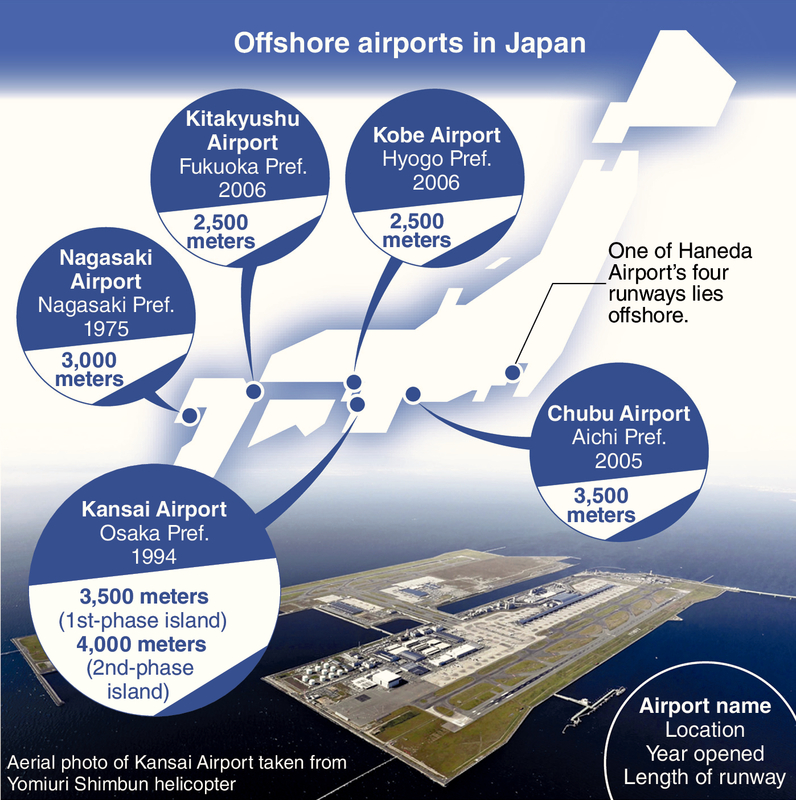
Nagasaki Airport, which opened in 1975, was established on the reclaimed island of Minoshima in Omura Bay, Nagasaki Prefecture. But Kansai International Airport was the world's first offshore airport constructed on a completely man-made island.
Constructing offshore airports is understandable for Japan, which has limited usable land. The airport served as a pioneer for Chubu Centrair International Airport, which opened in 2005, and Kobe Airport and Kitakyushu Airport, both of which opened in 2006.
Massive debt burden
Over time, the effect of the airport's offshore construction has spread in unexpected directions.
Kansai International Airport suffered a heavy debt burden stemming from 2 trillion yen in costs, including the construction of the second-phase airport island.
If the government did not inject money in the form of subsidies, the airport's management would become unstable. This distorted situation continued for many years.
Kansai International Airport had been operated as a joint public-private corporation under the policy of tapping private sector finances and business know-how, promoted by the administration of then Prime Minister Yasuhiro Nakasone.
However, the right to manage the airport was sold to Orix Corp. and Vinci Airport S.A.S. of France in 2016 under a formula called the concession method.
The concession method is a system in which the right to operate facilities is transferred to private companies for a certain period of time, while ownership of the facilities and land remains with the central and local governments. The method, part a of private finance initiative, or PFI, was introduced when the PFI Law was revised in 2011. The method is used for public facilities such as airports and expressways where tolls are collected, and is meant to use private sector funds and expertise to improve services in ways that reflect users' needs.
The airport is receiving about 49 billion yen a year for 44 years in compensation for the transfer. In making this decision, the airport climbed on the bandwagon of a policy of utilizing infrastructure by making use of the management sense of private companies. The real aim was different, though -- the administrative rights sale was aimed at paving the way for the airport to repay its debts.
When the airport opened, no one could have imagined that offshore construction would trigger a shift to private management. In this way, Kansai International Airport has become a pioneer in spinning off airport operations to private sector entities, and privatization has spread to other airports around the nation.
Looking back, Kansai International Airport has for 25 years been the stage upon which the government has "experimented" in aviation policy. While its achievements have been used as a reference by other airports, tasks remain to be dealt with in the future.
Tsunami, high waves
Kansai International Airport was forced to shut down when Typhoon No. 21 hit western Japan on Sept. 4 last year, coincidentally the anniversary of the opening of the airport. The typhoon flooded runways and power supply facilities.
The airport had taken preventive measures against tsunami and high tides by raising a seawall and taking other steps. Although it had said it was able to "withstand the kinds of disasters that occur once every 50 years," its vulnerability was exposed by record-high waves of about 5 meters.
Kansai Airports, which operates the airport, is now speeding up efforts to move its power supply facilities above ground.
It is premature to judge whether private management has succeeded or failed. Right after last year's typhoon, the chain of command was disrupted and the government had to intervene.
Kansai Airports' business performance has become brisk, having been revived by an explosive increase in the number of visitors to Japan. "We have yet to go through severe trials," a senior official of the airport said.
The airport has undergone a process of trial and error over whether it can serve as a good example for airport management, including disaster prevention capabilities. This approach will continue into the future.
Read more from The Japan News at https://japannews.yomiuri.co.jp/