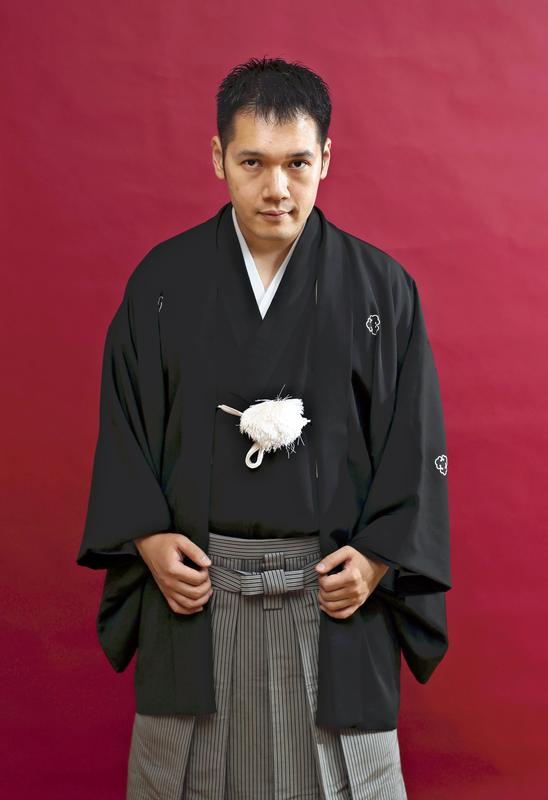
"A once-in-a-century genius." "Prodigy of the times." "This era's star." "A man who changes history."
That's some of the praise used to describe rising young kodanshi storyteller Kanda Matsunojo. A kodanshi is a perfomer of kodan, a storytelling art form similar to rakugo. But while a rakugo storyteller relates mostly comical tales in which he or she performs both sides of amusing dialogues, a kodan storyteller relies primarily on straight narration, and the stories are often more dramatic than funny.
Kodan enjoyed its peak from the end of the Edo period (1603-1867) to the middle of the Meiji era (1868-1912). However, by the mid-Showa era (1926-1989), the number of kodanshi decreased to only about 20 storytellers.
Matsunojo, 36, is striving to revive the traditional performing art -- which until recently had been described as an endangered species -- in the Reiwa era. Matsunojo, who has a 12-year career under his belt, is expected to be promoted to the top rank of shinuchi from his current secondary rank of futatsume. With his new rank, he will take up the name Kanda Hakuzan, a very prominent kodan master's name.
"In the past year, I haven't had more than 10 days off," Matsunojo said in a recent interview. "It's like I'm conducting a human experiment on how long people can work."
Tickets for his solo shows, in front of audiences of about 1,000, sell out immediately. He hosts TV and radio programs, and also appears on popular TV shows as a guest.
Matsunojo performs kodan all over the country. While traveling by train or plane, he checks the writings that he submits to magazines and learns and memorizes new kodan stories.
Although he is extremely busy, he has no intention of slowing down.
When asked why, Matsunojo said: "It's because I want to spread the charm of kodan as much as possible. I want to increase the number of people who want to listen to kodan in person. [Staying busy is] like handing out business cards [to as many people as possible]."
Analysis and confidence
In his youth, Matsunojo initially became interested in rakugo, not kodan. As a high school student, the culturally precocious teenager listened over and over to recorded performances of the late Sanyutei Ensho, known as the rakugo master of the Showa era, as well as Tatekawa Danshi.
"Looking back at that time, I was fascinated by the superb performances of long stories by Master Ensho as well as the loneliness created in the story 'Rakuda' [Camel] by Master Danshi," he said. "As a result, through rakugo, I came to understand the appeal of kodan."
From there, he contemplated what he wanted to do, and researched how to go about it. In his university days, he decided to become a professional in one of the three major traditional oral arts -- rakugo, kodan or rokyoku (another form of storytelling accompanied by tunes played on the shamisen).
At the same time, he went to see as many performances as possible of pro wrestling, movies, kabuki, bunraku, noh and kyogen, as well as shows by the Takarazuka Revue and Shiki Theatre Company.
"I may not have fully understood them," Matsunojo recalled. "But I was exposed to different elements of various performing arts." He believed it would benefit him as a professional storyteller "to have the viewpoint of an audience member."
As the aspiring storyteller experienced various entertainment styles and compared them with each other, he realized he liked kodan the best and would be the most suited for it.
Half a year after graduating from university, Matsunojo knocked on the door of kodan luminary Kanda Shori, becoming Shori's pupil in 2007 after realizing that not only were the master's performances excellent, but Shori was also a man of noble character.
Last year, Shori was named a living national treasure, the second person from the kodan world to be honored in this way. In becoming Shori's pupil, Matsunojo demonstrated the proverb, "Choosing a master is also an art."
Strong ambitions
Matsunojo has already mastered more than 140 stories he can perform with characters ranging from the great swordsman Miyamoto Musashi, to a villain who seeks to topple the Edo shogunate and even a ghost harboring a major grudge. Matsunojo brings Edo-period characters to life with his intensely energetic performances.
On Nov. 23 last year, Matsunojo was the show closer of a presentation by several oral performers at the National Engei Hall in Tokyo. Matsunojo performed the beloved "Nakamura Nakazo" before a packed house.
"Nakamura Nakazo" is the story of an Edo-period kabuki actor of that name who rose to stardom despite earlier hardships. In the story, Nakazo puts all of his effort into performing roles to try to attract audiences and subsequently earns fame. It is a story that is also performed in rakugo and rokyoku.
As Matsunojo himself is not from an elite or noble family, he superbly presented the ambitions of the actor who rose from the bottom ranks of the kabuki world. Also, in Matsunojo's "Nakamura Nakazo," the characters of the actor's wife or his master do not appear, a contrast to other storytellers' versions of the tale.
"My image of Nakazo is that he was isolated and lonely," Matsunojo said. "That might change as I age, but one thing I can say for sure is that I have to try many different approaches because Nakazo tried many different approaches.
"If I didn't, it wouldn't be respectful to Nakazo, would it?" he added.
"Did they watch me in earnest?" Matsunojo's Nakazo emotionally muttered amid the audience's applause at the end of Nakazo's performance. To this writer, it was as if Matsunojo was asking this to himself.
"In the end, it's all about how much I can make the audience feel like they're watching a documentary. That's the real challenge," Matsunojo said.
If he were in the audience, would that audience wholeheartedly want to see this kodanshi?
On stage, with a dramatic motion of his flat paper baton, Matsunojo strikes the desk before him -- Bang! Bang! -- as he continues to reflect on his performance.
Kanda Matsunojo
Matsunojo, whose real name is Katsuhiko Furutachi, was born in Tokyo on June 4, 1983. He became a pupil of Kanda Shori in 2007 and was promoted to the rank of futatsume in 2012. In 2013, he created a group called "Narikin" with 10 other young rakugo performers to widen the scope of their act. In February, he will be promoted to the rank of shinuchi and take the prominent kodanshi name of Kanda Hakuzan.
Profile
Kanda Matsunojo, whose real name is Katsuhiko Furutachi, was born in Tokyo on June 4, 1983. He became a pupil of Kanda Shori in 2007 and was promoted to the rank of futatsume in 2012. In 2013, he created a group called Narikin with 10 other young rakugo performers to widen the scope of their act. In February, he will be promoted to the rank of shinuchi and take the prominent kodanshi name of Kanda Hakuzan.
Read more from The Japan News at https://japannews.yomiuri.co.jp/