
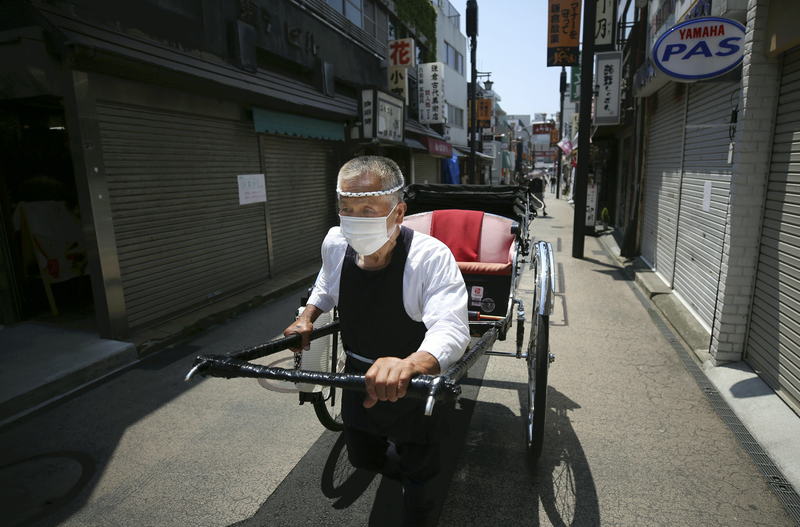
As the government continues to request self-restraint from leaving home, Noboru Aoki, 72, a rickshaw driver in Kamakura, Kanagawa Prefecture, makes his way around town with his rickshaw six days a week. While it's partially to maintain his endurance, he's also taken to social media to urge would-be visitors to refrain from coming to the area.
In a typical year, the shopping district Komachi Street, which connects Kamakura Station and Tsurugaoka Hachimangu shrine, is bustling with tourists and sightseers, but now many of the shops are closed.
"This time last year, [this area] was full of people and pulling my rickshaw was difficult," the 36-year veteran rickshaw driver said while looking out at the quiet town.
In 1984, he left his life as a salaryman behind and began working as a rickshaw driver guiding visitors around Kamakura. However, thanks to the new coronavirus, the number of visitors has dropped and since the declaration of the state of emergency almost all reservations have been canceled. In April, he saw only one customer. "It's gotten difficult now that my income has decreased," he said.
In late April, before the Golden Week holiday period, he took a photo of himself in front of his rickshaw wearing a mask, positioning his arms in the shape of an X and posted it to Facebook with a caption that read, "Please don't come to Kamakura Shonan."
At that time, the roads along the sea were congested with the cars of tourists and people were voicing their concerns over the risk of an infection outbreak. In order to resolve this, even one day sooner, now is the time to exercise self-restraint, he thinks.
In order to operate the 80-kilogram rickshaw, he must maintain his stamina. "I want to welcome everyone to the best of my ability once this is all over," Aoki says, continuing his training to be prepared for that day.
Read more from The Japan News at https://japannews.yomiuri.co.jp/












