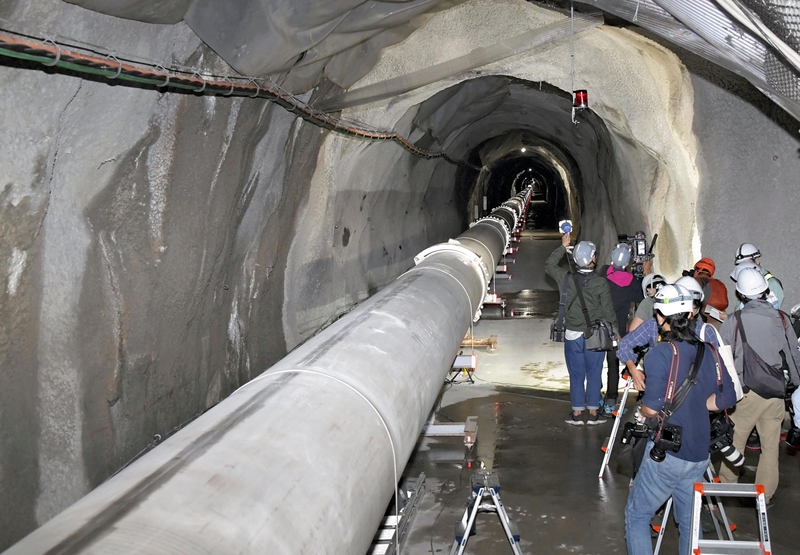
The Kagra gravitational wave detector was unveiled to the media on Monday by three research institutions involved in the project.
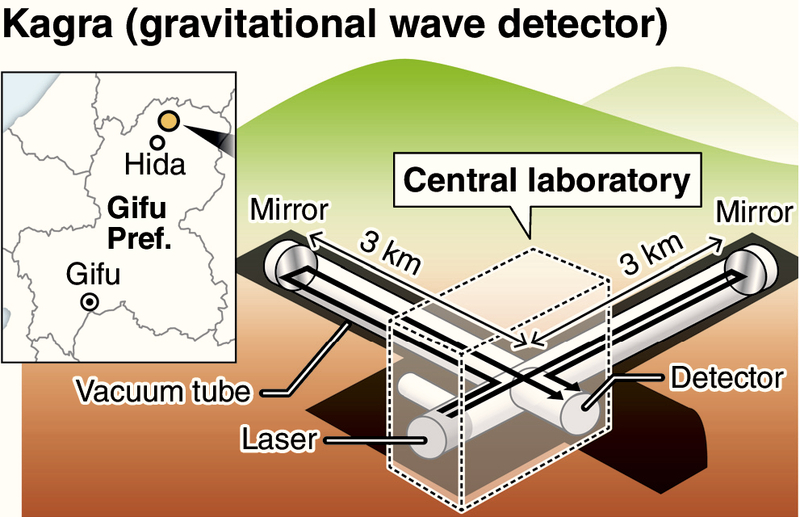
A ceremony to mark Kagra's completion will be held at its underground site in Hida, Gifu Prefecture, on Friday.
The University of Tokyo, the High Energy Accelerator Research Organization and the National Astronomical Observatory of Japan plan to start full operation of the detector within this year.
The United States and Europe have preceded Japan in building gravitational wave observation equipment. In 2015, a U.S. team observed for the first time gravitational waves caused when two black holes collided. Three American scientists won the Nobel Prize in Physics in 2017 for this observation.
Because Kagra has been built underground, it is less susceptible to vibration and other noise compared with the observation equipment built on the ground in the United States and Europe. The Japanese institutions aim to identify the source of gravitational waves by detecting these wave with a high degree of precision.
Gravitational waves are phenomena that occur when a mass in motion disrupts space-time and this disruption spreads like waves.
Kagra is constructed in an L-shape with two 3-kilometer-long vacuum tubes. A laser beam is split and reflected by mirrors in the two tubes. When gravitational waves arrive from space they will affect the time it takes for light to travel the tubes, so by detecting the time differences Kagra hopes to detect the presence of those waves.
On Monday, the central laboratory in which the laser and detector are located as well as part of a tunnel that houses the vacuum tubes were shown to the media.
"We're making preparations full of excitement," said University of Tokyo Prof. Masatake Ohashi.
Read more from The Japan News at https://japannews.yomiuri.co.jp/