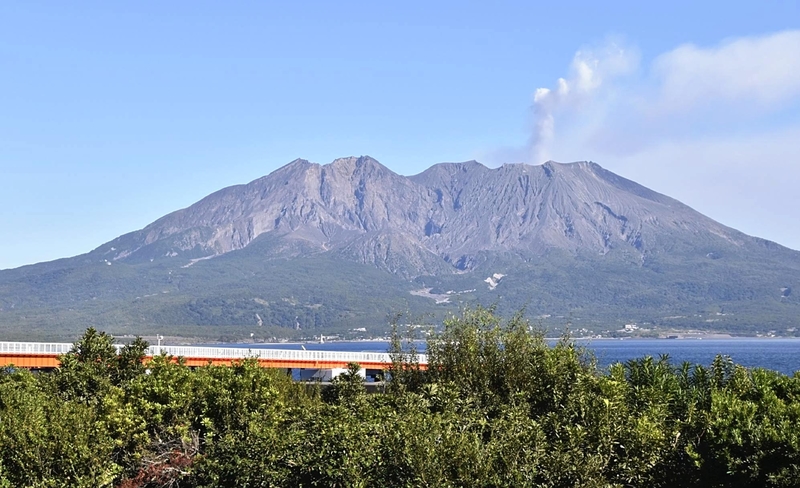
KAGOSHIMA -- Sakurajima island is the symbol of Kagoshima. However, the ash from the volcano on the island is a source of concern for the people of Kagoshima as it prevents people from drying laundry outside and it completely covers vehicles. Efforts are being made to turn such "nuisances" into a local resource.
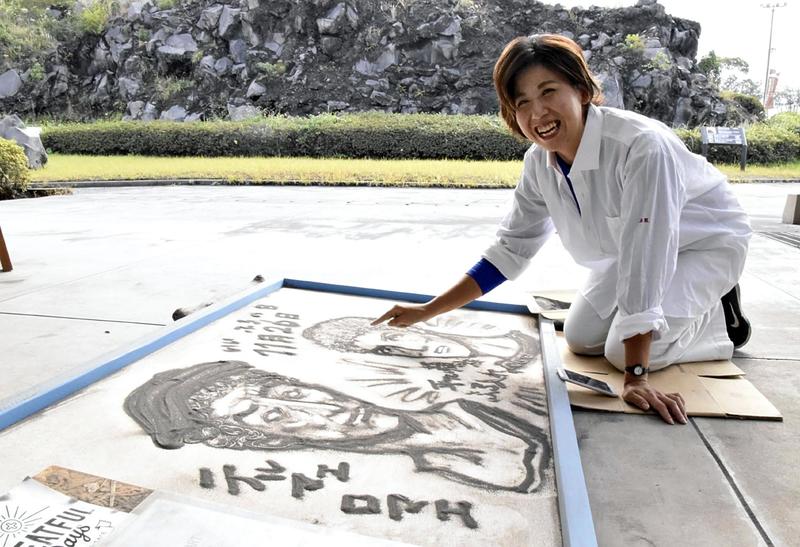
The Sakurajima Visitor Center in the city displays the history of the volcanic eruptions. In front of the entrance, Kyoko Uemura, 36, a former employee of a nonprofit organization that operates the facility, was working on "volcanic ash art."
Uemura was holding volcanic ash in her right hand after collecting it from the surrounding area. A line was drawn when she sprinkled the ash little by little on the ground.
Nov. 26 is known as "good bath day," and she drew the protagonist and another character from a manga about public bathhouses called "Thermae Romae" in a wooden frame -- 1.2.meters by 1.8.meters -- in just 10 minutes.
After strong earthquakes in Kumamoto Prefecture in April 2016, the visitor center launched a fundraising campaign. In order to raise money, her colleague suggested that the ash could be used to draw Kumamoto Prefecture's mascot Kumamon. She liked drawing anime characters, so she took up the challenge.
The width of the lines and depth of the color varies depending on the amount of ash used for the drawing and the height from which the ash is carefully scattered. The theme of the drawings varies as well. Saigo Takamori, who played a vital role in the Meiji government, and the Japanese national team who played well in the Rugby World Cup were popular motifs.
Sometimes Uemura draws visitors. It became popular when visitors posted Uemura's works on social media, and those who wanted to see the volcanic ash art have started visiting as well.
Uemura now works as a "volcanic ash artist." She said: "This art form was created because we are in close proximity to the volcano. I'm happy if this encourages people to become interested in Sakurajima."
Processed products using ash have also been developed one after another. Tomomi Kukita, 35, makes and sells volcanic ash jewelry in the city. "In Kagoshima, jewels fall from the sky," Kukita said -- a former colleague from the NPO Uemura used to work for. When Kukita was thinking of creating a new souvenir, she was fascinated by images of lava magnified with a polarizing microscope. "It was sparkling like a jewel," she said.
Based on this image, the volcanic ash, lame and hologram are hardened and formed into pendants, earrings and bracelets. These products have been sold at tourist spots for the past five years. Kukita said that one of the tourists told her, "My image of volcanic ash has changed."
The broadcast of an NHK yearlong drama series "Segodon" and events related to the 150th anniversary of the Meiji Restoration have brought attention to Kagoshima. In 2018, the number of tourists visiting the city exceeded 10 million for the first time, marking a record high.
Taking advantage of the momentum, the city hopes to vitalize the area further with Sakurajima. The city has created a logo featuring Sakurajima with the phrase "magma city," and has been using it on promotional material from this fiscal year.
In addition, the city has established the Sakurajima-Kinkowan Geopark Promotion Council jointly with other entities. The council has organized a yearly event offering workshops using ash for the past five years. It was held on Nov. 9, 2019, attracting about 19,000 visitors who enjoyed various workshops, including one for making key chains using ash. The local government and the private sector are working together to promote the various uses of volcanic ash.
Takuya Takahashi, a senior official of the Kumamoto city government, said: "People sometimes get sick of the ash, but they also feel attached to it because they spend a lot of time worrying about when it will fall. We want to enhance the attractiveness of the city as a tourist destination while making the most of the ash."
Used for ceramics, dried fish
In other areas with active volcanoes, the use of volcanic ash is also spreading.
In Mimatacho, Miyazaki Prefecture, volcanic ash fell when Mt. Shinmoedake erupted in 2011. Ceramist Morichika Yamashita, 66, added volcanic ash to his mixture and succeeded in creating a golden color on the surface. It took about six years to perfect the technique by adjusting the firing temperature and time. Yamashita has also succeeded in developing the color using volcanic ash from Mt. Aso in Kumamoto Prefecture and other places. "It showed that ash could be a valuable resource," Yamashita said.
On Miyakejima island in Tokyo, an eruption occurred in 2000. In an attempt to contribute to reconstruction, local residents have since worked to commercialize "ash dried fish," which uses volcanic ash to dry various fish such as sharks and flying fish.
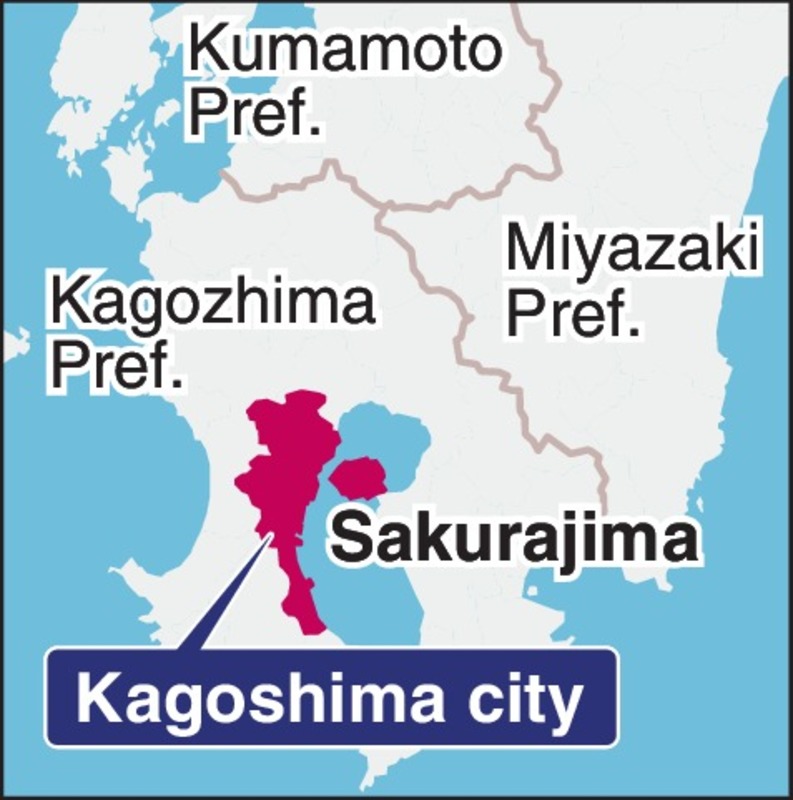
-- Kagoshima city
A city located in the center of Kagoshima Prefecture. It developed as a castle town of the Shimazu domain that unified the three provinces of Satsuma, Osumi and Hyuga. The population stood at 595,161 as of Dec. 1 last year.
Sakurajima is 1,117 meters above sea level. It was originally an island, but lava from the 1914 eruption flowed into Kinko Bay and connected the island to the Osumi Peninsula. Sakurajima is part of Kagoshima city and it takes about 15 minutes by ferry from the city to cross the bay. In 2011, there were a record 996 explosive eruptions.
Read more from The Japan News at https://japannews.yomiuri.co.jp/