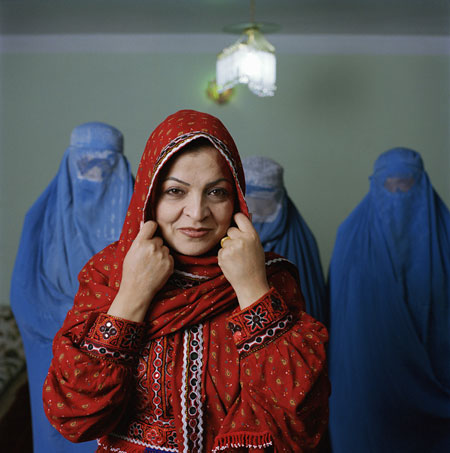
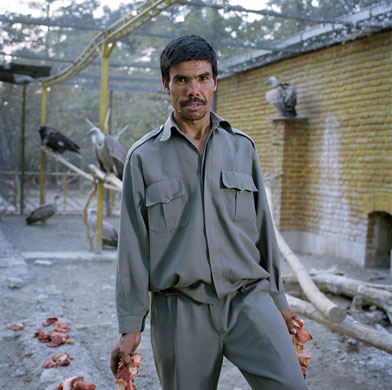
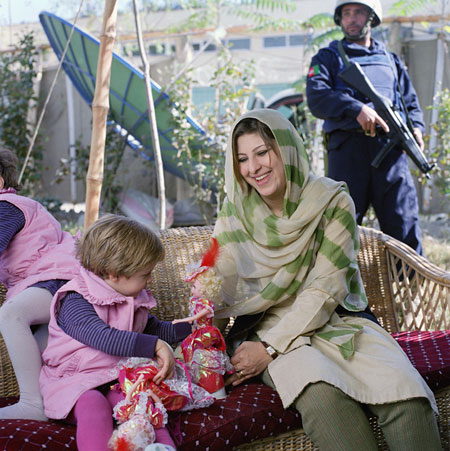
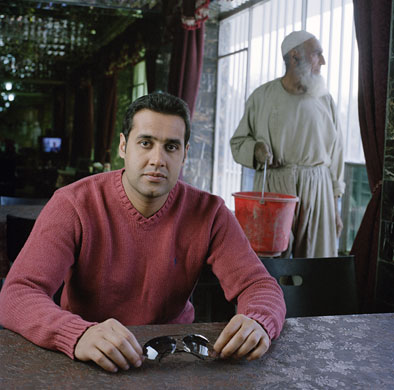
Qudriya Yazdan Parast is an Afghan MP committed to women’s rights. “I am always in danger. I have been attacked three times, my car destroyed, my house shot at, my guards beaten. It is dangerous for all female activists” Photograph: Louis QuailQurban Ali, zoo keeper, feeding the vultures their evening meal. “In the civil war, the zoo was completely destroyed because it was on the frontline. Most of the animals died, the vultures being one of the few exceptions, along with the lion, which apparently survived by eating humans” Photograph: Louis QuailNoor Akor supports his family of seven on a day; he lives on a mountain with no electricity or running water and it takes him an hour to walk to his work as a hairdresser. “I’ll vote for a real Afghan, someone who cares for the people, who can bring security, tranquillity and prosperity. President Karzai has two passports and 200 bodyguards every time he travels; he is not a real Afghan.” Photograph: Louis Quail
Humayan Beria works at Ariana TV studios as a writer and producer. He is the star behind some of Afghanistan’s biggest comedy shows, regularly attracting 90% of the audience. The head of programming, Fahim Sadozi, says, “There was no TV in Taliban times, but it’s hugely popular now. Every province bar one has Ariana, and 80% of the country watches television” – and this in a country where only 7% have proper sanitation. Ariana is working on an Afghan version of Who Wants To Be A Millionaire? on which contestants will win the equivalent of 0,000. There are also versions of Oprah, Dragons’ Den and Pop Idol. “Afghans find comfort in TV because of the dangers outside the home,” Sadozi says. “This popularity is not without its problems, however. It is prohibited to show skin on our shows. We have to blur the skin – even an arm”Photograph: Louis QuailHassina Syed, a businesswoman with two young daughters, owns the Gandamack Lodge hotel in Kabul. She also rents armoured cars, and runs a farming and property business, a travel agency and a bedding shop. She is married to a westerner, an ex-soldier and journalist who has lived in Afghanistan for 20 years. “For me, having money is dangerous. Kidnapping is a big problem. A friend’s uncle was kidnapped; they wanted 50,000, He was so mad, he said, ‘I am not paying that – he is an old man.’ Eventually they dropped the price and said, ‘OK, just cover our fuel and the bribe for the police – 0,000’, which he agreed to. The police are always involved, paid to look the other way” Photograph: Louis QuailEbrahim Faizi is a hotel manager and architect. He lived at the hotel during the civil war and for the first year of the Taliban era. The hotel took hits from rockets at least 20 times. “In the mujahideen years, you needed guards with guns; during the Taliban time, you left the doors open, but there was no business, no education. It was safe, but they were fucked up. Pakistanis, Chechens and Arabs invaded us. I remember playing football and the Taliban chased us, took the balls and threw some of the young people in jail. Girls were stopped on the streets – a special patrol would check if there was ankle showing, and give them a beating. “Democracy isn’t going to happen – it says you can have sex with any woman; Islam says you’re going to be punished. Democracy says it’s ok to be gay; Islam says you are going behind bars. I love democracy, but how can you implement it here?” Photograph: Louis QuailCommander Salah Mohamed, 2nd Lt Islamiedin and 2nd Lt Abdullah are police officers. One of the main problems for the force is overcoming corruption. Just before this photograph was taken, a man pulled over and handed six rolls of toilet paper to the commander. The police haven’t been paid for two months – accepting gifts, or bribes, big or small, is a way of getting by. Police are not permitted to talk to the press, but an Afghan elaborates: “My neighbour – a drug dealer – was arrested: the police found 6kg of heroin and an AK-47 in his house. The next day he is out of custody – how? The police forces around Kabul are all from the gangs. They are young, uneducated boys who can’t find work. If you ask them to write their name, they can’t do it – they just have a gun in their hand and they’re really good at shooting.” Photograph: Louis QuailAkba was a soldier for 15 years. Now he is a security guard. “All my life I have been fighting: in the mujahideen against the Soviets, in the civil war and most recently against the Taliban. Many of my friends were killed”Photograph: Louis Quail
Sign up to read this article
Read news from 100’s of titles, curated specifically for you.