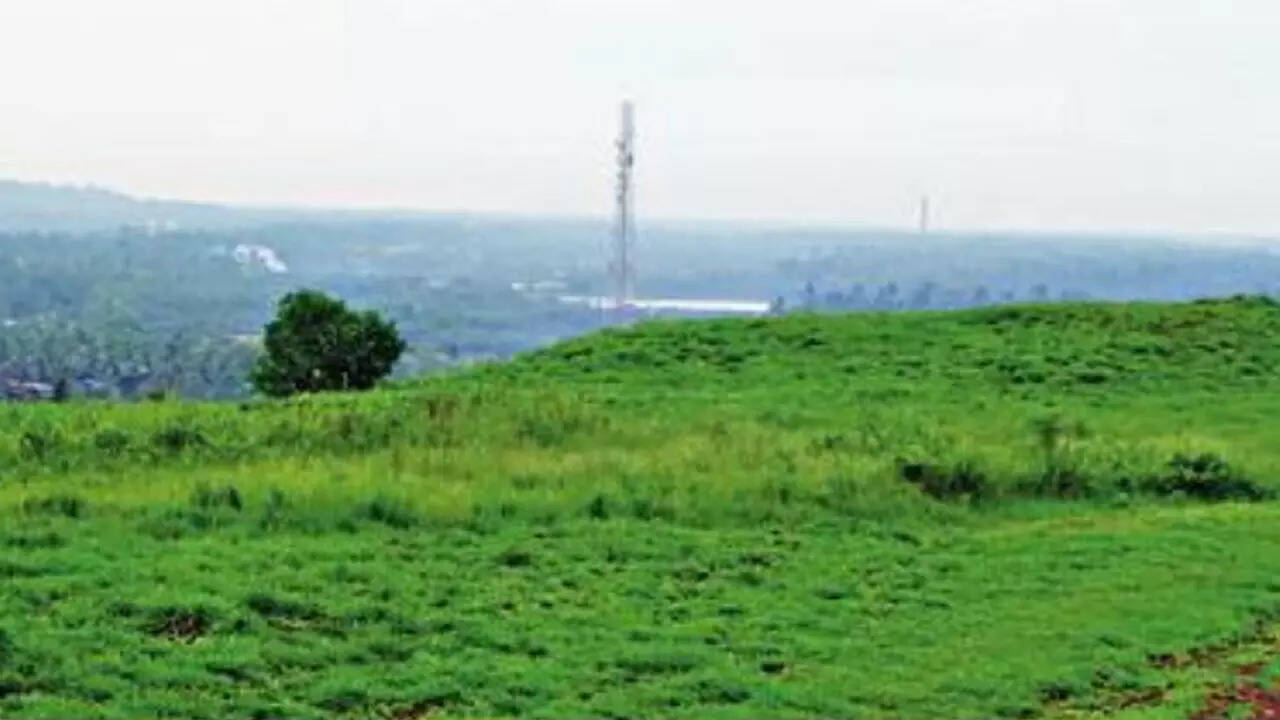
KOZHIKODE: Kannur’s Madayipara Biodiversity Heritage Site, through which SilverLine’s alignment passes through, is emerging as one of the focal points on the debate on ecological impact of the project.
The survey stone fixed at Madayipara was uprooted on Tuesday night by unidentified persons. Madayipara Samrakshana Samiti, which had led a successful agitation against clay mining in the hillock, has vowed that it will not allow K-Rail to destroy the biodiversity hotspot that has immense cultural and historical significance.
Though the laterite hillock, spread over 365 hectares, constitutes only 0. 01% of the geographical extent of the district, it houses 59% (670 of 1,132species) of the total plant species found in the district, including many rare ones. Also, researchers have spotted 255 bird species belonging to 173 genera at the staging point for migratory birds arriving from the Himalaya and Palaearctic countries.
It is also home to over 150 butterflies, 55 odonates and other diverse fauna. While CM Pinarayi Vijayan had said that SilverLine alignment does not pass through ecologically-fragile areas, environmentalists said the technical classification cannot be used as a yardstick to determine the ecological value of areas like Madayipara which are unique. “Technically, Madayipara may not be classified as an environmentally-fragile area. But there couldn’t be many other places in state which are blessed with such amazing biodiversity and are performing immense ecosystem services.
The laterite hill is actually a huge aquifer and stores 270 crore litres of water (estimated) during monsoon alone and plays a vital role in providing water security for the area by preventing salt water intrusions,” said VC Balakrishnan who is a driving force behind Society for Environmental Education in Kerala which was the first to compile a checklist of plant wealth in the area in the 90s. The unique geographical and geological features of the areasurrounded by rivers of Kuppam, Ramapuram and Peruvamba and Kawayi backwatershave played a key role in the area's much diverse floral and faunal diversity. The hillock houses two an- cient temples, one built in 344 AD and the other much earlier.
It has the remnants of a fort believed to have been occupied by the dynasty of Kolathiris and later by Tipu Sultan and a mosque estimated to have been built in AD 1124. Meanwhile, K-Rail MD Ajith Kumar V said the rail line will pass through a tunnel beneath the hillock and will have no impact on biodiversity or ecology. “There will be only two openings and construction will be limited to just some stretches at both ends and there will not be any disturbance elsewhere,” he said. But, samiti secretary KP Chandramgadan (79) said it will not be viable to tunnel through the hillock which has a height of only 30-35m at many places.
“The geological features of the hillock do not permit tunnelling as hard laterite surface is present only up to a depth of 8m. Beneath it is soft soil, ball clay and china clay which would make tunnelling unviable. Also tunnelling will destroy the water holding capacity of the aquifer. We won’t allow it to happen,” he said.