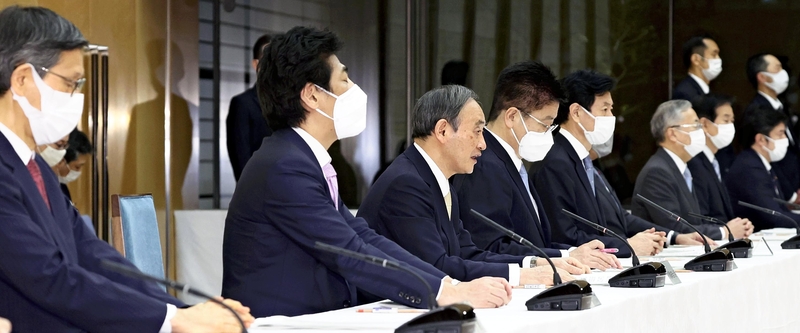
For the upcoming state of emergency for Tokyo, Osaka, Kyoto, and Hyogo prefectures that was announced on Friday evening, Prime Minister Yoshihide Suga has shifted the emphasis of measures to curb the coronavirus pandemic to containing the flow of people.
Details of the government's COVID-19 measures were not unveiled until just before the announcement of the formal decision to declare an emergency for the third time.
Businesses such as department stores and other large commercial facilities that will be subject to closure requests have been scrambling to respond to the relevant measures due to the lack of information ahead of the announcement.
"Although there might be confusion, we want businesses to understand the circumstances," said a Cabinet Secretariat official.
The central government had applied emergency-level priority measures to curb the spread of the virus in Tokyo, Osaka, and eight other prefectures. The measures gave prefectural governors the power to penalize eateries that did not comply with requests to shorten business hours. These measures were supposed to be as effective as the measures implemented during the second state of emergency issued in January.
In Osaka, priority measures have been in place since April 5. But since mid-April, when the measures were supposed to start bringing about an effect, the number of new cases has exceeded 1,000 almost every day.
On April 19, Osaka Gov. Hirofumi Yoshimura announced plans to ask eateries and large commercial facilities in the prefecture to temporarily suspend their businesses, and sports and other events to be canceled, in a bid "to bring the whole city to a halt."
The central government had until now largely targeted eateries, particularly those that serve alcohol, with the belief that they are the main channel of infections. It had attached importance to evidence, allowing large-scale sports fixtures and other events to go ahead if the safety of such events had been confirmed through trials or other such means.
The Tokyo metropolitan government had been reluctant to take such measures as requesting the cancelation or postponement of events, or calling for events to be held without spectators.
As the decision on spectators at the Tokyo Olympics is expected to be made in June, the announcement of stringent measures could dampen the mood ahead of the Games.
However, Yoshimura's idea of curbing the flow of people has been picked up by Yasutoshi Nishimura, the minister in charge of coronavirus measures, despite the lack of evidence indicating events are responsible for the spread of the virus.
According to a senior Cabinet Secretariat official, Nishimura is susceptible to the opinions of experts, who place their priority on curbing infections.
Suga and Chief Cabinet Secretary Katsunobu Kato had often played the role of keeping Nishimura in line, but both of them did not this time, according to a high-ranking government official.
"I cannot think of anything other than measures targeting eateries that operate at night," Kato has said.
The latest steps are "a mini lock-down that is not backed up by evidence, which suggests that the infection situation is serious," according to an official close to Suga. In Japan, there is no legal framework for lockdowns in which cities are effectively closed and businesses are forced to suspend operations.
A Liberal Democratic Party lawmaker and former Cabinet minister said, "Even though the government has changed its grand policy of taking measures in harmony with the economic activity, there has been no indication that the prime minister has exercised leadership."
Read more from The Japan News at https://japannews.yomiuri.co.jp/