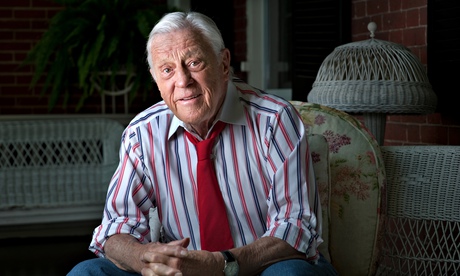
The most revered newspaper editor in America died last week and, naturally, we journeyed with his obituarists across the mountain peaks of Watergate and the Pentagon Papers. But Ben Bradlee was 93. The downfall of Richard Nixon, like the discomfiture of Lyndon Johnson, are history. Most of today’s readers probably only remember the Jason Robards version of Ben, still starring with an incredibly young Robert Redford and Dustin Hoffman on late-night movie channels. But now try a little reality…
The essential Bradlee features, much less dramatically, in the memoirs and video interviews he left behind. He’s laconic, funny, bone-dry: a benign enabler, a picker of great reporters, a comrade in arms, a wise man. It’s not my job to be loved, he says, though those who work for him mostly love him. But he doesn’t consider himself an icon – just a “blip”. He mingles uneasily with politicians and fears becoming their friends. He’s interested in facts, secrets and the human condition, not in politics or its ideologies per se.
He knows, deep in his bones, that even – or maybe especially – the president of the United States can look you in the eye and tell you a lie: “It ain’t necessarily so.” He grins sardonically over incantations about “national security”. He has his disasters (the Pulitzer for an invented tale that had to be handed back) as well as his triumphs. His greatest achievement, he claimed, was inventing the Post’s Style section in 1969, a features pullout ahead of its time that gave housewives left alone in Maryland during the day the feeling that they were surrogate members of the DC party set.
Side by side with Katharine Graham, he turned the Washington Post from an average, struggling city daily into a phenomenon that, for a time, seemed to challenge the New York Times. But the Graham family didn’t have the ambition, or the money, to sustain it. So now the baton has passed to Jeff Bezos. Now the Post’s future, if any, depends on the Amazon billionaire’s fortunes (and paying European taxes in Luxembourg, if at all). The blip, you might say, has almost gone. This is workaday history, not Hollywood history. This is ordinary, toilsome life in a bygone newsroom.
But the basic Bradlee, living on in legend, also asks one of the most immediate questions journalism – in print, on air, across the net – has to grapple with. Simply, do we need editors any longer? The new seeming editor of the Daily Telegraph arrives disguised as “director of content” reporting to a “chief content officer”. Trinity Mirror makes a cost-conscious group habit of rolling its local editorships into a distant one. A former BBC online master is busy remaking Johnston Press in his image and experience. The imperatives of “digital first” puts copy into cyberspace in a moment and works out later whether, if at all, it will fit into some computerised print grid.
And meanwhile, amid the broadband explosion, readers are billed as editors, too. They choose what they care about as they click. Their choices register on office screens. They have an immediate voice in what happens next, what’s trending – with journalists paying keen attention. Brands “care about their image, their narrative, their ability to… use stories to increase their market share and profitability”, the media consultant Grant Feller wrote on the Huffington Post site the other day. “To pretend that this is something new, we’ve invented a variety of phrases – content marketing, native advertising, branded content … But it’s just storytelling, except that instead of spending money – which is something journalists are exceptionally good at – its prime purpose is to make money.”
Bradlee operated in a different world. He said, openly, that if only 15% or less of the Washington Post audience wanted to read a long piece about, say, Angola, that was fine by him. No clickfest there. More, it’s astonishingly hard to see how the Watergate investigation could have happened today – not because there were momentous, shattering documents and leaks, in Snowden style, but because there weren’t. The Post didn’t have, or know about, Nixon’s tapes. For month after month, Woodward and Bernstein squeezed out small, slightly baffling stories that signalled where their inquiry had got to, not where it would finish. So much of the investigation was work in progress, not front-page news that scored big numbers and made big waves. It sent a signal to the burgling gang: “We’re on your tail!” But in modern terms, it was the precise reverse of compelling storytelling.
Of course, and still, new media isn’t the absolute message. Of course editors, hiring reporters, backing hunches, defending their patch, have a crucial part to play. Of course the clicks that made Renee Zellweger’s new face such an all-engulfing topic last week go way beyond decency and common sense. Ben Bradlee would still get a job somewhere in 2014. He might even make a reputation, as his latest successor in Washington, Marty Baron, is doing. But the newsrooms he’d seek to command would span the globe 24/7. He’d need to work through diffuse phalanxes of intermediaries. Lord Justice Leveson would raise an quizzical eyebrow when he claimed (truthfully) not to know who Deep Throat was. He’d be further away from everything, a job description in flux: a director of content, if you will, in search of ultimate direction.