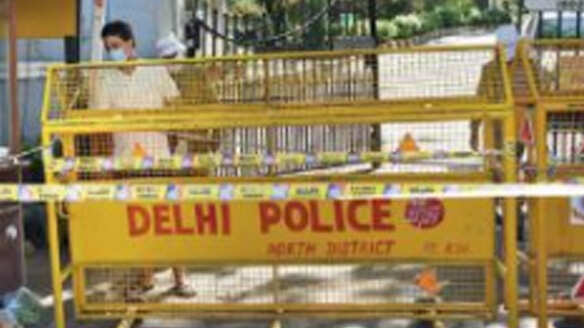
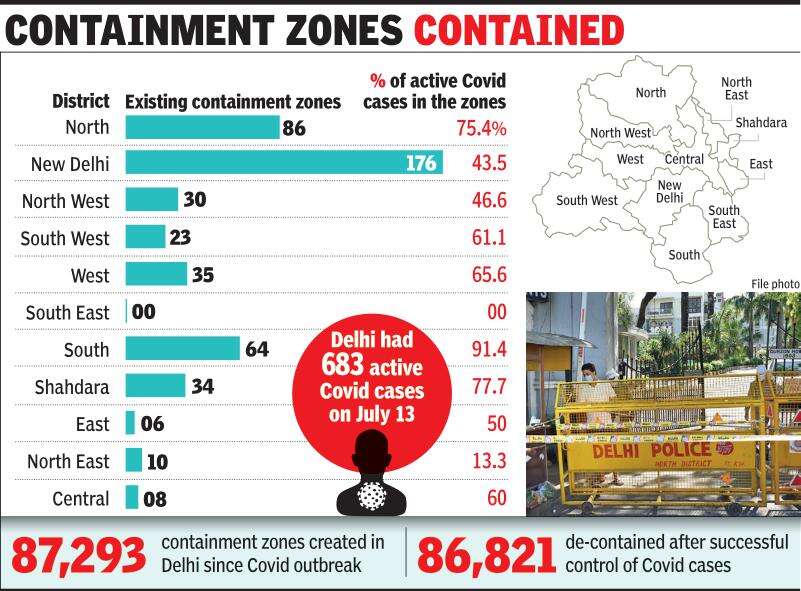
NEW DELHI: The number of containment zones in the city has reduced from nearly 58,000 less than two months ago to 472 as of now. South East district is the first among Delhi’s 11 districts to have no containment zone. East district has only six, Central eight and North East 10.
Currently, New Delhi district has the largest number of 176 containment zones, followed by North district that has 86 such areas. South district has 64 containment zones, West district 35, Shahdara 34, North West 30 and South West 23.
Containment zones indicate where the virus is still active and needs to be stamped out. They are created to stop Covid-19 from spreading to other areas and infecting a larger population. Initially, red zones were huge and covered a large population, but later the strategy was changed and the authorities started creating micro-containment zones, which had smaller areas and comparatively fewer people.
The number of containment zones witnessed a dramatic jump in the second half of April and reached 58,000 by mid-May. Between April 13 and May 13, on average 1,700 such zones were created every day. In April, there were only 6,852 containment zones, but within 30 days the number touched 57,550.
This was also the period during which Delhi witnessed a phenomenal rise in the number of active Covid-19 cases. The authorities then sealed the hotspots in a bid to prevent the virus from spreading. Delhi reported 28,395 cases on April 20, the highest number of cases in a single day ever. From then, the cases started reducing slowly.
The current number of containment zones is one of the lowest since the authorities started creating them towards the end of March 2020.
All residents living within red zones are screened for Covid-19 symptoms and tested. Surveillance is also increased in such places. Apart from a focused testing strategy in the hotspots, enforcement action is also higher. A red zone is decontained after 14 days if no new cases are reported and the patients recover.
An official said some districts were also creating containment zones even if one case was being reported. All districts have been asked to ensure that minimum 50% of active cases are located inside sealed areas.