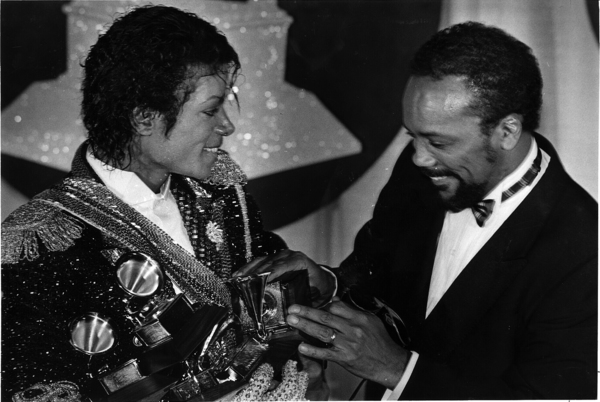
LOS ANGELES _ When Quincy Jones met 19-year-old Michael Jackson during filming of "The Wiz," it begat one of the most fruitful partnerships in pop music, spawning three acclaimed records _ "Off the Wall," "Thriller" and "Bad" _ that have collectively sold more than 100 million copies worldwide.
And now, eight years after Jackson's death, that partnership was at the center of a $30 million lawsuit that put the producer against the estate of the singer he affectionately called "Smelly."
On Wednesday, a jury ruled Jones was owed $9.4 million after a civil case in Los Angeles Superior Court in which the producer alleged breach of contract over agreements dating to the 1970s and '80s had shorted him out of millions in royalties.
The estate said an accounting error did cause the producer to miss out on some funds he was owed but put that figure at about $392,000 _ significantly lower than the $30 million Jones had been seeking.
Earlier, Jones had declined a roughly $3 million settlement offer.
In 2013, Jones filed a $10 million breach-of-contract lawsuit against Sony Music Entertainment, the parent company of Jackson's longtime label, Epic Records, and MJJ Productions, which is controlled by the singer's estate.
Jones claimed that the master recordings he worked on for "Off the Wall," "Thriller" and "Bad" were improperly remixed to deprive him of royalties and production fees he was entitled to under agreements he and Jackson signed in 1978 and 1985.
Jones claimed he was owed money from unpaid royalties and licensing fees for songs he produced that were used in productions after Jackson's death, specifically in the concert documentary "This Is It" as well as the two successful Cirque du Soleil shows built around the artist's catalog, "Immortal" and "One."
Under his contracts, Jones is entitled to a percentage of royalties from the work he did with Jackson, but lawyers for the producer and the singer's estate disputed whether he should share in the profits from the 1991 joint venture Jackson entered into with Sony and whether he should share in net profits from films such as "This Is It" instead of licensing fees from the songs used in them.
Jones, according to his testimony, felt cheated out of profits from the projects.
"If I was involved in making the records, I am entitled to it," Jones said on the stand, according to court transcripts.
The prolific producer stated in the suit that the estate "secretly entered into a venture agreement with Sony" in which the two labels would share profits after rights to the masters were "reverted from Sony to MJJ" and not distributed by Sony.
Jones asserts the move allowed the labels to "disguise" the revenues as profits instead of royalties.
Jones also argued that his contracts with Jackson stipulated he be given the first opportunity to re-edit or remix any of the masters and that he be given producer credit for each of the master recordings.
In the years since Jackson's death from a fatal cocktail of medications administered by his doctor, the King of Pop's estate has flipped the $500 million debt he left behind into a bounty of wealth via posthumous projects in record, film, stage and beyond _ last year alone the Jackson estate earned $825 million.
Jones has earned about $100 million from his work with Jackson, lawyers for the estate said, and $19 million since the artist's death. They argued during the trial that Jones was being "greedy and unethical."
Lawyers for Jones argued "This Is It" counted as a "videoshow," per his contract, entitling him to a share of net receipts. Yet lawyers for the estate said that term applies to music videos and doesn't apply to the film.
Jackson, and now his three children through the estate, own the masters to "Off the Wall," "Thriller" and "Bad."
When entertainment attorney Howard Weitzman, whose team represented the Jackson estate, argued that Jones doesn't have ownership interest in the masters and, therefore, isn't entitled to funds outside of the established royalty structure, Jones dismissed the argument. "It's a piece of paper," he said of the contract.
"Are you really trying to say that there's a line that we can't cross if I produce the record and it's only for albums? That's all I should get paid on? Come on," Jones said.
The producer said he was particularly incensed about the lack of credit he received for the posthumous concert documentary "This Is It."
"My name was nowhere near that, nowhere ... on the album, on the screen, nowhere," Jones said.
Issued by Columbia Pictures a few months after Jackson's death, the film documented preparations for what would have been Jackson's farewell tour. Its companion soundtrack featured unreleased demo versions of hits including "Wanna Be Startin' Somethin,' " "She's Out of My Life" and "Beat It," songs Jones helped produce.