We’re wrapping up this live blog now, many thanks for so many contributions, on and offline.
Here’s Denis Campbell’s full story from today’s march.
Health policy editor Denis Campbell, at the junior doctors demonstration in central London, has just filed this quick analysis of today’s event.
What has today’s demo achieved? It’s hard to say. But the impressive attendance, the fact that the marchers are truly representative of junior doctors not BMA dupes of Jeremy Hunt’s imagination and the support for them from the medical profession as a whole, as well as widespread media and public support, all mark this out as a dispute that is now very tricky for ministers to defuse.
That said, Hunt is playing an ever-harder version of hardball, insisting that junior doctors are in effect having the wool pulled over their eyes by the scheming BMA - a tactic of dubious value - and still insisting that 11,000 people a year die when they shouldn’t just because they were admitted to hospital at the weekend, even though the research paper he cites as the source of that claim specifically does not say that. If anyone is misrepresenting key facts, it’s him.
A Downing Street spokeswoman told me on Friday afternoon that David Cameron is still completely happy with his health secretary’s handling of the dispute and that they remain as one over the government’s offer to England’s 45,000 junior doctors.
The BMA’s move towards holding the ballot for industrial action they first decided upon three weeks ago - details of when it will be held will emerge in the next few days - is likely to bind Cameron and Hunt together, at least publicly.
While the BMA insists that it has been backed into a corner by Hunt - in effect forced to resort to the ballot because their pleas for an agreed settlement have fallen on deaf ears - the reality of them taking industrial action, which is likely to involve action short of a strike, like a work to rule, could yet prove their undoing.
Unlike members of other trade unions like Tube train drivers, it’s very hard for doctors to actually strike, as their patients depend on them.
Indeed, some very senior doctors fear that taking action will hand the initiative back to Hunt, who is currently very much on the defensive.
Updated
Summary
- Half of British adults believe they would be in greater danger if they were admitted to hospital at the weekend, a new Observer/Opinium poll says.
- An estimated 20,000 people have marched through London to protest against changes to the junior doctor contract, which many claim will leave them financially worse off and abolish safeguards that prevent them working longer hours.
- Thousands of others have also gathered in Nottingham and Belfast for marches to protest the contract.

- The crowd was addressed in Waterloo Place by speakers including shadow health secretary Heidi Alexander, 92-year-old activist Harry Leslie Smith and TV doctor Ranj Singh.
- Alexander called on health secretary Jeremy Hunt to “stop the high-handed demands, show you are prepared to compromise and put patient safety ahead of politics.”
- Under the current plans, the contract will reclassify doctors’ normal working week to include Saturdays and late evening working.
- Hunt, claims the British Medical Association has misled junior doctors about the contract, a claim vociferously denied by both the union and many of the doctors protesting.

- The former conservative health minister Dan Poulter, a practising doctor, has appeared in a video produced by junior doctors in a show of solidarity with those marching.
- Celebrities including author JK Rowling, Great British Bake Off host Sue Perkins and comedian Rufus Hound also expressed support for the demonstrators.
- Consultants at London’s busiest hospitals have been working today, unpaid, in order to cover the shifts of junior doctors on today’s march.
The Dickson family have been marching in the place of their junior doctor daughter Dr Karen Dickson, who is working this weekend at Derriford Hospital in Plymouth.
Keith and Elana Dickson, along with their daughter Ella, travelled to London for the protest after Dr Dickson was unable to attend in person.
“She’s concerned that the new contract isn’t safe, for doctors and patients, and that it is part of a bigger plan to incrementally destroy the NHS,” Ella told the Guardian.
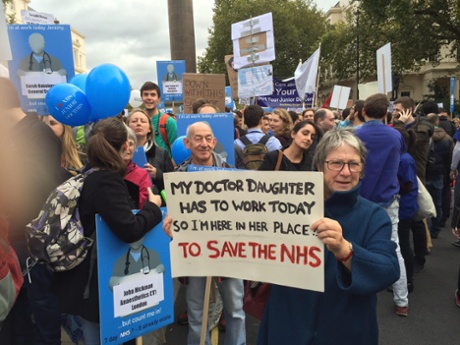
It’s not just junior doctors on the march today, there are also many GPs and nurses marching in solidarity, or showing support online, despite not being directly affected by the contract.
I am a GP. I care deeply about our #NHS. I was a #juniordoctor. I stand with them now. #notsafenotfair #istandwithjohann #juniorcontract
— Dr Nikita Kanani (@NikkiKF) October 17, 2015
As specialist nurse, I support today's junior doctor protest #saveourNHS #juniorcontract #weneedtotalkaboutjeremy #notsafenotfair
— Helen Rice (@Helen_Rice) October 17, 2015
I'm a GP who was once a junior doctor. Look at this crowd! Where would the NHS be without them? #juniorcontract
— Hocus Pocus (@Pickletray) October 17, 2015
Good luck to the Doctors protesting today. This worn out old nurse supports you 100%. #juniorcontract #juniordoctors
— Shortwide (@Dengiskhan) October 17, 2015
Conservative MP Sarah Wollaston criticises Hunt's approach
Conservative MP and former GP Sarah Wollaston has been tweeting about the protest today, having already expressed support for the junior doctors and calling for a re-think by the Department of Health in a September Telegraph article.
2/3 simply won't wash to claim 'most docs will be better off' without clarifying which will be far worse off if total pay envelope the same
— Sarah Wollaston MP (@sarahwollaston) October 17, 2015
3/3 failure of DH to appreciate/address wider causes of #juniordoctors low morale + obfuscated communication. Really need to start again
— Sarah Wollaston MP (@sarahwollaston) October 17, 2015
Updated
Roshana Mehdian, a 29-year-old junior doctor, addressed the crowd through a loudspeaker as they sat down on Whitehall during the march.
She said there were 20,000 people on the march and started a chant of “Where are you Jeremy?”.
20000 people asking 'where are you Jeremy?' #juniorcontract pic.twitter.com/h86uHgz2Tm
— Roshana Mehdian (@RoshanaMN) October 17, 2015
“We are protesting against an unfair and unsafe contract and this is showing our strength of feeling,” she told the Press Association.
“We are here to show Jeremy Hunt that we will not accept that contract.”
Updated
The march is on the move now towards Westminster, where doctors and supporters will eventually assemble in Parliament Square.
Doctors march on Westminster #juniorcontract pic.twitter.com/aOh9ezoYFx
— Tom Riddington (@DrTomRiddington) October 17, 2015
And off we march... #juniorcontract #saveourNHS #notfairnotsafe pic.twitter.com/sIWSqdWDhj
— Chloe Chin (@drchlo) October 17, 2015
On foot and on wheels the protest over the #juniorcontract is on the move pic.twitter.com/AbozQUaSVA
— Thomas Moore (@SkyNewsThomas) October 17, 2015
It’s fair to say there’s unlikely to be any aggravation for police at this particular demonstration.
"This is the most polite gathering of people ever" says @metpoliceuk officer #juniorprotest #juniorcontract
— Sarah Sturrock (@SturrockSarah) October 17, 2015


Harry Leslie Smith: NHS is UK's greatest achievement
Harry Leslie Smith, the 92-year-old NHS activist, is speaking at the rally in Waterloo Place now.
The NHS is “Britain’s greatest achievement”, he said, because it has freed millions from the worry of having to pay if they fell sick.
Our @Harryslaststand on stage telling us of pre #NHS times #SaveOurNHS #notsafenotfair #juniorcontracts pic.twitter.com/ntmP1GuTIi
— Aysha S. Raza (@DrAyshaRaza) October 17, 2015
An honour to see @Harryslaststand standing with junior doctors against the #juniorcontract pic.twitter.com/WO7RvhJzxa
— Tom Riddington (@DrTomRiddington) October 17, 2015
The pensioner told the crowd about his life as a child before the creation of the NHS, when his mother could not afford medical treatment and his sister died in a workhouse infirmary.
Hero #juniorcontract @Harryslaststand pic.twitter.com/JdQmQ2Rcll
— Larry Bird (@Examtweeting) October 17, 2015
Updated
The protest has a distinctly musical flavour (those multi-talented doctors) with chants including “there’s only one Nye Bevan”.
#juniordoctors assembling in Waterloo Place, London #notsafenotfair #juniorcontract #saveourNHS #Solidarity pic.twitter.com/ICKGxiG7Sv
— Unite the Resistance (@resistunite) October 17, 2015
Earlier in the march, protesters were treated to a rendition of a song that riffs Jessie J’s song Price Tag - with the refrain “it’s not about the money, money, money”.
#juniorprotest #juniorcontract #notfairnotsafe amazing scenes pic.twitter.com/T0GP23xbZw
— Jen Jardine (@jenejardine) October 17, 2015
The crowd has also been hearing from TV doctor Ranj Singh, a 36-year-old paediatrician who has appeared on Good Morning Britain and CBeebies.
On the new contract he said: “They’re not fair and they’re not safe. For anybody involved - that’s patients and staff.”
He said there has to be a willingness to discuss options, adding: “We want what is best for our patients.”
Amazing speech by @DrRanj at the #juniordoctors protest! pic.twitter.com/j4pg9C0e9B
— Just Paul (@ItsPaulBonhomme) October 17, 2015
Peter Stefanovic, a partner in the clinical negligence department at Simpson Millar solicitors, has given a rousing speech to the assembled crowd in London.
"Everybody in the UK should be here standing shoulder to shoulder with you today" - Peter Stefanovic, med negligence lawyer #notfairnotsafe
— Sarah Gill Martin (@sarahgillmartin) October 17, 2015
Asked about the new contract, he told the Press Association:
It’s an absolute public disgrace. An absolute public disgrace. The injustice staggers the imagination.
I am quite frankly astonished that I’m the only advocate that has come forward to fight for the junior doctors.
Updated
This latest aerial photograph shows the huge numbers attending the London protest in Waterloo Place. Demonstrators will be leaving shortly for a march to Parliament.
Wow! #juniorcontract #todaywemarch #notfairnotsafe @UKWENTs @TheBMA @jessicaelgot pic.twitter.com/R0rtINElmf
— WENTs (@UKWENTs) October 17, 2015
Half of Britons believe weekend hospital care puts them in danger
Half of British adults believe they would be in greater danger if they were admitted to hospital at the weekend, a new Observer/Opinium poll says.
The research, designed to measure the impact of Jeremy Hunt’s assertion that patients admitted to hospital at weekends were 15% more likely to die, found a significant numbers of patients had delayed trips to the doctors on a Saturday and Sunday.
The figures showed that 35% of adults have delayed seeking medical help at the weekend. Some put off visiting a doctor because their illnesses were minor, but 21% delayed their visit because they feared the quality of care would be lower.
Here’s the full piece:
Would you delay going to hospital over a weekend? Let us know in the comments.
Updated
Here are some more of the inventive banners being carried by junior doctors and their supporters at the rally this afternoon.
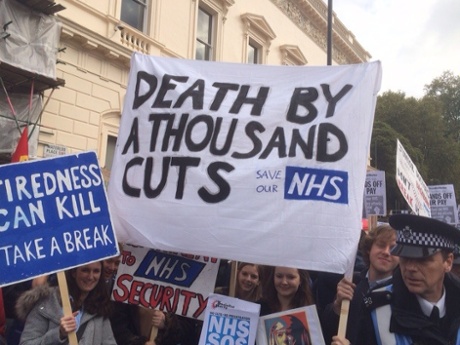
Best #juniorcontact protest placard? #juniordoctors pic.twitter.com/KGZ8K2EDDi
— HannahJane Parkinson (@ladyhaja) October 17, 2015
@jessicaelgot GP on my way to support trainee wife, friends and colleagues #juniorcontract #notsafenotfair pic.twitter.com/xHEY5XsKOT
— Mike (@casertron3000) October 17, 2015
#juniorcontract #NHS all those supporting who can't be here pic.twitter.com/4D2HeDZIgM
— leon (@246170) October 17, 2015
.@Johan malawana @jessicaelgot @TheBMA #savetheNHS #juniorcontracts #notsafenotfair pic.twitter.com/gh5Po96n48
— Sancy Low (@sancylow) October 17, 2015
@jessicaelgot @guardian @_beardy_ @HP_izzle best yet pic.twitter.com/KYDe5NTT5X
— Lauren Jane Hyman (@redspecks) October 17, 2015
Now off to join Doctors & NHS workers taking on the Tories awful plans for our NHS! Including ace home-made banners! pic.twitter.com/OGkzkIFW49
— Samuel Tarry (@SamTarry) October 17, 2015
Updated
Dr Na’eem Ahmed, a radiology specialty registrar, has written in to the Guardian about why he supports the march, calling the contract changes “anti-aspiration”.
Our letter in the @TheLancet with stalwarts of the #NHS will tell you that is about more than pay http://t.co/EZUJOyiPff #juniorcontract
— Na'eem Ahmed (@DrNaeemAhmed) October 17, 2015
He writes:
Much of the recent coverage of the proposed changes to the junior doctor contract has quite rightly focused on the immediate effects on salary, hours worked and its potential implications on patient care.
Yet more worryingly, on the background of a growing inequality gap, the rising costs of education and training coupled with the proposed contract changes mean that there now is a very real prospect that medicine becomes a career for the privileged few.
A review by the General Medical Council in 2013 found in a survey of 39 000 doctors in training only 6.3% came from the most deprived areas in UK. In 2010/11 the undergraduate intake included 57% of accepted students coming from the top three socio-economic classes and only 7% from the bottom three.
Medical students will now need to consider accumulating debts in the region of £70,000. The recent scrapping of university maintenance grants mean that students from low-income families will be shouldering this financial burden themselves.
The reality is that doctors in training can spend up to ten years working their way to consultant grade. During this time, junior doctors often will be required to move from hospital to hospital, complete postgraduate qualifications and attend courses.
The BMA report that the proposed contract changes may result in a 40% pay cut for some junior doctors. Doctors with dependents who choose to work less than full time appear to be much worse off under the new contract.
Rather than having a world-class health system that promotes the brightest and best, we will be limiting career options within medicine to those that can afford it.
Updated
Shadow health secretary: 'Wrong to punish staff for government's NHS mismanagement'
Heidi Alexander, the shadow health secretary, is speaking now at the rally in central London.
Here are her remarks, via a preview of her speech from Labour HQ:
I spent Wednesday morning with a junior doctor, and let me say this - junior doctors are the backbone of the NHS. They already work nights, they already work weekends, and they even work Christmas Day.
It’s wrong that this Government is OK with the idea of paying some junior doctors less to do the work they do now. They’re wrong to want to remove the safeguards which prevent junior doctors from having to work excessive and exhausting hours.
And they’re wrong to punish staff for their own financial mismanagement of the NHS.
Nobody wants to see industrial action but nobody wants junior doctors too exhausted to provide safe patient care either.
I have a simple message for Jeremy Hunt today. Stop the high-handed demands, show you are prepared to compromise and put patient safety ahead of politics. The ball is in his court. He needs to listen to junior doctors and he needs to recognise public concern.
If he continues to ignore those concerns, the outcome will be bad for doctors, bad for patients and bad for the NHS.
"I support you & I support NHS. I think it's wrong that Jeremy Hunt punishes staff for his own mismanagement of the NHS" - Heidi Alexander
— HannahJane Parkinson (@ladyhaja) October 17, 2015
Stop the high handed demands. Patients before politics. Heidi Alexander to Jeremy Hunt #juniordoctors #juniorprotest #notfairnotsafe
— Lindsey Kent (@LinsMedic) October 17, 2015
Updated
Here’s an exceptionally catchy YouTube video by three final year medical students at the University of Nottingham, giving their musical perspective on the junior contract.
The video’s stars say they are “naturally very concerned by the proposed changes to junior doctor’s contracts”.
“We have made a fun, light-hearted video in the hope that people will actually want to watch it, thus increasing general awareness and understanding of what we feel is a very serious issue.”
Protests over the contract are simultaneously taking place in Belfast and Nottingham.
In the East Midlands, the rally is starting at the Brian Clough statue, off Old Market Square, and the Nottingham Post reports about 350-400 doctors are expected to attend.
#notsafenotfair #saveourNHS #Nottingham #juniorcontract #juniordoctors pic.twitter.com/DQPC7zWxB3
— Emily Milnes (@emily_loulou) October 17, 2015
Big turnout in Nottingham #juniorcontract pic.twitter.com/xTRhiFCKJs
— Tim Ritzmann (@TRitzmann) October 17, 2015
In Northern Ireland, doctors are protesting at Belfast city hall, and the Facebook page for the event has more than 1,000 people committing to attending.
Crowds building for NI Junior Doctor Rally, #Belfast City Hall. #juniorcontract #notfairnotsafe #notsafenotfair #nhs pic.twitter.com/u3bjPRCNT9
— Amanda Ferguson (@AmandaFBelfast) October 17, 2015
Hundreds gather outside City Hall in Belfast #juniorcontract #notfairnotsafe #belfast pic.twitter.com/HOHlJOfVpc
— Niall Doherty (@_nialldoherty) October 17, 2015
Super turnout for today's junior doctor rally in Belfast today #juniorcontract #juniordoctors pic.twitter.com/UXW5o6lTvw
— Neil Harrison (@neilhphoto) October 17, 2015
Crowds at @juniordrsrally in #Belfast #juniorcontract #juniordoctorprotest #NHS pic.twitter.com/9NaVF7rxwy
— Fergal McFerran (@FergalMcFerran) October 17, 2015
Belfast #juniorcontract rally @johannmalawana #standingtogether pic.twitter.com/zYEtFCiOuE
— BMA Northern Ireland (@BMA_NI) October 17, 2015
Please do get in touch if you’re attending a protest in either Nottingham or Belfast and tell us about atmosphere there too - either tweet @jessicaelgot or email me on jessica.elgot@theguardian.com.
Updated
London protest kicks off at Waterloo Place
Protesters have gathered for speeches at the rally which will take place for the next couple of hours, and will include shadow health secretary Heidi Alexander and 92-year-old NHS campaigner, Labour activist and author Harry Leslie Smith.
Organisers say they expect around 16,000 people to attend.
The junior doctor protest organisers, already here and setting up! See you soon x #juniorcontract pic.twitter.com/jdaeNIvIAy
— Roshana Mehdian (@RoshanaMN) October 17, 2015
Enroute to the #juniorcontract protest pic.twitter.com/6W9oZmGHTb
— Andrew Collier (@DrACollier) October 17, 2015
Placards everywhere! United we stand! #saveournhs #juniorcontract pic.twitter.com/BogLq8TJwF
— Left & Write (@lftwrt) October 17, 2015
We have to stand together say @clarercgp and @RoshanaMN #juniorcontract #notsafenotfair @Harryslaststand and me! pic.twitter.com/JiGQvfcWN3
— Jos Bell (@Jos21Bell) October 17, 2015
Happy to be marching for our #juniorcontract with @beccilocky and @Lisix. #notsafenotfair pic.twitter.com/gmegJdBZH3
— Max Stirk (@ToTheMaxStirk) October 17, 2015
Just arrived at #juniorcontract protest. Great turnout of medics stirred into action http://t.co/tWASMBBjkk pic.twitter.com/6Dku1Ia9ac
— Bob Gill (@drbobgill) October 17, 2015
Our protest would be much bigger but juniors ALREADY WORK WEEKENDS! #juniorcontract pic.twitter.com/ibk1cObq8r
— Andrew Collier (@DrACollier) October 17, 2015
Health school students from @KingsCollegeLon assembling for today's #juniorcontract demonstration. pic.twitter.com/X6pumxMETc
— Areeb Ullah (@are_eb) October 17, 2015
#JuniorContract Drs on junior dr demo pic.twitter.com/EORk8hXJn0
— paula peters (@paulapeters2) October 17, 2015
Updated
The march is set to start in a few minutes at Waterloo Place, here’s a map of the route.
Map of the Junior Doctors London Protest - 17/10/15 @ 2pm #ourliveyourhands #juniorcontract https://t.co/sdKbr1nXDC pic.twitter.com/kBd0hFCzm0
— OurLives YourHands (@JrDrsOLYH) October 14, 2015
The Guardian’s health policy editor puzzles over the Health Secretary’s true agenda in pushing the junior contract:
What does Jeremy Hunt think he’s doing here? What’s his strategy for dealing with something when even the Daily Telegraph is warning that Conservative activists don’t understand why it’s become such a problem?
Reading reports of what the health secretary said in his round of pre-demo broadcast interviews this morning, about how the dispute is all the BMA’s fault because they’ve misrepresented the government’s position, makes me even more puzzled by his whole approach to the wave of medical anger that he himself has triggered.
His erstwhile ministerial colleague Dr Dan Poulter recently revealed in the Guardian that the broad parameters of an agreement were in place in the negotiations with the BMA’s Junior Doctors Committee a year ago, but Hunt then suddenly ripped that up when the JDC walked out of talks over an unrelated matter involving their consultant colleagues.
When I spoke to JDC Chair Dr Johann Malawana yesterday for this piece, he put it well: “I don’t understand what Jeremy Hunt’s agenda here is. There are conspiracy theories about the Tories and the NHS [that they deliberately want the NHS to fail so they can bring in a new system of paying for healthcare].
“But whatever happens to the NHS you still need a certain level of capacity to deliver a healthcare system. The conspiracy theory doesn’t make any sense [in understanding Hunt’s tactics] because even the most efficient health services in the world don’t alienate junior doctors and try and push them out of medicine.”
Can anyone see the logic, purpose or benefit of Hunt’s attitude this far to the junior doctors?
Apart from covering the shifts of colleagues, many consultants are also joining the march today to show support.
@jessicaelgot I am a consultant and will be marching. Today's consultants were yesterday's juniors #juniordoctorprotest #notsafenotfair
— Vinod Achan (@surreyHEART) October 17, 2015
@jessicaelgot my consultant is marching with me!
— benjamin (@ProtocoIDriven) October 17, 2015
Consultant today, junior doctor yesterday. On way to the march to support all junior doctors. #istandwithjohann #patientsneedjuniors
— Nidhi Gupta (@busydoctor) October 17, 2015
Consultants offer cover for junior doctors
Consultants at London’s busiest hospitals are coming into work today, unpaid, in order to cover the shifts of junior doctors on today’s march.
Dr Helgi Johannsson, clinical director of anaesthesia at Imperial, said four consultant anaesthetists have decided to come in to St Mary’s Hospital in Westminster on Saturday to cover junior colleagues on the march.
“This is one of those specialism where colleagues are often needed to cover very unsociable hours, and we have calculated our juniors in anaesthesia could receive a 20% pay cut,” he told the Guardian. “And we are not talking about young people, these are people who are in their 40s.”
“So one colleague quietly said to me, ‘I’m not doing anything Saturday, I think it’s important to come in and cover,” he continued. “So we started to spread the idea around the department and there was a great deal of enthusiasm.”
One of those covering for her junior colleagues at St Mary’s is Dr Vidhya Nagaratnam, a consultant neuro- anaesthetist. “It is extremely important to make this show of unity because this contract is aimed at dividing us from our junior colleagues. We are strong when we stand together,” she told the Guardian.
“This is a chance to make a real difference, and as this contract doesn’t affect me as a consultant, this is a way I can do something about it too. We all do already work Saturdays anyway, but this is an extra Saturday, and not paid.”
Dr Nagaratnam said she knew of many other consultants in hospitals across the country who were doing a similar gesture, at Addenbrookes hospital in Cambridge, the Whittington hospital in north London and at Charing Cross hospital in the city centre, in specialisms ranging from trauma to urology and gynaecology, and including a 62-year-old consultant neurosurgeon.
Updated
Shadow Health Secretary Heidi Alexander has written a piece for the Guardian this morning about her day spent shadowing a junior doctor. She says she was “blown away by his skills, knowledge, professionalism and humanity.”
How is it right that he could end up worse off as a result of a new contract? Why on earth should anyone want to remove the safeguards that prevent hospitals from making doctors work excessive and punishing hours?
It may be the junior doctor contract today. But what, and who, will it be tomorrow? Perhaps the healthcare assistant, who told me she was working a 13-hour shift and will take home about £1,300 a month.
Alexander is addressing the march later today where she is set to tell Jeremy Hunt to “stop the high-handed demands, show you are prepared to compromise and put patient safety ahead of politics.”
The full article is here:
Updated
J Gopal Rao, husband to a gastroenterology medical registrar in Derby, has written in to say his wife is protesting today not just about pay, but about work/life balance for doctors.
It’s not just about the doctors themselves today, but about their families.
The untold hours they put in outside ‘normal’ work time is a challenge, but we accept it because we know they care deeply about their patients and as part of the spirit de corps they want to help their colleagues and friends.
By normalising those unsocial hours - when we should be at weddings, birthdays, even just in the park with the kids - this junior contract is putting considerable strain on the families of doctors as well as medics themselves.
Updated
Doctors en route to the march have been sharing pictures of some excellent manners.
Here’s just some of the homemade handiwork:
On the train to London for the junior doctor protest with @HP_izzle. Sign made. #juniorcontract #bma #banksy pic.twitter.com/Ovrwb1y5uK
— Laura Beard (@_beardy_) October 17, 2015
Here goes. Tomorrow we protest. Let's hope we are heard. #juniordoctors #notfairnotsafe Pls support on Twitter! 💪🏼 pic.twitter.com/jgCaDBFwbb
— Saskia (@girlinbrogues) October 16, 2015
Middle class banners have punctuation #juniorcontract pic.twitter.com/f9CmcEYVp1
— Keith Donovan (@keith_donovan) October 17, 2015
For @jessicaelgot by @conscri_PT who is an @edsheeran fan #notsafenotfair pic.twitter.com/tn4hNeCTjZ
— J Gopal Rao (@gopalisation) October 17, 2015
@jessicaelgot Contract is not safe for patients & would also mean I have less time with my daughter & a pay cut. pic.twitter.com/k5mwn7Ctma
— Beth Ikponmwosa (@BIkponmwosa) October 17, 2015
Many junior doctors, and consultants too, have been tweeting why they won’t be at the demonstration today - many are currently in work but are tweeting pictures in their scrubs and lanyards to show solidarity with colleagues marching today.
@jessicaelgot @vlm1victoria I'm not on the march as I'm working 12&1/2 hours radiology on call. #juniorcontract pic.twitter.com/jqXlo9s7wE
— J u i c y JOHN (@Juicy_John) October 17, 2015
Working 7am-7pm Sat. Happy to work but let's be clear this isn't sociable #ImInWorkJeremy #NHSselfie #juniordoctors pic.twitter.com/5MP2If0CIK
— Lucy Guthrie (@lucyguthrie) October 17, 2015
@jessicaelgot Like our support from Chester? pic.twitter.com/aQKqkmYb0f
— Robyn Powell (@DrHollysMum) October 17, 2015
Junior doctor, working 3rd weekend in a row. Would be marching in London #juniorcontract @jessicaelgot pic.twitter.com/4xJKHcNdKr
— Andy Conway Morris (@andymoz78) October 17, 2015
Consultant obstetrician, at work, 0830 on a Saturday. Good luck in the march #iminworkjeremy pic.twitter.com/UasiO7HyjZ
— Jon Ash (@drparsley) October 17, 2015
Weekend Children's ICU team. we care 4 your sick kids 😊 #ImInWorkJeremy #istandwithjohann #NHSselfie pic.twitter.com/hT9SFKVA49
— Claire Snowden (@drcsnow) October 17, 2015
I fully support the doctors protest today. I'd be there myself but #ImInWorkJeremy #juniorcontract @johannmalawana pic.twitter.com/FTkCcq3paE
— TajFregene (@TajFregene) October 17, 2015
Others are tweeting thanks to consultants who have agreed to cover the shifts of junior doctors while they go on the march in London.
my #consultant will be holding my bleep 2day 2 allow me 2 join #juniordoctorprotest @jessicaelgot @TheBMA this is 24/7 service @Jeremy_Hunt
— Reena Aggarwal (@drraggarwal) October 17, 2015
Many of my consultant friends covering their juniors shifts2day2allow them2highlight their concerns on #juniorcontract ,great support!
— Serena (@SStirling1980) October 17, 2015
I am delighted that my consultant colleagues are coming in on Saturday (unpaid) to allow our trainees to go to the #juniorcontract protests
— Dr Helgi (@traumagasdoc) October 14, 2015
I’d love to hear from junior doctors who have had their shifts covered voluntarily by consultants - tell me about support you’ve received, or otherwise, from senior colleagues, trusts and management, on either @jessicaelgot or by emailing jessica.elgot@theguardian.com.
Updated
There’s a great deal of support for doctors from celebrities and other high-profile pictures on Twitter, including author JK Rowling, Great British Bake Off host Sue Perkins and comedian Rufus Hound.
Standing with the #juniordoctors protesting the Tories' #juniorcontract today!
— J.K. Rowling (@jk_rowling) October 17, 2015
Sending all support to the Junior Doctors marching in London today over changes to their contracts #saveourNHS
— Sue Perkins (@sueperkins) October 17, 2015
Kindest, fondest and most respectful good wishes for all #JuniorDoctors standing up to the Tory Scourge today. You deserve better #MarchHard
— Rufus Hound (@RufusHound) October 17, 2015
I will be at today's #juniorprotest b/c I remember what England was like before the #NHS when the poor died and the rich looked away
— Harry Leslie Smith (@Harryslaststand) October 17, 2015
Big support for protesting junior doctors today! Saving lives, fixing us and keeping us well, but getting screwed over by the government.
— Owen Jones (@OwenJones84) October 17, 2015
Dr Gemma Eyres, who was an emergency medicine registrar who left to retrain as a GP, has emailed the Guardian in response to Jeremy Hunt’s appearance on BBC Radio 4 where he said junior doctors had been misled.
She writes:
This is more than just junior doctor contracts. This is about a Conservative government consistently under-funding the NHS.
Want to know why the CQC is starting to put increasing numbers of hospitals in special measures? Want to know why the NHS deficit is nearly £1bn, six months into the year?
It is because of staffing issues and high locum costs. Costs that are being driven by a Department of Health who is demoralising its workers.
We cannot do our best for patients anymore, we cannot guarantee safety because we are being undermined, underfunded and overwhelmed.
The NHS is the best health service is the western world. Stop destroying it Mr Hunt!
Please join us today to protest.
'We haven't been misled' say doctors
One of the top trending topics this morning was #istandwithjohann, which was junior doctors expressing support for Dr Johann Malawana, chair of the BMA’s junior doctors committee, and by inference the man Jeremy Hunt has claimed “misled” junior doctors over the terms of the contract.
Malawana, a registrar in obstetrics, has called on David Cameron to step in and help end the row over their new contracts because Hunt is too “polarising” in his dealings and cannot negotiate to avert strike action.
Doctors are furious at the implication they have been “misled” because they cannot understand the contract themselves, and activists have been asking medics on social media to tweet the hashtag.
90% of ppl trust doctors. 16% of ppl trust politicians. #istandwithjohann & trust him, not @Jeremy_Hunt , to tell truth re: #juniorcontract
— Heather Ryan (@DrHFRyan) October 16, 2015
Can Jeremy Hunt find *one* doctor who thinks the BMA is misleading them? Today I'll show you 16000 who don't.#bbcr4today #istandwithjohann
— Pete Deveson (@PeteDeveson) October 17, 2015
I am not misled by the BMA. The contract is not fair and not safe #istandwithjohann #r4today
— Laura Peltola (@lauranaes) October 17, 2015
BMA is not misleading doctors - please don't patronise us Hunt. contract #notfairnotsafe! #istandwithjohann @johannmalawana @BBCr4today
— Dr Thomas Lewis (@tcdlewis) October 17, 2015
Updated
Here’s the plan of action for the protest.
Start: 2pm at Waterloo Place
The march then moves along Pall Mall and Whitehall.
It will end in Parliament Square outside the House of Commons between 5pm and 6pm.
Here’s some key people to follow on social media at the march.
Dr Anna Warrington, who is leading a group of junior doctors organising the protest.
#dearjeremy please hear voices of the many who, as elected to government, you represent and therefore must listen to http://t.co/iPQKH4iRi6
— Dr Anna Warrington (@AnnieMaryMogg) October 11, 2015
Dr Johann Malawana, chair of the BMA’s junior doctors committee, and the man Hunt has claimed “misled” junior doctors.
I woke up this morning to find out I have the power of mass hypnosis... If only I knew this before!! #juniorcontract
— johannmalawana (@johannmalawana) October 17, 2015
Dr Roshana Mehdian, an orthopaedic registrar making media appearances to speak about opposition to the contract.
Today we march. And we march in solidarity with @TheBMA 👊🏽 #istandwithjohann #juniorcontract
— Roshana Mehdian (@RoshanaMN) October 17, 2015
Dr Dagan Lonsdale, the intensive care specialist registrar, who appeared on Radio 4 with Hunt on Saturday morning.
On my way to be interviewed by @BBCr4today about the junior Dr contract. Like every shift at work I'm early (and in need of caffeine)
— Dagan Lonsdale (@DaganLonsdale) October 17, 2015
Shadow health secretary, Heidi Alexander, will be speaking at the march.
Jeremy Hunt totally evasive on @BBCr4today about whether pressure was put on Monitor to delay publication of q1 financials. Says it all.
— Heidi Alexander (@heidi_mp) October 17, 2015
Conservative MP and former health minister Dan Poulter, who is supporting the junior doctors.
As a doctor & MP, my first priority is to protect patients. My thoughts on the proposed new junior doctor contract http://t.co/iCpbiBCxud
— Dr Dan Poulter (@drdanpoulter) October 4, 2015
The BMA is tweeting and re-tweeting interesting insights into the demo.
Jeremy Hunt continues to conflate #juniorcontract & #7dayNHS - who is being misleading says @johannmalawana http://t.co/8Z56VnBIJG
— The BMA (@TheBMA) October 17, 2015
The Guardian’s senior health correspondent, Denis Campbell, will be at the demo.
Even Torygraph sees it as a carcrash. Jeremy Hunt's junior doctor headache may become a severe migraine | @Telegraph http://t.co/jTVoz5lJ4u
— Denis Campbell (@denis_campbell) October 16, 2015
Please do get in touch with any others I’ve missed.
Updated
Tory MP records video message of support for doctors
The former conservative health minister Dan Poulter, a practising doctor, has appeared in a video produced by junior doctors in a show of solidarity with those marching.
In the video he says:
We need to make sure this is not a contract about delivering cuts in doctors’ pay … but making sure doctors are properly remunerated.”
Text on the screen at the end of the video says Poulter was unable to attend Saturday’s march but he wanted to show his support.
He hopes the march is a success and results in junior doctors achieving a contract that is fair and safe.
It is not the first time Poulter has expressed support for the cause. He wrote in the Guardian last week that doctors were “rightly upset about proposed cuts to their pay, but the recent unprecedented decision to ballot for strike action is not fundamentally about money, it is rooted in very valid concerns about a contract that could compromise patient safety”.
Here’s the full piece:
Updated
Junior doctors set to protest in London, as Hunt claim union is 'misleading'
- Thousands of doctors are expected to join a protest in London over the government’s plans to impose a new contract.
- Strike action among doctors is still on the cards after negotiations broke down between NHS Employers and the BMA over the contract, which covers all doctors up to consultant level.
- Under the current plans, the contract will reclassify doctors’ normal working week to include Saturdays and late evening working.
- Critics have argued the deal could mean pay cuts of up to 30%, with “normal hours” reclassified as being from 7am to 10pm, Monday to Saturday.
- Extra payments for unsociable working will only be earned outside these hours, rather than the current arrangements of 7am to 7pm Monday to Friday.
- Dr Anna Warrington, one of the independent group of junior doctors who has organised the protest, said the event was “about explaining our concerns to a wider audience”.
- The health secretary, Jeremy Hunt, has claimed the British Medical Association has misled junior doctors about the contract, a claim vociferously denied by both the union and many of the doctors protesting.
- Hunt said if he were a junior doctor and believed the government was pushing through the changes claimed by the BMA he would also be protesting. He says the government is not pushing through such changes.
I have made absolutely clear we do not want to reduce the pay going to junior doctors at all.
What we need to do is change the balance of pay between weekdays and weekends so we don’t force hospitals to roster three times less medical cover at weekends.
-
Dr Johann Malawana, BMA junior doctors committee chair, said he hoped Saturday’s march would be a “wake-up call” to ministers.
Updated