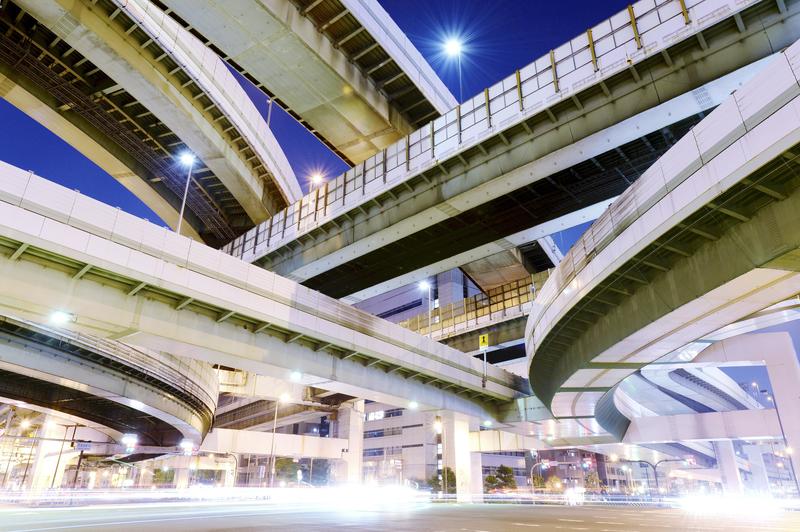
OSAKA -- Huge structures, such as bridges and buildings, have a mysterious charm. The term "kojo-moe" (factory love), which refers to people who feel affection for the imposing presence of factories with many tanks and pipes, has gained popularity and is now largely accepted.
Under such circumstances, the number of people who love looking at the forms and shapes of highway junctions is quietly on the rise. Among these structures nationwide, the Hanshin Expressway's Awaza Junction in Nishi Ward, Osaka, is rated as the most beautiful in western Japan, or the "yokozuna of western Japan," for its dynamic appearance.
'Power and dynamism'
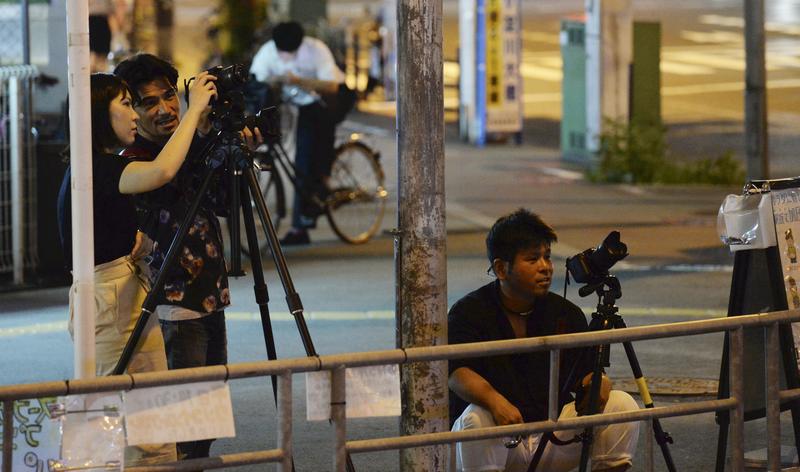
One night in mid-July, I visited the Awaza intersection, where I met Mana Kondo, a 26-year-old company employee from Kyoto. Every time the traffic light changed from red to green, cars, trucks and bicycles busily came and went. When I looked up, I saw the eight roads of Awaza Junction crossing over each other.
"There is no other place where I can feel the power and dynamism of an expressway so closely," Kondo said, while taking pictures with a fascinated look on her face. She said she likes looking at junctions when she is traveling. The junction's overwhelming presence dominates the space and apparently prompts feelings of admiration among junction lovers.
Underground are the Osaka Metro Sennichimae Line and Chuo Line, as well as gas pipes and other infrastructure. In such a place, it is not easy to construct the foundations to support such a huge structure. Hiroshi Yamawaki, a 41-year-old company employee from Osaka, said, "I wonder how difficult it was to build this many roads directly over a place where subways and things like gas pipes run." He said that winter is the best time to take beautiful pictures of the junction because the air is so clear that rays of light, such as those from cars and street lamps, can be seen clearly.
Most beautiful in western Japan
Awaza Junction connects the Osaka Port Line running east to west, the Kobe Line running north, and an interchange on the south side. About 130,000 vehicles pass through the junction each day. To merge with the Kobe Line and connect to an exit and entrance, the junction has a triple layer structure consisting of the Osaka Port Line and two roads over and under the line that run north-south. The road at the highest level of the junction is about 25 meters above the ground, and the lowest is about 10 meters up.
Photographer Ken Oyama, 45, who published a photo collection called "Junction" featuring junctions across the nation and has experience organizing tours to view them, said, "The beauty of the junction's complex form and shape deserves the title of 'yokozuna in western Japan.'" In a ranking by junction lovers, the Hakozaki Junction of the Metropolitan Expressway in Chuo Ward, Tokyo, was ranked the "yokozuna of eastern Japan."
Various formations
It may seem to the unacquainted that all junctions have similar structures. Are there any big differences between them?
According to Hanshin Expressway Co., junctions can be divided into several groups according to factors including their shapes as seen from above. A junction where looping roads that look like circular leaves extend out from the center in four directions is called a "clover-type" junction. A three-road junction that forms the shape of a "Y" is called a "Y-type" junction. Awaza Junction is relatively close to the "diamond type," where the roads surrounding the central part form a diamond shape, according to the company.
Masashi Arai, 40, an official of the company, explained the charms of Awaza Junction by saying, "To build the structure, its necessary functions were intensively concentrated in limited space in an urban area, and this resulted in it having a great impact on people when they look at it from below." According to Arai, when looking at junctions like clover-type ones from ground level, they do not look so dynamic because their structures seem dispersed. In a diamond-type junction, the structures create layers, which helps make it look massive.
In essence, junctions are just points we pass through, and I wonder how many people look at them carefully. In the first place, drivers cannot pay attention to the shapes and structures of roads when driving on expressways. However, on websites, there are many affectionate comments from people drawn to junctions.
Awaza Junction is located in central Osaka and does not have any rich nature or a historic atmosphere. The surrounding environment is noisy, so I would have thought it better to quickly pass through. However, after listening to junction lovers, my impression of it changed. The huge structure was built using various advanced technologies, such as construction methods for building long roads and the carefully calculated curves that enable drivers to steer smoothly through them.
Looking at the junction, this familiar place now looked like a beautiful urban structure.
Access
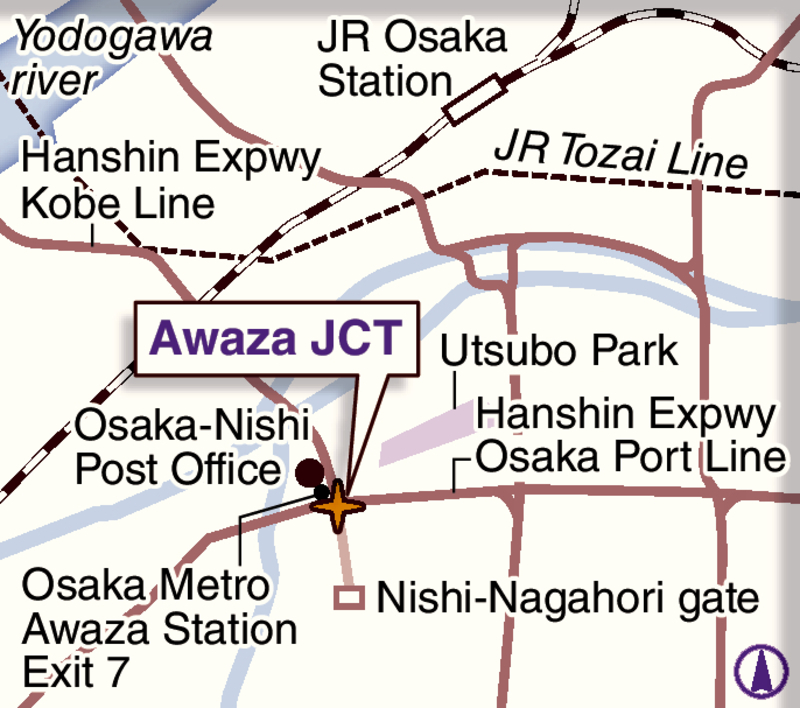
Awaza Junction is located almost directly above the intersection of the Osaka municipal Chuo Odori street running east to west in central Osaka and the Osaka prefectural Shin Naniwa-suji street running north to south. The junction is a short walk from Awaza Station on the Osaka Metro Chuo Line and Sennichimae Line. A photo spot popular among junction lovers is the area in front of the Osaka-Nishi Post Office, near Exit 7 of the station. From this spot, it is possible to photograph both the curves and straight lines of the bridge girders.
Read more from The Japan News at https://japannews.yomiuri.co.jp/