Jumping rope has become a popular form of exercise that can easily be enjoyed at home as the novel coronavirus outbreak has made going out difficult. The World Health Organization even recommends jumping rope as a way of maintaining good health. Online jump-rope classes and jump-rope contests hosted via smartphone apps also are available, having the added benefit of being something that can be enjoyed without worrying about infection risk.
Sixth-grader Sara Kondo of Chigasaki, Kanagawa Prefecture, participated in an online jump-rope class this summer. She challenged herself to try a jump-rope technique that incorporates a triple jump with the support of the instructor shown on the screen. "You will be among the best in the world if you can do this technique. Let's do our best together," the instructor said. "I didn't know how to practice jumping rope, but it was easy to learn about it because I just had to copy the instructor's movements," Kondo said.
Nagoya-based Japan Jump Rope Academy began offering online jump-rope classes in April as the pandemic made holding in-person classes difficult. With a monthly fee of 3,000, yen including tax, members have free access to videos made by the academy. "We are receiving more inquiries partially because many elementary schools have given students a jump rope assignment to complete during schools' pandemic-driven temporary closures," said Shoichi Kasuo, the academy's president.
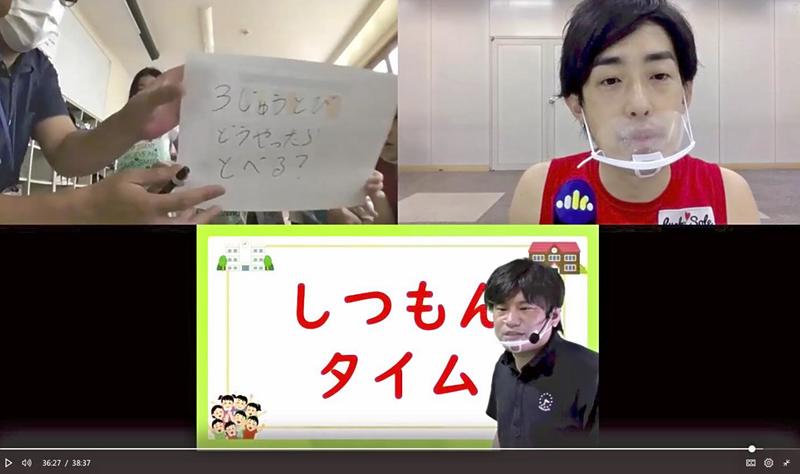
Guinness World Records jump roper Hijiki Ikuyama also lends his efforts to online classes. In early August, he appeared in an online program provided by Sumitomo Life Insurance Co. and Houkago NPO Afterschool, a nonprofit organization in Tokyo, linking a conference room in Tokyo to a children's facility in Kawasaki. Ikuyama in the program performed a quadruple jump and advised each of the children on techniques such as how to hold the rope and turn their arms.
"Things cannot be the same as they would be in an in-person class, but I would like to use this online program as a new tool to show the appeal of jumping rope and to help improve [students'] jump-rope skills," Ikuyama said.
Jumping rope also seems to be attracting attentions on a global scale. The World Health Organization, the Federation Internationale de Football Association and the United Nations are promoting jumping rope, dancing and other activities that children can easily enjoy amid concerns over a lack of exercise, especially among children, as many were forced to refrain from any outings because of lockdowns in response to the coronavirus pandemic.
Online jump-rope competitions have also begun to be held.
The Nagoya-based Japan Jump Rope Project (JJRP), which has conducted national competitions seeing 3,000 participants every year, has recently begun holding video contests.
Members are asked to download the free app "Jumpsta SC" and submit a video entry of themselves jumping rope for 30 seconds. They are then ranked based on the number of times they jump. There are several competition categories depending on age and the type of jumping. Members are free to submit as many entries as they like. A commemorative gift is awarded to those who achieve a high rank.
According to JJRP representative Keiko Suzuki, several projects, including the one held for the first time where parents and children jump rope together, proved popular. "I hope jumping rope will help build the physical strength of both the adults and children who tend to be glued to their smartphones," Suzuki said.
Senshi Fukashiro, president of Japan Women's College of Physical Education and a jumping rope expert, said jumping rope is an efficient exercise that effortlessly consumes energy. "Anyone, regardless of age, can do it, and enjoying it doesn't require a large place," the expert in kinesiology of exercise said. "Let's keep healthy and overcome the virus through the fun of jumping rope."
Read more from The Japan News at https://japannews.yomiuri.co.jp/