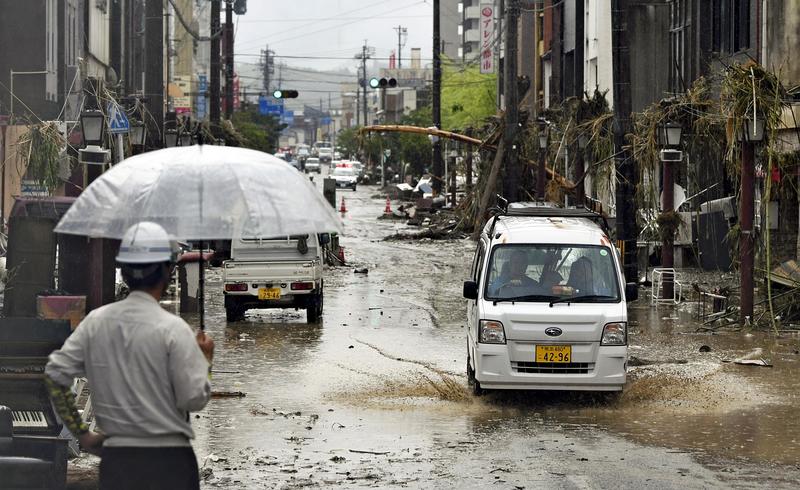
Kumamoto, Fukuoka and other areas in northern Kyushu have been hit by heavy rains.
In all cases, cumulonimbus clouds have banded together to form an "elongated precipitation band" that dumps huge amounts of rain. This goes against the usual image of the rainy season as a time of continuous drizzle, and has created a series of disasters involving heavy rain.
--Warming
"I'm sick and tired of it happening every year. How long is this going to go on?" said Hideyo Sakamoto, 68, who came to a community center near his home in Hita City, Oita Prefecture, around noon on Monday.
A mountain in back of his home collapsed during the heavy rains that hit northern Kyushu in July 2017, forcing him to live in the community center for about a week. Ever since then, he has taken refuge in the community center almost every year.
This year the Chikugo River that flows through the city flooded. People he knows had their houses inundated, some above the floorboards.
Kyushu has experienced severe floods in many recent years, including events in July 2009 and 2012 that took many lives.
According to University of Tokyo Prof. Hisashi Nakamura, an expert in climate dynamics, air containing a large amount water vapor coming from seas south and west of Kyushu and flows into the seasonal rain front in the region this time of year.
When two air currents join together to provide a continuous supply of water vapor, it can create an elongated precipitation band that generates heavy rains.
In addition to this, the seasonal rain front has stalled near Kyushu this year, providing a continuous inflow of hot, wet air that is generating major precipitation.
A Japan Meteorological Agency official stressed how unusual the situation was, saying, "We've never seen a rain front stay for so long."
According to the agency, the number of "heavy rains" (at least 80 millimeters per hour) observed nationwide is up by 1.7 times on average compared to about 40 years ago.
It is thought that the air now contains large amounts of water vapor, which some say is due in part to global warming.
Kazuhisa Tsuboki, a professor of meteorology at Nagoya University, said, "It is believed that global warming is progressing at a rapid pace in the area around Japan. That could make rain more likely, not just for Kyushu but nationwide."
--Localized, short
Is it possible to predict the occurrence of an elongated precipitation band?
Typhoons are a typical example of a weather phenomenon that causes heavy rain. They are hundreds of kilometers large and last for multiple days.
In contrast, elongated precipitation bands focus intense rainfall over a small area. They can drop an enormous amount of precipitation in just a few hours.
They are small and do not last long, and can be triggered all of a sudden by local topography, winds and other factors, which makes them difficult to predict.
The warm, moist air that creates rain is generated at sea, but the forecasting network is sparser in the ocean compared to on land, which places limitations on predictions.
Regarding the heavy rain that fell on Kumamoto, an agency official said, "The actual amount of precipitation was way over the forecast."
Ryohei Misumi, head of the water and landslide disaster prevention research department at the National Research Institute for Earth Science and Disaster Resilience, said, "Honestly, it's pretty tough to make forecasts that are accurate to the municipality level with current technology."
--Practical applications
Tetsuya Takemi, an associate professor of meteorology at Kyoto University, said, "As global warming progresses, the mechanism behind rain will remain the same, but the amount of rain will keep increasing. Major flooding like happened this year, which used to happen once if at all in a person's life, could start happening two or three times during a lifetime."
Work is proceeding in Japan on new technologies that use cutting-edge meteorological radar and other tools to forecast the elongated precipitation bands that keep causing flood damage.
It remains to be seen whether technology can be developed that can accurately respond to sudden weather changes like happened during this year's downpours.
Read more from The Japan News at https://japannews.yomiuri.co.jp/