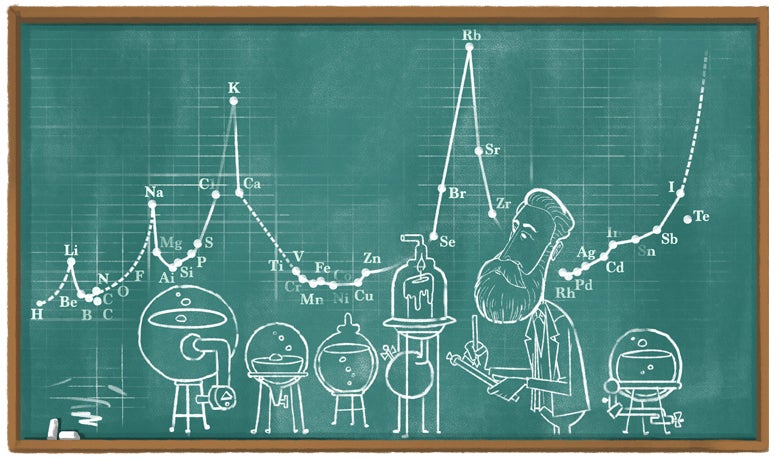
Google is celebrating the 190th birthday of the chemist and writer Julius Lothar Meyer with a Doodle depicting him experimenting in the lab to a backdrop of his vertical display of elements.
Born in the town of Varel, Germany, on this day in 1830, Meyer was one of the two pioneers to discover the periodic law of chemical elements and develop the first periodic table.
Meyer grew up in a medical family, his father Friedrich August Meyer was a physician, and he initially studied medicine at the University of Zurich in 1851.
He then turned his focus to physiological chemistry and earned his doctorate from the University of Breslau with a thesis on the effects of carbon monoxide on the blood in 1858.
A year later, he embarked on a career as a science teacher.
Meyer published his seminal book Die Modernen Theorien der Chemie (Modern Chemical Theory), which included a rudimentary system for organising 28 elements based on atomic weight – a precursor to the modern periodic table, in 1864.
Meyer was not alone, however, in the race to create a complete system as Russian chemist Dmitri Mendeleev was developing similar ideas of his own.
Meyer designed a more comprehensive table in 1868, but before he could publish, Mendeleev released a periodic table of all elements known at that time.
Meyer’s subsequent 1870 paper included a revised version of his earlier table and was groundbreaking thanks to its graphical demonstration of the relationship between atomic volume and atomic weight, which provided strong evidence for the periodic law describing cyclical patterns among the elements.
In 1882, Meyer, jointly with Mendeleev, received the Davy Medal from the Royal Society in recognition of their work on the periodic law.
Meyer moved to Tubingen in 1876, where he taught and guided the work of more than 60 doctoral candidates
He died on 11 April 1895, aged 64.