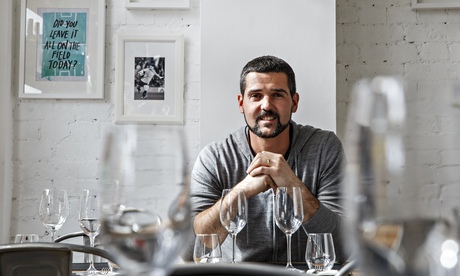
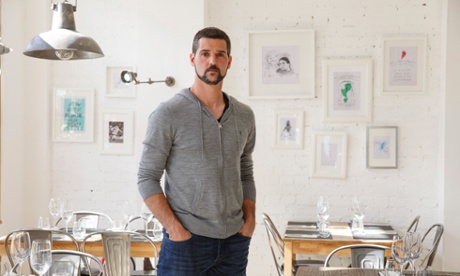
Julián Speroni is sitting at a table in the restaurant he co-owns, sunlight streaming in past the bottles of wine and olive oil perched in the window and the goalkeeper oblivious to the gridlock of the mid-afternoon school run choking Purley Cross outside. He has been asked to rattle off a list of the most talented players alongside whom he has lined up for Crystal Palace. A few throwaway names would do for his undemanding audience but, even putting politics aside, he seems genuinely stumped. “That’s so tough,” he says. “You’ve got to remember that, before this season, I’d played with almost 200 team-mates at Palace. Probably more.”
The excuses, however justified, do eventually give way to an answer. “As a defender I’d say Gonzalo Sorondo, someone we didn’t see enough of because of injuries, but what a player. Technically, so strong. When it comes to natural talent I saw Victor Moses going from academy to first team and Wilfried Zaha too. Raw talent growing up. Look at the potential of Yannick Bolasie. There was Nathaniel Clyne and José Fonte, Dougie Freedman and Andy Johnson, Clinton Morrison … no, it’s too difficult.” It says everything about the Argentinian’s longevity at Palace that Moses, now of Chelsea, was 13 when Speroni arrived in south London. Zaha, then 11, was still a year away from joining the academy.
The post-season has been transformed into a celebration for Speroni. On Tuesday he welcomes Dundee, his first British club, to Selhurst Park for a testimonial to celebrate his 11-year stint with his current team. The majority of Alan Pardew’s squad will feature, with the manager himself to enter the fray at some stage alongside his contemporary, John Salako. Former team-mates, from Aki Riihilahti to Danny Butterfield, will play a part while the visitors, backed by 1,700 travelling fans, will include Charlie Adam, Fabián Caballero and Temuri Ketsbaia in their number.
The 36-year-old goalkeeper will be feted by those in the Holmesdale who once draped a banner from top to bottom tier acclaiming their very own Manos de Dios. Speroni himself is still struggling to comprehend the level of adulation. “When they did that for my 250th game, I’d gone out on the pitch expecting a little flag or something so big,” he says, sizing it up with one arm. “Then I saw those banners. I still can’t thank them enough.”
Speroni often ends up pinching himself when he contemplates the journey he has made from Saavedra, Buenos Aires to the Premier League via Dundee. Or, putting the geography to one side, to mid-table in the most watched league in world football via one relegation, a painful administration and 11 different managers – permanent, interim or caretaker – at Palace alone. His story is unconventional, that of a Boca Juniors fan who had fallen in love with the game while accompanying his grandfather to La Bombonera every other week but who ended up spending time in the academy at their rivals River Plate before breaking into the first team at his local side, Club Atlético Platense.
There he once returned to the dressing room after training to find armed men eager to berate the team for their failings. There were two senior appearances before footage of his displays reached Ivano Bonetti, the Italian – and former Palace player – in charge of Dundee at the time, and an unlikely opportunity in Europe awaited. He did not speak a word of English and he and his childhood sweetheart (and future wife), Marina, enlisted in a Tayside college to pick up the basics. “But we had seven Argentinian players in the squad so that helped. I’d read the lyrics of songs I liked, lots of Led Zeppelin and AC/DC, and got my friends to correct me when I spoke poorly. And I played. We reached the Scottish Cup final in my first full season. I had my nose broken in training just before the game – I came for a cross and one of my team-mates smacked me in the face with the back of his head – and they said I shouldn’t play. But I was never going to miss a Cup final. I had two black eyes at Hampden.”

There were only two and a half years at Dens Park but he impressed enough to be inducted recently into the club’s hall of fame, with the rush to book flights and hotels for the testimonial a reflection of the esteem in which he is still held. Palace, newly promoted under Iain Dowie, prised him away in 2004 for £500,000, though a quick glance at a YouTube video of his home debut, against Everton, offers a reminder that his association with his new club might have been short-lived. It is at around 90 seconds into the clip that Speroni grimaces, the commentator declaring “and I’m not quite sure what he’s doing” as the goalkeeper dawdles at a back-pass, fails to trick Kevin Campbell and ends up conceding a penalty. “It’s actually Tony Popovic’s fault for passing me the ball,” he says. “And it wasn’t a penalty. Come on, he dived. As for the hair, what was I thinking? I don’t know. I was young …
“You always want to impress early on when you sign for a new club but at the time I had a bit of South American naivety in me still. I’ve never stopped the ball in the box since. I look back at that now and think: ‘Why?’ I had time, I could have kicked it straight away. But I grew up playing football, passing the ball around, sometimes taking risks. I learned. If I’d done that back home it would have just been forgotten. Here I paid a big price. It took me three years to get back into the team.”
There were only 15 league appearances in those first three seasons. He did not appear on a winning side in the Premier or Football League until December 2006, by which time Peter Taylor was in charge and had offered Gabor Kiraly’s understudy the chance to move on “to get some games”. “I learned a lot in those first few seasons, even when things weren’t good and I was out of the team. Mentally I became tougher. It was necessary to have that little shock, to learn how the game was played in this country – different to Scotland, to Argentina, to anywhere else. Even though I suffered a lot those first few years, I could take a lot of positives from it.” When Kiraly left at the end of that campaign, Speroni had his chance. In the eight seasons since he has started all but 10 of Palace’s 352 league games.
The top flight has showcased his abilities as he made his name on a bigger stage with those trademark reaction saves. The pair from Eden Hazard when Tony Pulis’s Palace prevailed at Selhurst Park last season were two of his best, though Speroni tends to reflect on team performances rather than personal excellence with more pride. He charts the club’s revival to an excruciating afternoon at Hillsborough on the final day in 2009-10, when the club languished in administration with its very existence on the line. They were in the Championship and a draw was required at Sheffield Wednesday to secure safety at their hosts’ expense. “The psychology of that season was incredible,” he reflects. “We’d been playing well, winning games and targeting the play-offs, and then we had 10 points deducted and were suddenly in a relegation battle. And, just like that, we couldn’t win a game and the club’s future was up in the air.
“That game got to us all but Hillsborough was where the bond was really strengthened with the fans. Screaming at [the club captain] Paddy McCarthy in stoppage time when he headed one out of my hands and behind for a corner … we were having a right go at each other when the referee blew the final whistle.”
The 2-2 draw kickstarted a new era for Palace. “That was when things changed for the club. New owners took over that summer and since then we’ve managed to build the situation we’re in now. It all started at Hillsborough. If we’d lost that game, I don’t know where Palace would be now.”
Their return to the elite in 2013 was played out under another three managers and via a play-off success over Brighton & Hove Albion that was briefly overshadowed by “Poogate”. Palace’s players had arrived at the Amex for the second leg of the semi-final to find the tension in the tie had clearly already had an explosive effect. “There was, well, a mess. We didn’t know what had happened. Ian Holloway went crazy but I don’t think he knew what had happened. He just jumped to conclusions and blamed everybody. I smelled it … but I didn’t want to go closer. The first I knew that it was actually our coach driver, who had been ill, was when Paddy told the audience on stage at my testimonial evening. But what spirit we showed that night.”
The final at Wembley included a critical save to deny Watford’s Troy Deeney a tap-in, even if Manuel Almunia was the busier of the two goalkeepers on show, before Speroni was finally granted a chance to excel more regularly in the top flight. It was Pulis who oversaw safety last term, his No1 praising the “organisation” instilled in a squad who made history by surviving a Premier League campaign for the first time since the elite were revamped. The team have progressed again under Pardew this year, with Speroni now established as the latest in a succession of Palace goalkeepers who have spanned the generations: he now sits alongside John Jackson, John Burridge and Nigel Martyn.
“That people even put my name anywhere close to those guys, for me, is just unreal,” he says. “They’ve been such heroes for this club, real legends. It’s an honour for me that people put me within that group. People talk to me about the way Palace fans feel about me, and I see it when I meet them around the ground or in the street, but I don’t see myself as that person. Players move around all the time in the modern game and when I first signed I never thought I’d be here for 11 years. But I’ve never felt the need or a reason to leave.”
Fulham tried once and Sunderland and West Brom were poised last summer before his latest one-year extension kicked in, but he has put down roots in the area. His son, Thiago, is six and would be torn should England ever confront Argentina on the football pitch, while his daughter, Isabella, is seven months old.
All the money raised at Tuesday’s game will go to charity, from Marie Curie to local community projects “struggling without the funds”. “I’ve been blessed through my career in many ways,” adds Speroni. “I want this to be a celebration of my time at the club; a memory the fans can take home and one I will cherish forever.”
Speroni’s managers at Crystal Palace (11): Iain Dowie; Peter Taylor; Neil Warnock (1); Paul Hart (interim); George Burley; Dougie Freedman; Lennie Lawrence (caretaker); Ian Holloway; Keith Millen (caretaker, 1); Tony Pulis; Millen (caretaker, 2); Warnock (2); Millen (caretaker, 3); Alan Pardew.