On Aug. 4, Julian Beaudion (D) withdrew from the South Dakota general election for the U.S. Senate — the fifth time a major or minor party U.S. Senate nominee has withdrawn this year. As a result, this year ties with 2014 for the most nominee withdrawals (voluntary, misconduct-related, or due to death) since 1918.
Beaudion said he decided to withdraw following a fire at his house: "After the fire, an opponent and those associated with the opponent, hit my family and I with intimidating threats to drop out of this race." Beaudion also said that he would not endorse either of the remaining candidates in the election — incumbent Sen. Mike Rounds (R-S.D.) and Brian Bengs (I).
South Dakota Democratic Party Deputy Director Joe Zweifel said the party will not nominate a replacement candidate.
Four other nominees have left general elections this year
On July 10, Graham Platner (D) withdrew from the Maine general election following an accusation of sexual assault. Troy Jackson (D) won the July 25 nominating convention to replace Platner.
On July 11, then-incumbent Sen. Lindsey Graham (R-S.C.) died. There will be a special Republican primary on Aug. 11 to select a replacement nominee for the South Carolina general election.
On July 17, Cindy Burbank (D) withdrew from the Nebraska general election. It is unlikely the Nebraska Democratic Party will be one after the party endorsed Dan Osborn (nonpartisan) in August 2025.
On July 28, David Roth (D) announced he would withdraw from the Idaho general election after “work[ing] with my team to meet our remaining financial obligations and complete the formal withdrawal process.”
Twenty-eight of the 39 nominees who withdrew from a general election were replaced by their party. Seven of those 28 replacement nominees have been elected, with the most recent being former Sen. Frank Lautenberg (D-N.J.).
With the Democratic Parties in Nebraska, Idaho, and South Dakota either saying they will not nominate a replacement candidate or not commenting on their next moves, independent candidates will be left to run against Republican incumbents in each of those states.
In an analysis on independent candidates running this year, NPR's A.J. Simmons wrote, "In many states, one party's label has become a political liability, and candidates appear to be adapting accordingly. Every viable independent Senate candidate is either a former Democrat or closely aligned with the Democratic coalition in a state, and all are running in Republican-dominated states where Democrats are unpopular.”
Three states could have only one major party candidate on the general election ballot this year
From 2000 to 2024, there have been 16 general elections for the U.S. Senate with no Democratic candidate, compared to four with no Republican candidate. If the Democratic Parties in Nebraska, Idaho, and South Dakota choose not to nominate a replacement candidate, the number of general elections without a Democratic candidate would increase to 19.
During that period, each of the three states held one general election for the U.S. Senate with no Democratic candidate. There was no Democratic candidate on the Nebraska ballot in 2024. The same was true in Idaho in 2004 and in South Dakota in 2010. None of those states had a general election without a Republican candidate.
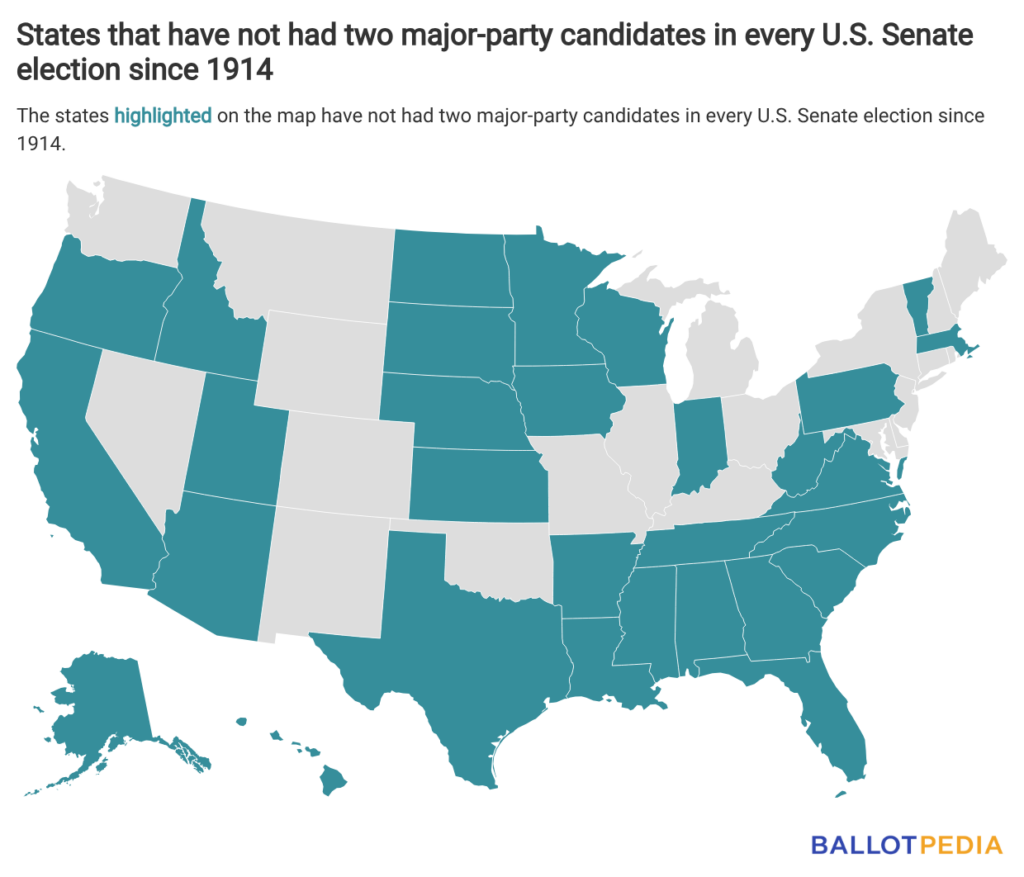
According to Smart Politics' Eric Ostermeier, there are 20 states in which a Democratic and a Republican candidate have run in every U.S. Senate election since 1914. That was the year that the first U.S. Senate elections took place following the passage of the Seventeenth Amendment, which allowed for the direct election of U.S. senators.
In the other 30 states, there has been at least one U.S. Senate election that did not include either a Democratic or a Republican candidate.