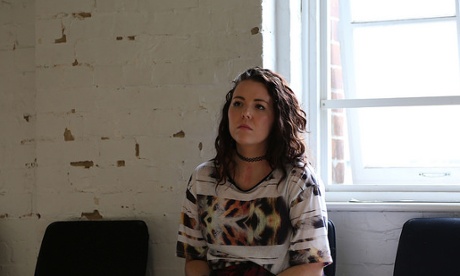
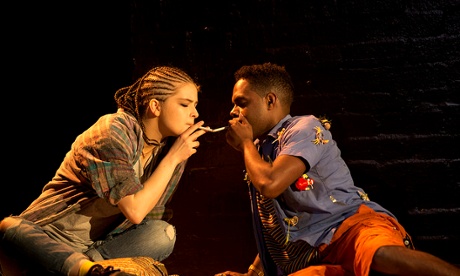
One of the brightest young talents on the Australian stage, Julia-Rose Lewis won the Philip Parson fellowship for emerging playwrights for her first play Samson. After a run at Brisbane’s La Boite and currently running at Sydney’s Belvoir theatre, the coming-of-age story of four young people dealing with their first experience of grief has attracted much praise. Here the young playwright talks about an unfortunate clash between friendship and religion, why helping other women is the best way forward and why working with her sister is the ideal creative partnership.
Where did the idea for your play Samson begin?
It was an amalgamation of a few different images I smashed together to create a story. One was this very religious element, another is a young boy jumping from the rope swinging and dying and then it was this idea of teenage isolation.
Why were you interested in exploring religion?
I had a best friend who discovered a Christian church when we were about 20 and it completely changed who I thought she was. She felt she had found her true self, whereas I felt like she was a completely different person. So I became obsessed with this gap between who I thought she was and who she felt like she was and how organised religion played into that. Also my family was Catholic but not really Catholic, so I grew up with this religious iconography in my life but never really understood it, so I’ve always been fascinated by trying to understand what religion is.
And why did death come into it?
My first experience of death was when my father died when I was 9 and that was a really formative event. A few years later my grandmother died of cancer and she was a really pivotal part of my life as well. Then my mum got diagnosed with multiple sclerosis. Even though those three events were spread out over 10 years, they forced me to realise life is so short. I have so many questions around how people choose to live their life and that question links directly to what faith we choose to get us through life. Every human has to have faith in something, whether you are religious or not, you have to find a faith in something to explain those events in life that are so big we can’t fathom their impact.
Is Australian theatre is good at depicting young people?
The thing about plays for or about young people is they age very quickly. This play feels very current now, the language feels relevant, the themes feel relevant, the way they are existing in space and the humour feels relevant to now, but in five years time, it won’t be any more. It just won’t. Like all of the great plays about young people that have come before this, like Away, Blackrock and Summer of the Aliens, even though they are the most wonderful plays, they feel dated. So to keep a currency on Australian stages, playwrights have to be working quite fast to spit those plays out so the conversations around young people stay relevant. What it was to be a young person in Australia when I was a teenager is completely different to young people now, and I’m only 25, so things shift so fast.
What did it mean to you to win the Philip Parsons award?
That was so unexpected and so amazing. The people I was shortlisted with were all people I look up to and had looked up to for years. In my mind, I was aspiring to achieve the things they had achieved. It was such an honour to even have my name in that list with five other writers who I think are brilliant, and then to win it was this extra unbelievable thing. It’s the most amazing freedom. It’s Belvoir saying, we will pay you to write a play, now take the time you need to dream up what that play needs to be. I can write the play I really want to write, rather than the first one that comes to my mind.
You and your sister are writing a play together called Sibling Rivalry. How does that work?
We have such different tastes in what we love and have such different skills, but when we work together, we work so well. We have huge arguments creatively but then very quickly get over it and move onto the next point. It’s the ideal creative relationship because there is nothing I can say to my sister that is going to be more hurtful than things I’ve said to her in the past. We’ve already covered all of the ground for arguments, so we can just smash through ideas. It will probably be a comedy about our lives, which have been somewhat tragic but also somewhat hilarious.
Which plays have had the greatest influence on you as a writer?
There are different plays that resonate with me for specific projects. So for Samson the play that had the biggest impact on my desire to write for young people and to make it resonate was Summer of the Aliens by Louis Nowra. [It’s] my favourite play for young people and it’s so under-produced. For one of the other plays I’m writing at the moment, I’ve been really influenced by Caryl Churchill’s Far Away. It’s not that I want to recreate the play, I want to recreate the feeling that play gives a viewer or a reader.
Which other Australian playwrights are you excited about at the moment?
There’s a young writer called Sharni McDermott, who hasn’t had anything produced yet but I’m really excited about what she does. But I get excited about seeing everyone’s work, because everyone has such different ideas and I love seeing what people come up with.
Between you, Nakkiah Liu and Lally Katz, there seems to be a groundswell of young female Australian talent. Do you think that’s happening?
Yes, when I think about the playwrights I’m really excited about, they are mostly female playwrights. It feels like there is an energy behind the female voice at the moment, in what women have to say and their perspective, even if it’s not necessarily a play about women. Because the industry and the audiences are really engaged in those writers, it gives them confidence. Then the work they create is filled with all this energy and fire and confidence, and it makes the work better. I have been so blessed to benefit from playwrights like Lally Katz and Nakkiah Liu lighting the fire and letting it burn, I’ve been able to inherit confidence and create this work. There’s a feminist who says that every time you take a step up in your career, it’s your responsibility as a woman to grab the hand of a young woman who is one step below you and pull her into the position that you were in. Lally has mentored me and Nakkiah has been so supportive of me, so I feel like those women really did grab my hand and pull me up a level. So for young writers like Sharni McDermott I want to grab her hand and pull her up behind me. Once that cycle starts moving, it is unstoppable.
Complete this sentence: good theatre comes from...
Bravery. Any time people are willing to risk a lot to create something, the work is better. I went to a play reading last night for a friend called Shari Irwin. It’s her first play and it’s semi-autobiographical, and she risked her own personal story by putting it on stage. It made the work amazing because she was risking so much. If artists can keep being brave in what they put out, then you get a lot back.
Samson, Belvoir, Sydney, until 31 May