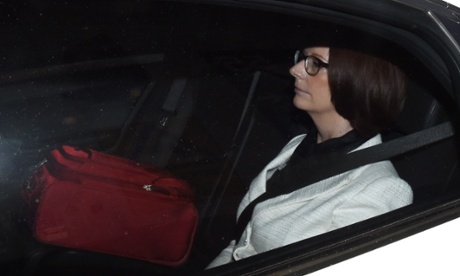
Julia Gillard did not commit any crime in setting up an Australian Workers Union (AWU) slush fund, the counsel assisting an inquiry into trade union corruption has said, but called into question her professional conduct as a lawyer.
The former prime minister, who in 1992 was a lawyer for Slater and Gordon, helped set up a fund for AWU officials Ralph Blewitt and Bruce Wilson. She was romantically involved with Wilson at the time. It is alleged that the fund was subsequently used by Blewitt and Wilson for embezzling funds.
On Friday, the royal commission into trade union governance and corruption released the submissions of its counsel assisting.
“It is submitted that she [Gillard] did not commit any crime, and was not aware of any criminality on the part of these union officials,” the submission states.
“Some aspects of her professional conduct as a solicitor appear questionable, and had she adopted a more rigorous approach to the task, it might have been more difficult for Mr Wilson and Mr Blewitt to have behaved as they did.”
It goes on to claim that Gillard received money from her corrupt ex-boyfriend.
“The evidence supports a finding that Ms Gillard was the beneficiary or recipient of certain funds from Mr Wilson.”
The former prime minister provided legal counsel for the fund for Blewitt and Wilson, which raised $400,000. She gave evidence to the royal commission that she believed that Wilson and others wanted a fund to draw on when running for union elections.
The counsel claimed the evidence given from others proved that Gillard received funds from her then boyfriend, but was aware of facts that would have revealed where the funds originated if she had put her mind to it.
“It is not possible to identify after all this time the precise source of the funds, since Mr Wilson seems to have drawn cash from the accounts operated in Victoria as well as from the [fund’s] account. The skimpy nature of the available evidence does not make it possible to infer on the balance of probabilities that Ms Gillard was aware that she had received the $5,000 which [had been] put into her bank account on Mr Wilson’s instructions,” the assisting counsel wrote.
“But she was aware of facts, had she turned her mind to them, which would have indicated that the source of the wads of bank notes cannot have been the low union salary of Mr Wilson of about $50,000 – a man who was supporting his family in Perth, his own household in Melbourne, and his relationship with Ms Gillard in Melbourne, and who was not shown to have had any income from property exceeding the cost of mortgage repayments – but must have been some fund he did not own but did control. That is, she must have been aware of facts, which had she turned her mind to them, would have revealed that Mr Wilson was making payments to her in breach of some fiduciary duty.”
The counsel assisting wrote of Wilson: “there can be no real doubt he acted with the requisite intent to deceive.”
“Mr Wilson was the driving force behind the [fund]. Given his dominance over Mr Blewitt, it may be inferred he also was the driving force behind the [fund’s] illegal activities,” it said, going on to state that both Wilson and Blewitt should be charged with criminal offences.
Gillard has always protested her innocence in the matter, saying she did not know that the fund would be misused.
Tony Abbott pledged to investigate dealings in the trade union movement during the 2013 federal election, and established the royal commission after becoming prime minister. On Friday he announced a joint police taskforce to investigate alleged corruption in Victorian trade unions.
The submission criticised the movement’s handling of the scandal, noting that neither Blewitt nor Wilson had been “called into account”, and that the fund was a “telling example of what can happen if a union slush fund is allowed to flourish in an environment where proper governance is non-existent or ineffective”.
Labor leader Bill Shorten, himself the former head of the AWU, wouldn’t comment on the royal commission’s submissions.
The royal commission started its inquiry in March this year. The commissioner, former high court Justice Dyson Heydon, will deliver an interim report on 15 December.