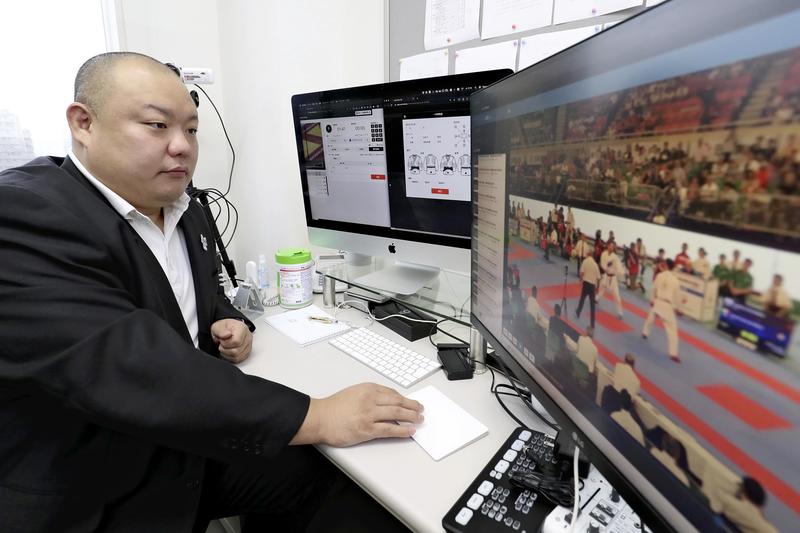
In a room tucked away on the campus of a university in Chiba Prefecture, Japan's Olympic medal prospects in judo are being enhanced by a researcher on a personal computer.
Sitting behind the screen is Takanori Ishii, an associate professor at Ryotokuji University in Urayasu who is in charge of scientific research for the All Japan Judo Federation. He has developed a system for analyzing videos of matches.
The system was constructed in the aftermath of London 2012, when for the first time ever Japanese men failed to win a gold medal in judo at an Olympics. Under the system, the techniques of foreign competitors are categorized according to such aspects as how they tie up and from which side they attempt their throws.
Details are continually recorded, bringing to light everything from each competitors' tendencies to changes in their behavior. By dividing the judo-gi, or uniform, into 14 sections, the system also identifies such characteristics as where the opponent grabs when he is attempting a shoulder throw.
The effectiveness of the system was demonstrated at the 2016 Rio de Janiero Olympics -- the men's team came away with medals in every weight class, including two golds.
In the past, coaching and developing strategies for matches relied mainly on subjective feelings based on the experience of predecessors. Ishii himself was a judoka, and competed in the 100-kilogram weight class in a generation that included Olympic gold medalist Kosei Inoue. Ishii watched videotapes of Inoue and others' matches so much that the tapes started wearing out and breaking.
Although Ishii lost to such top opponents, he always gave them a good fight. "The gap could be closed with a bit of research," he said with conviction.
The system has brought objectivity to the judo world. Such know-how will also be adopted in karate, which will make its Olympic debut at the Tokyo Games this summer.
Having made this large contribution to judo's success in Rio, Ishii was added to the staff of the Japan Karatedo Federation in 2018. His analysis system, making use of videos that are continually stored, will be thrown into the fray at Tokyo 2020.
"If you don't acknowledge this as a defeat, you'll never win," Ishii told the karate federation after a disastrous world championships in November 2018, when Japan won just one gold medal in the kumite (sparring) competition. "If you think [my system] is unnecessary, just get rid of me now."
Up to then, Ishii had had trouble convincing the powers that be of the importance of data analysis. "It's like they felt I was trying to bring in some weird thing from judo," Ishii said of the mood he had encountered.
Full-fledged data analysis in karate started in January 2019. Under Ishii's direction, vast data was accumulated, including the number of punches and kicks, and the times when points were scored. A video trove of about 4,000 matches was collected.
From now, techniques will be sorted into close to 30 different categories, and the system will reflect the scoring percentage of the kicks and punches.
Payoff in gold
Ishii joined the judo federation's scientific research department in 2005 to start research on an analysis method, after he became aware of the importance of analyzing an opponent during his own playing career.
As the federation tried to bounce back after the London 2012 humiliation, he earnestly began developing the system. Steadily inputting match videos, he eventually accumulated close to 40,000.
The videos were not limited to competitors; he also ascertained when judges issued shido warnings for passivity at the Rio Olympics. This proved helpful in Shohei Ono winning the 73-kg gold medal.
It can also provide an advantage in unforeseen situations. In the 90-kg class in Rio, eventual gold medalist Mashu Baker faced a virtually unknown opponent in the semifinals. But Ishii and staff from the scientific research department edited videos of the opponent from earlier matches and got them into the hands of Japan team coaches in well under an hour. That gave Baker insight into the opponent's favored moves, and he went on to win the match.
The method of analysis has advanced since Ishii started studying videos during his college days. "It's not a sure-fire way to assure a victory, but it can provide a helpful push," Ishii said.
Combined with his duties as an associate professor at Ryotokuji University, Ishii said he gets an average of about four hours sleep per day.
"I'll ride it out with fighting spirit all the way to the Tokyo Olympics," he said with a laugh.
Read more from The Japan News at https://japannews.yomiuri.co.jp/