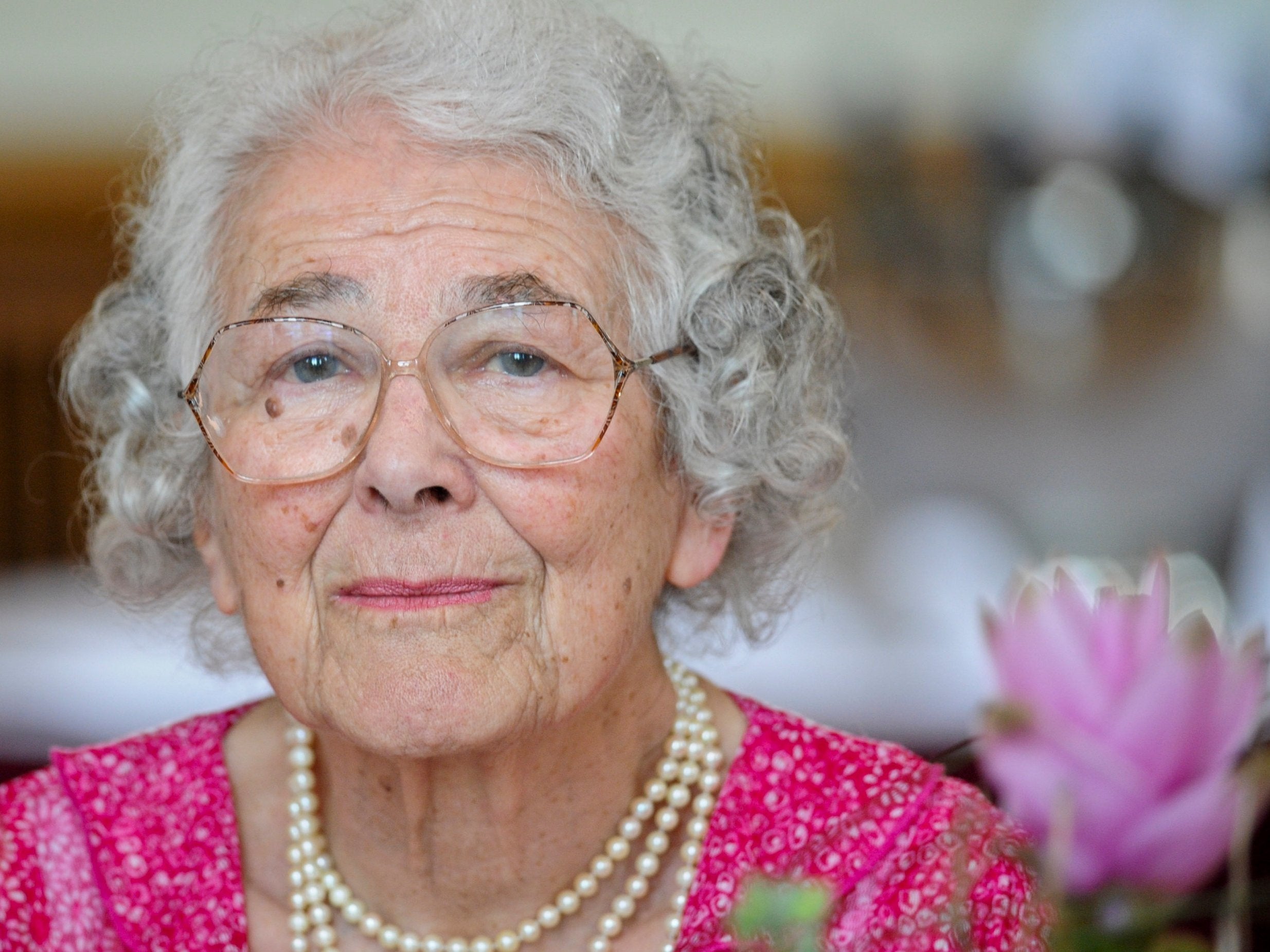
“I remember asking Judith Kerr if the tiger symbolised the 1960s sexual revolution, where normal mores and suburban life became upended by this wild and exotic creature,” tweeted the journalist Emily Maitlis, when news broke today of the death of the 95-year-old children’s book author, best known for writing The Tiger Who Came to Tea. “She told me no, it was about a tiger coming to tea.”
Kerr was 94 when her book, first published in 1968, sold its millionth copy last year. A tale both simple and bizarre (as the best-loved children’s books often are), it presents a fantastical scenario with a beautifully straight face. A girl called Sophie is sitting down for afternoon tea with her mother, when a talking tiger knocks on the door and proceeds to eat – ever so politely – all the food in the house. “He ate all the supper that was cooking in the saucepans… and all the food in the fridge… and all the packets and tins in the cupboard… Then he said, thank you for my nice tea. I think I’d better go now.” The next day, Sophie and her mother go out and buy a “big tin of tiger food”, but the tiger never returns.
The book – with its warm, sketchy, colourful illustrations – instantly captured the imaginations of both children and parents, but Kerr went into it with a degree of trepidation. It was the first she’d ever done, and she was “very uncertain about what I was doing. I had never done a picture book or gone to book illustration classes”. Perhaps it was this very naivety, and the fresh, uncynical approach she brought to her creation, that made the book so enduringly popular.
Kerr also authored the older children’s novel, When Hitler Stole Pink Rabbit, a semi-autobiographical account of her family’s escape from Nazi Germany in 1933. Maitlis’s socio-political interpretation of Kerr’s work, then, wasn’t completely outlandish.
Born in Berlin in 1923, Kerr spent her early years living in an elegant house in Berlin. Her father Alfred was a Jewish theatre critic, and her mother Julia was the daughter of a Prussian politician. But in 1933, the night before Hitler came to power, her father – who had openly criticised the Nazis – was warned they were coming for him. The family packed up and fled to Switzerland, then France, before eventually settling in Britain. Later, his books were burnt by the regime.
When the Second World War began, Kerr helped wounded soldiers as part of her work for the Red Cross. After getting a writing job at the BBC, she married fellow scriptwriter Nigel Kneale in 1954, and had two children, Matthew (now also an author) and Tacy. But it was when she was drawing and writing stories in her studio that Kerr was at her happiest. “When I come in here,” she told The Times, “I know who I am and everything is alright.”
Another of Kerr’s beloved series was Mog, the tale of an endearingly forgetful cat. In 2002, in the 16th book in the Mog series, the tabby cat died. “Mog was tired. She was dead tired… Mog thought, ‘I want to sleep for ever’. And so she did.” It was an unusual decision, for a book aimed at young children to tackle such a topic, but Kerr was resolute.
“I don’t think it was so much about killing off Mog, as rather doing something about dying,” Kerr said a few years later. “I’m coming up to 80, and you begin to think about those who are going to be left – the children, the grandchildren. I just wanted to say: remember. Remember me. But do get on with your lives.”