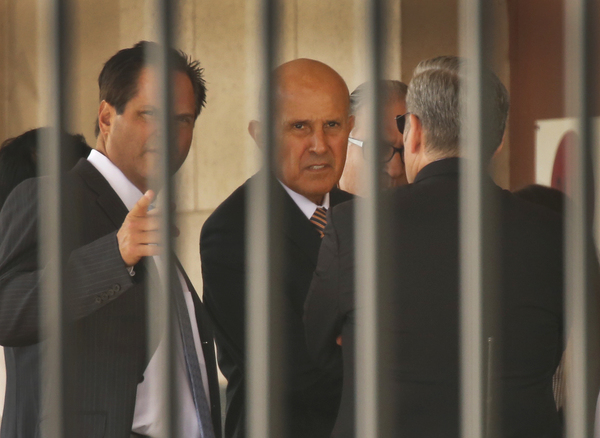
LOS ANGELES _ A federal judge rejected a plea agreement Monday under which former Los Angeles County Sheriff Lee Baca would have served up to six months in prison for lying to federal authorities, saying the punishment was not severe enough.
Addressing prosecutors and Baca in a downtown courtroom, U.S. District Court Judge Percy Anderson said the deal "would trivialize the seriousness of the offenses ... the need for a just punishment, the need to deter others."
Anderson said he would allow Baca to withdraw his guilty plea, and he set a new hearing date for Aug. 1.
Baca must now choose among several unappealing options. He could go ahead with the sentencing and accept whatever punishment Anderson has in mind. He could withdraw his guilty plea and take his chances with charges the government might decide to bring. Or he could negotiate a new deal with federal prosecutors for a longer sentence the judge would find more acceptable.
Baca, 74, had pleaded guilty this year to lying during an FBI investigation into allegations that his department had tried to block a federal inquiry into abusive deputies in the county jails. His plea was part of a deal that would have seen him serve less time behind bars than any of his subordinates _ including his former No. 2, Paul Tanaka _ received in related obstruction-of-justice cases.
Baca's attorney, Michael Zweiback, argued that the former sheriff should not serve any prison time because he is in the early stages of Alzheimer's disease.
After Monday's hearing, Zweiback said he was disappointed with the judge's decision but hoped to resume talks with prosecutors. He said he would not accept an agreement that includes a guilty plea without a specified sentence.
"At that point, we might as well take our chances at trial," Zweiback said.
Zweiback said he would rather go to trial than leave the sentence in Anderson's hands.
"We've seen how that works out," he said.
Zweiback said it is rare for a judge to override a plea agreement in favor of more prison time for a defendant. Even though the attorneys knew it could happen, there is now "a lot of confusion on both sides in terms of where does this leave us, what does it truly mean in terms of reaching something that is in some way acceptable?" Zweiback said.
Baca's Alzheimer's could be a factor if the case heads to trial and his ability to understand the proceedings deteriorates.
"He has a window of time, and that window of time is closing," Zweiback. "If the government believes it's two years in ... getting to trial and sentencing him, that could leave Mr. Baca in very bad shape."
Thom Mrozek, a spokesman for the U.S. attorney's office, said prosecutors could not comment because the case is still ongoing.
Prosecutors countered that Baca's cognitive impairment is "slight" and that he would receive adequate medical care in prison. A prison sentence for Baca would be a deterrent for other law enforcement officials, they wrote.
Baca, who retired in 2014 before completing his fourth term as the head of the nation's largest sheriff's department, won praise in office for establishing close relationships with local Muslim leaders and championing education for jail inmates.
But even as he introduced teachers and classrooms into the county jails, some of his deputies were brutally beating inmates and even a jail visitor. He adopted a hands-off management style, delegating many day-to-day decisions to powerful underlings, such as Tanaka.
In 2010, federal officials secretly launched an investigation into corruption and brutality by jail deputies. After sheriff's officials discovered that an inmate, Anthony Brown, was an FBI informant, they booked him under false names and shuttled him to different locations. They also tangled with the FBI, going to the home of one agent and threatening her with arrest.
Prosecutors alleged that Tanaka directed the efforts to hide Brown from the FBI and intimidate the FBI agent, with Baca playing a lesser role.
The courtroom Monday was packed with Baca's supporters, including former Los Angeles Dodgers manager Tommy Lasorda. Many in the audience wore yellow pins in solidarity with Baca.
Assistant U.S. Attorney Brandon Fox told Anderson that Baca's lies were part of an attempt to cover up what had been going on in the Sheriff's Department.
"That's not what a leader does," Fox said. "That's what a coward does."
The retired sheriff addressed the judge, saying he regretted not taking control of the sheriff's investigation into Brown and would do it differently if given the chance.
"I stand here today humbled and filled with remorse for my mistakes as sheriff of Los Angeles County," Baca said in court, wearing a dark suit with cuff links and a lapel pin that bore sheriff's stars. "I did not lead, instead I delegated the responsibility for this important duty and I should not have."
Anderson said federal prosecutors had applied a law in deciding Baca's punishment that "underappreciates this defendant's culpability." Under Baca's leadership, the judge said, sheriff's officials derailed a federal investigation that sought to expose an "us-versus-them" culture in which deputies were taught to cover up for one another and responded to inmates with enough violence to send them to the hospital.
A six-month sentence, he said, "would not address the gross abuse of the public's trust ... including the need to restore the public's trust in law enforcement and the criminal justice system."
By the time Baca pleaded guilty in February to a single count of lying to federal authorities, seven sheriff's officials had already been convicted after going to trial in related cases, receiving sentences of a year and a half to more than three years in prison.
Tanaka was convicted by a jury in April and received a five-year sentence from Anderson.
Prosecutors have said they agreed to six months for Baca in part because of his willingness to plead guilty; Tanaka's attorney characterized the deal as "a sweetheart kiss."
In his plea agreement, Baca admitted to lying in an April 12, 2013, interview with investigators, stating that he was not aware of the plan to confront the FBI agent at her home.
In fact, according to the agreement, Baca was at a meeting where officials came up with the plan, telling his subordinates that they "should do everything but put handcuffs" on her.
Baca was also involved in a conversation with subordinates about keeping Brown away from the FBI, though he said in the interview with federal investigators that he was not, the agreement said.