CHICAGO _ A judge refused Wednesday to let attorneys for a Chicago police officer charged in the murder of Laquan McDonald review protected juvenile records detailing the teen's chaotic history as a state ward, saying she was troubled by the request.
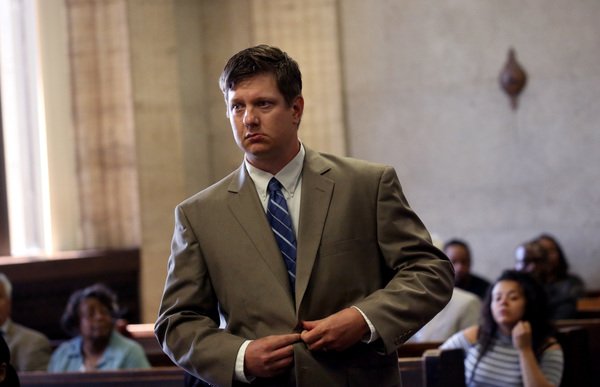
Judge Patricia Martin, who presides over the juvenile court's child protection division, held that Officer Jason Van Dyke has no legal right to the confidential files simply because he is charged criminally with the teen's death.
"This court is troubled by your argument that you have a (legal) standing because you represent a person who is charged with the murder of this young man ... I don't find you have a special interest in these files," said Martin, citing the state's Juvenile Court Act.
The judge's ruling came after lawyers for McDonald's mother strenuously objected to the request by Van Dyke's legal team, calling it "a fishing expedition" for "otherwise irrelevant and inadmissible evidence to shift focus away from the graphic video" of the shooting.
"Laquan McDonald is a victim, and was for most of his life," the lawyers wrote in the 21-page document filed Wednesday. "Now, in death, (Van Dyke's lawyers) seeks access to the most intimate details of his young life for purposes of defending the man who shot Laquan repeatedly as he lay defenseless in the street."
A special prosecutor appointed to the criminal case last week also objected to Van Dyke's request.
"There hasn't even been an argument as to why Mr. Van Dyke would be a properly interested party," Assistant Kane County State's Attorney Joseph Cullen, a member of the special prosecutor's team, told the judge before her ruling.
The officer's legal team has said little about its request for the typically confidential child-protection records, citing a "gag" order imposed by a judge presiding over the murder case. In a short written request filed earlier this summer, attorney Steven "Randy" Rueckert said only that his inspection of the court files was necessary as the defense team prepared to defend Van Dyke against the charges.
"I can't tell you what my reason for looking is because I don't know what's in there," Rueckert told the judge Wednesday of McDonald's juvenile records. "But I'd like to look. I'd like to investigate for my client, who is charged with murder."
Van Dyke, 38, has been suspended without pay since he was charged with first-degree murder in November just hours before the court-ordered release of a video of the shooting caused a firestorm of controversy.
The video from a police dashboard camera showed the white officer shooting the black teen 16 times as he walked away from police with a knife in his hand, ignoring commands to stop. It contained no discernible audio but belied the written accounts of other officers at the scene that McDonald had lunged with the knife before Van Dyke began to shoot.
An uproar ensued. Street protests went on for weeks, police Superintendent Garry McCarthy was fired, and the U.S. Justice Department launched an in-depth probe of police practices.
Court records on juveniles are presumed confidential and not open to the public. The law recognizes that the news media and other "interested parties" may have restricted access with a judge's consent if they demonstrate a compelling interest for disclosure outweighs the confidentiality and privacy rights of the child.
Robert Robertson, one of the attorneys for McDonald's mother, argued in the court filing that the video of "the shots seen around the world" removed any lingering questions that might make McDonald's juvenile records relevant.
"Any self-defense claim is laughable on its face in light of the excessive number of shots, the positioning of Van Dyke and McDonald during the shooting, and that McDonald was shot in the back as he was walking way from Van Dyke," the mother's attorney wrote.
In the past, Daniel Herbert, the officer's lead attorney, has said Van Dyke feared for his safety and that of other officers when he opened fire that night.
McDonald's records, previously reviewed by the Chicago Tribune for a lengthy profile on his life, detailed his difficult childhood as a state ward as well as his seven drug-related arrests, beginning when he was just 13.
His mother, Tina Hunter, herself a teenage state ward when she gave birth to him, twice lost custody of him due to allegations involving inadequate supervision and excessive corporal punishment, court records showed. He found stability in his great-grandmother's home but, the records showed, McDonald struggled with behavioral, learning and mental health issues, and had several truancies and school suspensions and expulsions.
He began a self-admitted daily marijuana habit at about age 12. He also used PCP, which was in his system at the time of the shooting, according to court records and his autopsy. Although he admitted being in a gang and selling drugs, McDonald was never accused of carrying a gun or other weapon during his earlier police contacts and arrests. He was, though, at times accused of being verbally and physically aggressive with juvenile detention staff, the records said.
His great-grandmother died in August 2013, and McDonald's mother that October petitioned the court to get back custody. He was living with an uncle while Hunter, who according to the records was always involved in her son's life, continued counseling and other services to get him back.
Hunter is raising a 16-year-old daughter in the Chicago area. They received a $5 million out-of-court settlement from the city last year for McDonald's death.
She argued through her attorneys the continued release of such intimate details about her family history will only cause them further pain and embarrassment. The mother has declined all interview requests.
"Throughout this entire process," Robertson wrote, "(they) have guarded their privacy and have continued to grieve behind closed doors."