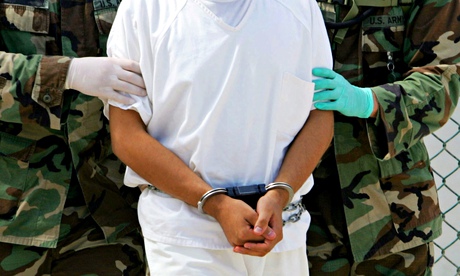
The US Department of Defense has been given a week to explain why it has not yet complied with a federal court order to list the individual exemptions for the disclosure of over 2,000 photographs depicting military abuse of detainees in Afghanistan and Iraq.
At a district court hearing in Manhattan on Wednesday, judge Alvin Hellerstein described the consequences of the government’s decade long court battle to suppress the photographs, as a way “to obtain a very substantial delay” on disclosure.
“I have a feeling where we are at this point – to make up a phrase – at a line in the sand,” Hellerstein said, instructing counsel for the Defense Department to submit in writing how long it would take to comply with the ruling made in August 2014, or to appeal the order.
The American Civil Liberties Union has been fighting a transparency case against the Defense Department since 2004. Some photographs, which document treatment of detainees in detention facilities after the September 11 attacks, are said to be more disturbing that the infamous images of detainee abuse at Abu Ghraib uncovered in 2004.
Both the district court in 2005 and the second circuit court of appeals in 2008 held that the images should be released. But legislation was subsequently introduced through the senate to exempt the photographs from Freedom of Information laws, as they would jeopardize national security.
In 2012, then Defense secretary Leon Panetta reclassified all the photographs, having been presented with a small selection of the collection. Panetta’s move was subsequently challenged, with Hellerstein ruling last year for the individual exemptions to be made.
On Wednesday, Hellerstein reiterated his scepticism for the blanket reclassification, stating he was “highly suspicious of something certified in gross”. The judge has already been presented with a small sample of the images, and has indicated that there were not clearcut national security exemption grounds for some that he saw.
Hellerstein also indicated he could be willing to review the entire collection of images. However, he added: “I did not enjoy seeing the pictures the first time, I would not want to see them again.”
It remains unclear how many images are being held by the department, but former Connecticut senator Joe Lieberman – one of those who introduced the legislation to prevent disclosure in 2009 – said there were almost 2,100.
The potential disclosure would follow the publication of a damning report into the CIA’s use of torture against high value detainees at ‘black sites’ following the September 11 attacks. The report found that the CIA’s use of torture – including waterboarding, rectal feeding, and the use of stress positions – was both brutal and ineffective, and that the CIA repeatedly misled Congress and the executive branch about its effectiveness.




.png?w=600)